
TLDR
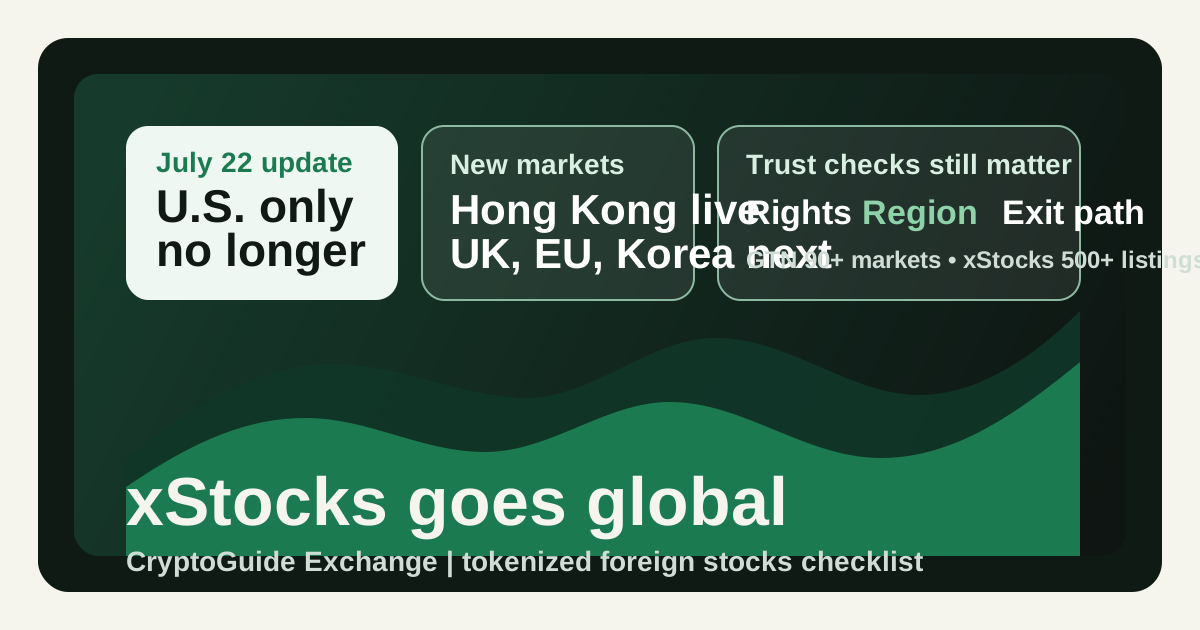
On July 22, 2026, xStocks said it was moving beyond tokenized U.S. equities for the first time, starting with Hong Kong-listed shares and planning UK, EU and South Korea assets in the following weeks. The same post says the framework already has more than 500 listed xStocks, over $35 billion in volume and nearly 200,000 holders, while GTN supplies execution, custody and record-keeping across more than 90 markets. The trust-first reading is more cautious than the growth headline. Broader market coverage does not remove the core product tradeoff: users still need to check issuer structure, ownership limits, region restrictions, trading hours and what happens when a tokenized stock is marketed like a normal foreign share but is not one.
Key takeaways
- xStocks said on July 22, 2026 that Hong Kong-listed equities would go live that week, with UK, EU and South Korea assets expected in the weeks ahead.
- xStocks says GTN is the infrastructure partner for this expansion and reaches more than 90 markets.
- xStocks says the network already spans more than 100 exchanges, wallets and DeFi apps, but availability still depends on jurisdiction and local approvals.
- Kraken's xStocks risk disclosure says holders do not own the underlying shares, do not get voting rights and do not have legal claims to the underlying stocks.
- Kraken says xStocks trade 24/5, not fully 24/7, and that dividend handling is done by increasing the token balance rather than paying a normal cash dividend.
- CryptoGuide Exchange is an independent research and comparison platform, not an exchange, broker, custodian, investment adviser or legal adviser.
Market context: why this matters now
Tokenized equities are turning into exchange inventory rather than a one-market experiment. The first phase was about bringing U.S. tech names and ETFs into crypto apps. The next phase is broader: if tokenized wrappers can cover Hong Kong, then later the UK, EU and South Korea, exchanges can market an "all markets, one account" story without asking users to open separate brokerage relationships in each region.
That is commercially powerful. It also raises a trust problem. The more global the wrapper becomes, the easier it is for users to forget they are often buying a tokenized claim built by a crypto distribution stack, not a conventional local share held through an ordinary broker.
What changed on July 22, 2026
xStocks said on July 22 that it was moving "beyond tokenized representations of U.S. equities for the first time" and opening the framework to internationally listed equities, starting with Hong Kong. It also said Hong Kong names would be live that week, while tokenized assets from the UK, European Union and South Korea would follow in the weeks ahead.
The same announcement included a few concrete scale numbers that matter for credibility checks: more than 500 listed xStocks, over $35 billion in volume and nearly 200,000 holders. It also said xStocks already trades across 100-plus exchanges, wallets and DeFi applications. Those facts show this is no longer a pilot page buried inside one exchange app. They do not tell you what rights the end holder gets.
Who is affected first
Platform operators and active crypto users benefit first. xStocks says GTN handles global execution and custody across more than 90 markets and that the same integration can widen the list of markets without rebuilding the product stack. That is valuable for exchanges, wallets and venues that want more assets fast.
Retail users are affected more unevenly. xStocks says distribution to GTN's institutional clients will follow once required licenses are in place, subject to regulatory approval in each market. Kraken's own support pages and risk disclosures still list geo restrictions, including no access in the United States, Canada, the United Kingdom and Australia, with additional constraints by region. So a product can expand into UK-listed stocks before being available to users in the UK. That mismatch is exactly why the wrapper needs to be checked before the headline is trusted.
Decision checklist before buying tokenized foreign stocks
- Check what you actually hold. Kraken says xStock holders do not own the underlying shares and have no voting rights.
- Check whether your country is eligible. Market coverage and user availability are not the same thing.
- Check the trading schedule. Kraken markets xStocks as 24/5, while xStocks says some assets can trade 24/7 in select regions across the network.
- Check dividend handling. Kraken says dividends are automatically reinvested into more of the same token instead of being paid as a standard cash dividend.
- Check the issuer and distributor names. Kraken says xStocks are issued by Backed Assets (JE) Limited and offered to eligible clients via Payward entities.
- Check whether the foreign-market token is live now or only planned. xStocks describes some upcoming regions as forward-looking and subject to approvals.
- Check your exit path. A tokenized stock can be portable onchain and still depend on exchange liquidity, issuer redemption terms or regional restrictions when you want to sell or move it.
Comparison table: tokenized foreign stock vs ordinary cross-border brokerage share
| Check | Tokenized foreign stock via xStocks-style wrapper | Ordinary cross-border brokerage share |
|---|---|---|
| What you hold | Economic exposure through a tokenized wrapper offered by a crypto distribution stack. | A conventional brokerage position in the underlying listed share. |
| Ownership rights | Kraken says no direct ownership, no voting rights and no legal claim to the underlying shares. | Rights depend on the broker and share class, but ownership is tied to the actual security. |
| Market access story | One account can market multiple countries and onchain transferability. | Access usually depends on each broker's local-market connectivity and account permissions. |
| Trading hours | Can be extended beyond local exchange hours, but product rules vary by venue and region. | Mostly follows the local venue and the broker's supported sessions. |
| Dividend treatment | Can be handled through token-balance adjustments rather than standard cash payouts. | Usually follows ordinary dividend processing through the broker. |
| Main extra risk | Issuer, distributor, geo restriction, redemption and wrapper-model risk. | Brokerage, custody and local-market risk with a more familiar rights framework. |
Practical explanation: where users can misread this expansion
The first mistake is to assume more countries means fewer restrictions. In practice, expansion can add more compliance edges. A tokenized stock linked to a Hong Kong name may be tradable through some venues and blocked in the very country whose market the platform plans to add later. Users need to separate the underlying market from the distribution geography.
The second mistake is to confuse token portability with shareholder rights. xStocks can make a foreign-stock wrapper easier to move and easier to integrate into wallets or DeFi, but Kraken's own risk disclosure still says holders do not own the underlying shares. A smoother interface does not close that rights gap.
The third mistake is to treat scale numbers as proof of simplicity. More than 500 listings and $35 billion in volume show traction. They do not answer the real user questions: who is the counterparty, when can you exit, what happens during a corporate action and which legal regime governs the wrapper.
Risk notes
Geo restrictions can contradict the marketing impression
xStocks says UK-listed assets are planned, while its own site also says xStocks are not currently available in the United Kingdom. Kraken separately lists the UK among unavailable regions. Users should read availability pages and terms, not only launch posts.
International reach adds operational layers
GTN's role across more than 90 markets is a strength for scaling. It also highlights how many layers can sit between the user and the underlying share: issuer, distributor, custody, execution, ledgering and local regulatory permissions.
Foreign-share branding does not equal ordinary foreign-share rights
Kraken's disclosure is explicit that xStocks do not confer ownership. That matters even more when the wrapper references another country's market, because users may already be navigating unfamiliar local rules before the tokenization layer is added on top.
CryptoGuide take
xStocks expanding beyond U.S. equities is a real market-structure step, not just a marketing refresh. It shows tokenized equities are moving toward broader exchange distribution and cross-border reach. But the same update is also a reminder that reach and rights are different things. If an exchange markets tokenized foreign stocks as frictionless global access, the user should ask the old questions first: do I own the share, can I use it in my region, what are the exit rules and which entity stands behind the wrapper when something goes wrong?
FAQ
What changed with xStocks on July 22, 2026?
xStocks said on July 22, 2026 that it is moving beyond tokenized U.S. equities for the first time, starting with Hong Kong-listed shares and planning UK, EU and South Korea assets in the following weeks, subject to regulatory approvals.
Do xStocks give direct ownership of the underlying foreign shares?
No. Kraken's xStocks risk disclosure says holders do not own the underlying shares, do not get voting rights and do not have legal claims to the underlying stocks or residual assets in a liquidation.
Does broader xStocks market coverage mean the product is available everywhere?
No. xStocks and Kraken both say geographic restrictions still apply. xStocks says products are not available in the United States or to U.S. persons, and Kraken says xStocks are not available in the U.S., Canada, the UK or Australia, with additional restrictions depending on region.
Conclusion
The July 22 xStocks expansion matters because it pushes tokenized equities from a U.S.-stock story toward a multi-market exchange product. That will attract more platforms and more users. It should also raise the standard for disclosure. Before buying tokenized foreign stocks, users should verify rights, region eligibility, dividend treatment, exit mechanics and the exact legal entities in the stack rather than assuming a broader map means a simpler product.
Related pages
- Tokenized stocks on crypto exchanges: what users should check first
- OKX Unified Tokenized Stocks: what exchange users should check first
- Wall Street crypto adoption: tokenized deposits, stocks and stablecoins
- Kraken vs Coinbase comparison
- What makes a crypto exchange trustworthy