
TLDR summary
On July 23, 2026, OKX announced another wave of Unified Tokenized Stocks listings, including XIBM, XHOOD, XORCL and XUSAR, after rolling out the product on July 15, 2026. The pitch is simple: trade tokenized U.S. stocks and ETFs around the clock from the same OKX account, quoted in USDT, with deposits and withdrawals over Solana and X Layer. The trust-first reading is less simple. OKX says the product is not issued by OKX, does not represent actual ownership of the underlying equity and does not automatically include shareholder rights. Users should treat it as exchange infrastructure with issuer, region and withdrawal risk, not as a normal stock app feature.
Key takeaways
- OKX published its first Unified Tokenized Stocks launch on July 15, 2026 and added another set of names on July 23, 2026, with more scheduled on July 24, 2026.
- The July 23 listing notice names XIBM, XHOOD, XORCL and XUSAR first, then XCOIN, XIREN, XLLY, XDELL, XPLTR, XNFLX, XBMNR and XASTS in the next listing window.
- OKX says the product is powered by xStocks, supports deposits and withdrawals on Solana and X Layer, and trades 24/7 with pairs quoted in USDT.
- OKX's own product page says Unified Tokenized Stocks provide price exposure only and do not represent actual ownership of the underlying stock or default shareholder rights.
- OKX's terms restrict access to eligible users in select jurisdictions and explicitly prohibit U.S. persons and users located in the United States.
- CryptoGuide Exchange is an independent research and comparison platform, not an exchange, broker, custodian, investment adviser or legal adviser.
Market context: why OKX is pushing this now
Crypto exchanges are moving toward a broader "everything account" model: spot crypto, perpetuals, stablecoins, tokenized cash rails and now tokenized equities in the same interface. OKX's Unified Tokenized Stocks product fits that pattern exactly. Instead of asking users to open a brokerage account, move dollars and learn a separate custody stack, OKX keeps the trade inside a crypto-native account funded with USDT.
That convenience is real. So is the abstraction. The more a venue compresses different products into one screen, the more users need to check whether a familiar label like "stock" still means normal equity ownership, direct rights and ordinary market protections. In this case, OKX's own disclosures say it does not.
What changed in July 2026
OKX's July 15, 2026 launch article said it was rolling out more than 40 tokenized U.S. stocks and ETFs for customers across Southeast Asia, Northeast Asia, the CIS region, MENA and Türkiye, and that the product was not available to customers in the United States or Europe. On July 23, 2026, OKX followed with a new listing notice covering XIBM, XHOOD, XORCL and XUSAR that same day, followed by XCOIN, XIREN, XLLY, XDELL, XPLTR, XNFLX, XBMNR and XASTS from July 24, 2026.
The listing page adds details that matter more than the headline. OKX says trading is always open, including weekends, and that outside U.S. market hours pricing is based on the last close plus a market estimate. It also says dividends are not paid out as cash; instead, the value is reinvested at the issuer level and passed on as a small increase in share balance, net of applicable withholding tax.
Decision checklist before using Unified Tokenized Stocks
- Check whether your region is eligible. OKX's terms say the product is only for select jurisdictions and excludes U.S. persons and users in the United States.
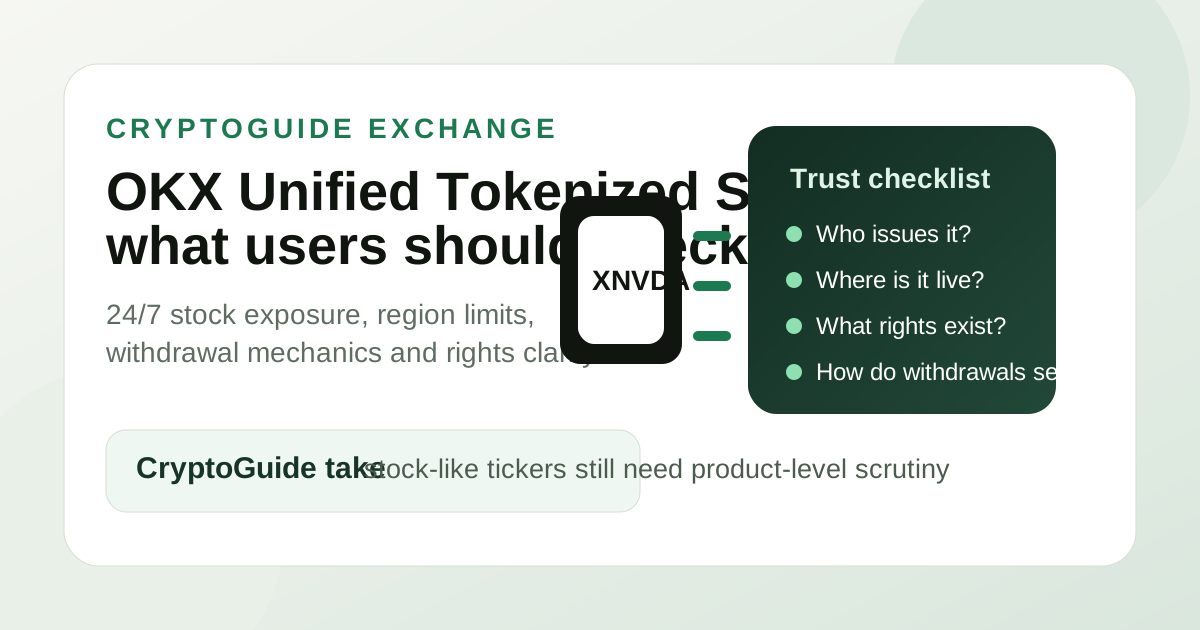
- Check whether you are buying ownership or only exposure. OKX says this product provides price exposure, not actual equity ownership.
- Check who issues the token. OKX says it is the distributor and trading venue, while the current provider is xStocks backed by Backed Assets.
- Check how off-hours pricing works. OKX says weekend and off-session pricing relies on the last close plus a market estimate.
- Check dividend handling. OKX says dividends are reinvested into a higher balance rather than paid out as normal cash distributions.
- Check withdrawal mechanics. OKX converts balances into share-equivalent units and can settle withdrawals in a supported issuer's token available at the time.
- Check whether you are comfortable with extra issuer and custody layers on top of the underlying stock exposure.
Comparison table: OKX Unified Tokenized Stocks vs ordinary brokerage shares
| Check | OKX Unified Tokenized Stocks | Ordinary brokerage shares |
|---|---|---|
| What you hold | Tokenized stock exposure on OKX, standardized into share units for trading. | Direct share ownership recorded through conventional brokerage and market infrastructure. |
| Issuer role | OKX says it is the distributor; the token is issued by a third-party provider. | The broker is not usually the issuer of the stock itself. |
| Shareholder rights | OKX says no default ownership claim or voting rights unless a provider states otherwise. | Voting and corporate-action rights usually follow the underlying share and broker setup. |
| Trading hours | 24/7, with off-hours pricing tied to last close plus market estimates. | Mostly tied to exchange hours, with limited pre-market and after-hours sessions. |
| Dividend handling | Reinvested at provider level into a small balance increase, net of withholding tax. | Usually paid as cash or managed through standard brokerage dividend settings. |
| Exit path | May involve on-platform sale or withdrawal in supported issuer tokens on supported networks. | Usually sold or transferred through the brokerage system without token-conversion steps. |
| Main extra risk | Issuer, wrapper, regional eligibility, pricing-model and token-withdrawal complexity. | Brokerage, settlement and market risk, but with a more established rights framework. |
Practical explanation: where users can misread the product
The easiest mistake is to see familiar tickers and assume ordinary stock ownership. OKX's FAQ is direct: Unified Tokenized Stocks track price exposure, not the security itself. That means the user experience may feel simpler than a brokerage account while the legal and operational structure is actually more layered.
The second mistake is to over-trust the word "unified." In OKX's own explanation, unified refers to holding, trading and unit-of-measure on the platform. It does not mean the user can always pick a specific issuer token on withdrawal, and it does not erase differences among issuers, custody arrangements or multiplier adjustments after dividends and corporate actions.
The third mistake is to treat 24/7 access like a free upgrade. Constant trading is convenient, but OKX explicitly says off-hours pricing uses the last close plus a market estimate. That can be useful for access and still produce a very different risk profile from trading on the primary equity venue during standard market hours.
Risk notes
Region risk is part of the product, not a footnote
OKX's July 15 announcement and product terms both frame availability as region-specific. xStocks also states that its products are not available in the United States or to U.S. persons, and notes additional geo restrictions. Users should not assume a tokenized stock page implies local availability.
Backed does not mean simple
xStocks markets its products as 1:1 backed by underlying assets held in regulated custody, and OKX says the current product is powered by xStocks. That is useful context, but it does not remove issuer, custodian, redemption or platform risk. Backing quality matters; so does the path a user must take to realize that backing.
Price exposure is narrower than ownership
OKX repeats that the product is about exposure, not direct equity ownership. That difference affects voting rights, legal claims, dividend treatment, withdrawal expectations and how much trust users should place in the interface alone.
CryptoGuide take
OKX is building one of the cleaner exchange-native wrappers for tokenized U.S. equities, and the product is more concrete on July 23, 2026 than it was a week earlier. The problem is not that tokenized stocks exist. The problem is that the interface can make them look simpler than they are. The right editorial stance is not anti-tokenization. It is pro-disclosure: if a product relies on third-party issuance, market-estimate pricing, regional exclusions and token-based withdrawals, those are core product facts, not minor implementation details.
FAQ
What changed with OKX Unified Tokenized Stocks on July 23, 2026?
OKX announced new Unified Tokenized Stocks pairs including XIBM, XHOOD, XORCL and XUSAR on July 23, 2026, with more names such as XCOIN, XIREN, XLLY, XDELL, XPLTR, XNFLX, XBMNR and XASTS scheduled from July 24, 2026.
Do OKX Unified Tokenized Stocks give normal shareholder rights?
No. OKX says the product provides price exposure only, does not represent actual ownership of the underlying equity and does not carry shareholder rights such as voting unless explicitly stated by the provider.
Can every OKX user trade these tokenized stocks?
No. OKX says Unified Tokenized Stocks are only for eligible users in select jurisdictions, and its terms prohibit U.S. persons and users located in the United States.
Conclusion
OKX's July 2026 rollout shows how fast tokenized equities are becoming normal exchange inventory. That does not make them the same as ordinary shares. If you use them, the right habit is to verify the legal wrapper, issuer path, pricing method, withdrawal mechanics and regional availability before you treat a stock-like ticker inside a crypto app as a standard brokerage position.
Related pages
- Tokenized stocks on crypto exchanges: what users should check first
- ICE and OKX tokenized securities push: what exchange users should check
- Wall Street crypto adoption: tokenized deposits, stocks and stablecoins
- Review OKX exchange profile
- What makes a crypto exchange trustworthy