
TLDR summary
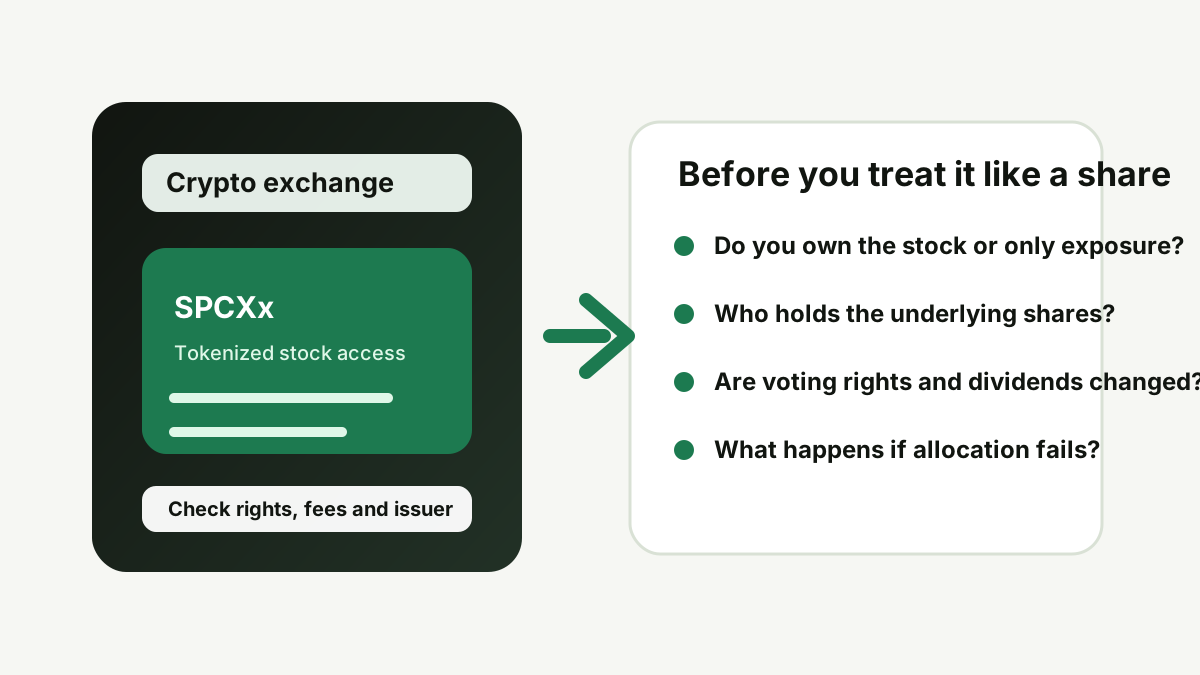
Tokenized stocks are moving from niche experiment to mainstream crypto-exchange feature. Kraken's xStocks launch and the June 12, 2026 SPCXx allocation problems show why users should separate hype from product structure. A tokenized stock may offer price exposure and onchain transferability, but that does not mean you own ordinary shares with the same rights, liquidity or legal protections.
Key takeaways
- June 12, 2026 was an important stress test for tokenized stock demand, not a proof that the model is already mature.
- Kraken says xStocks are available to eligible non-U.S. users and are issued by Backed Assets (JE) Limited, not by the underlying public companies.
- Kraken's risk disclosure states xStock holders do not own the underlying shares, have no voting rights and no direct legal claim to the underlying stock.
- Tokenized stock products can differ on trading hours, custody, dividends, fees, redemption and country restrictions.
- Crypto users should compare these products like exchange infrastructure, not like ordinary stock app features.
What changed in June 2026
On June 12, 2026, the Wall Street Journal reported that xStocks' tokenized SpaceX product, SPCXx, ran into allocation problems after more than $1 billion in customer demand. According to that report, Bybit and Bitget Wallet did not receive allocations, and Kraken said client funds for unfilled IPO-access orders were returned.
That matters because tokenized-stock marketing often emphasizes 24-hour access and broader distribution. The allocation issue showed that when the underlying supply is tight, the crypto wrapper does not remove the bottleneck. It simply moves it into a different operational layer.
Market context: why exchanges want tokenized stocks
Kraken's June 30, 2025 product announcement framed tokenized U.S. stocks and ETFs as a way to bring 24-hour-style market access, onchain transferability and wallet-based use to eligible non-U.S. clients. The xStocks website goes further and pitches tokenized equities as infrastructure for centralized exchanges, wallets, DEXs and market makers.
That makes sense commercially. Tokenized stocks give exchanges a new fee surface, keep users inside the same app and let platforms market a broader "all assets in one place" story. For users, though, the right question is not whether the idea sounds modern. It is what exactly the token represents.
What users actually get
Kraken's xStocks risk disclosure is unusually clear on the core point: holders do not own the underlying shares, do not get voting rights and do not have legal claims to the underlying stock or residual assets if the company is liquidated. The product provides economic exposure, not ordinary share ownership.
Kraken also says xStocks can be bought with fiat, crypto or stablecoins, support self-custody withdrawals, and currently trade 24/5 rather than fully 24/7. Dividend payouts are not paid as cash in the standard way. Instead, the disclosure says dividends are automatically reinvested into more of the same token.
Comparison table: tokenized stock vs ordinary brokerage share
| Check | Tokenized stock on a crypto platform | Ordinary brokerage share |
|---|---|---|
| Ownership | Often economic exposure only, depending on the issuer terms. | Direct share ownership through the brokerage and market plumbing. |
| Voting rights | May be absent. Kraken says xStock holders have no voting rights. | Usually available subject to the broker and share class. |
| Dividends | May be reflected through token mechanics instead of cash payouts. | Usually paid in cash or through broker elections. |
| Trading schedule | Can be extended, but not always fully round-the-clock. | Tied to the exchange and after-hours venue rules. |
| Transferability | May support wallet withdrawal and onchain movement. | Usually stays inside the brokerage system. |
| Main added risk | Issuer, wrapper, platform, custody and redemption complexity. | Brokerage and market risk, but with more established rights frameworks. |
Decision checklist before using tokenized stocks
- Read the legal issuer name, not just the exchange brand. In Kraken's case, xStocks are issued by Backed Assets (JE) Limited and offered by Payward Digital Solutions Ltd.
- Check whether you own shares or only a tokenized claim linked to share performance.
- Verify voting-rights, dividend and corporate-action handling before assuming the product behaves like a brokerage account.
- Check country restrictions. Kraken says xStocks are not available in the U.S., Canada, the UK or Australia.
- Check the trading schedule. "24/7" marketing language can differ from the live trading window in the risk disclosure.
- Understand what happens if orders cannot be fulfilled, the platform rolls back trades or the issuer faces operational problems.
- Treat wallet withdrawal as a feature, not a guarantee that counterparty risk disappears.
Risk notes
The Kraken disclosure says xStocks expose users to market risk, platform risk, regulatory risk, liquidity risk and the financial and operational risks of both Kraken and Backed. It also notes that tokenholders can lose their entire investment. Those are not small-print edge cases. They are the real product design.
The June 12 allocation problem also showed a practical exchange risk: even if the interface says a tokenized stock is available, supply, custody or settlement constraints can still block access at the moment users care most.
CryptoGuide take
Tokenized stocks are credible as exchange infrastructure, but they should be evaluated like structured market products, not like ordinary shares with prettier packaging. The useful innovation is access and portability. The trust gap is rights clarity. Platforms that push tokenized equities without making the ownership tradeoff obvious are asking users to do too much legal interpretation on their own.
Related pages
- Wall Street crypto adoption: tokenized deposits, stocks and stablecoins
- Regulated crypto perpetual futures in the US
- Compare crypto exchanges
- Run a trust check on a crypto platform
FAQ
Are tokenized stocks the same as owning normal shares?
No. Tokenized stock products can provide economic exposure without direct ownership, voting rights or the same legal claims as ordinary shares.
Can tokenized stocks trade 24/7?
Not always. Kraken's xStocks disclosure says xStocks trade 24/5, with weekend trading still in development, so users should check the current live schedule instead of assuming full round-the-clock access.
What was the June 12, 2026 SPCXx issue?
The Wall Street Journal reported that xStocks saw more than $1 billion in demand for tokenized SpaceX access, but some partner platforms did not receive allocations. Kraken said funds for unfilled client orders were returned.
Conclusion
Tokenized stocks are likely to stay. They solve real distribution problems for exchanges and appeal to users who want crypto, stablecoins and equity exposure in one account. But the June 12, 2026 disruption is the part worth remembering: convenience can arrive before rights clarity. CryptoGuide is an independent research and comparison platform, not an exchange, broker, custodian, investment adviser or legal adviser, and this is a product category where those distinctions matter.