
TLDR
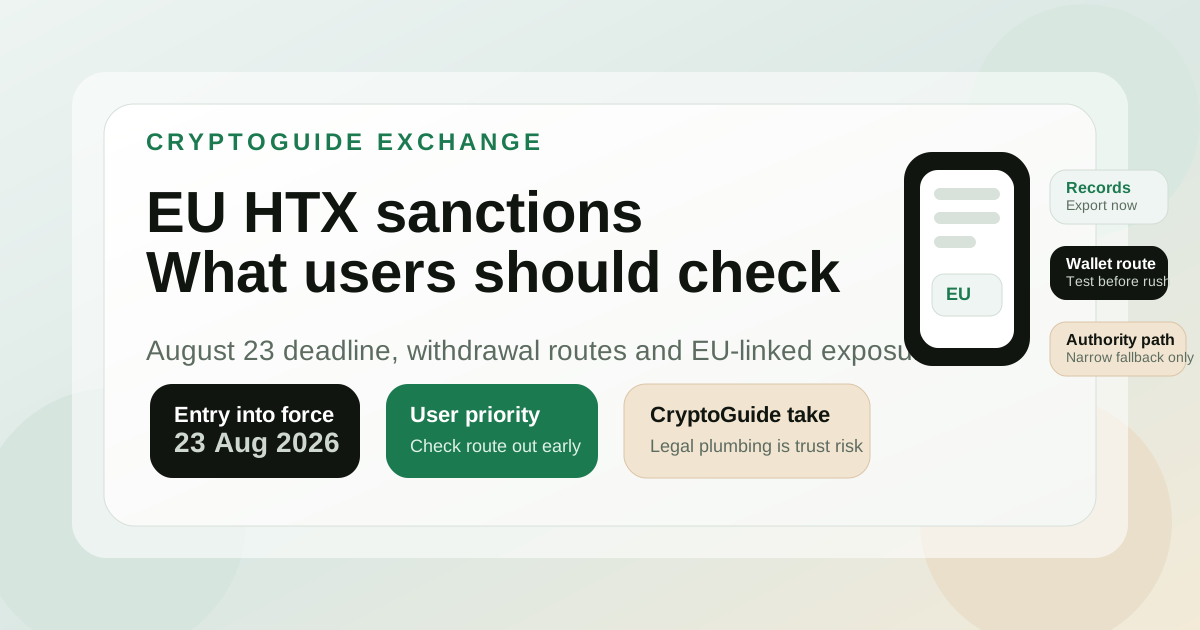
On July 23, 2026, the EU adopted its 21st Russia sanctions package and expanded its transaction ban to 14 crypto-related service platforms based outside the EU. The amended regulation lists HTX (Huobi Global SA) with an entry-into-force date of August 23, 2026. That does not read like a normal exchange product update. It is a compliance event with a calendar deadline. Reuters reported HTX was among 18 crypto-service companies the EU said helped Russians evade sanctions, while the Council said the broader package hit “over a hundred banks and crypto operators.” The trust-first takeaway is simple: if you are exposed to HTX through an EU person, company or banking path, do not wait until August 23, 2026 to find out how withdrawals, counterparties or account wind-down might work.
Key takeaways
- The EU adopted the sanctions package on July 23, 2026, and the regulation lists HTX with an August 23, 2026 entry-into-force date.
- The measure is a transaction ban involving listed firms, not a generic marketing warning and not the same thing as saying all user assets are frozen.
- HTX appears in the EU text as “HTX (HUOBI GLOBAL SA)” alongside other crypto platforms the bloc says significantly frustrate its Russia sanctions.
- The regulation also created a limited authorization route for certain EU, EEA and Swiss nationals or residence-permit holders to withdraw funds or close accounts at newly listed firms.
- That authorization path is narrow, time-bound and depends on national competent authority approval, so it should not be treated as a casual backup plan.
- CryptoGuide Exchange is an independent research and comparison platform, not an exchange, broker, custodian, investment adviser or legal adviser.
What changed
The official shift happened in two layers. First, the Council's July 23, 2026 press release said the EU was extending its transaction ban to 14 crypto-related service platforms based in Georgia, Panama, the UAE, the Marshall Islands, Kyrgyzstan and Belarus, while also creating a new power to impose a full third-country ban for crypto-asset services in future cases. Second, the amended regulation spelled out the names and dates. In Annex XLV, HTX (Huobi Global SA) appears with an entry-into-force date of August 23, 2026.
That date matters because it turns a political announcement into a user deadline. For EU-linked users, August 23 is the point where “I will deal with this later” becomes a much weaker plan.
Who is affected most
The most exposed users are not only people physically located in the EU. They also include users whose trading entity, treasury company, payment route, stablecoin settlement flow or banking counterparties sit inside the EU. Market makers, corporate treasury teams, OTC users and active traders who move between venues can all have more compliance touchpoints than they assume.
Retail users matter too. If a person in the EU still keeps operational balances on HTX, the risk is not only whether they can technically log in. The harder question is whether waiting until the final week creates extra friction around withdrawals, account closure, bank screening or support response quality at exactly the moment everyone else is also trying to get clarity.
Practical explanation: transaction ban versus ordinary exchange offboarding
| Question | Ordinary exchange offboarding | EU sanctions transaction ban case |
|---|---|---|
| Why access changes | Business choice, product shutdown or region exit. | Legal restriction tied to a named entity and entry-into-force date. |
| Main user risk | Operational inconvenience or service migration. | Compliance friction, delayed decision-making and counterparties refusing exposure. |
| Can you rely on support to improvise a fix? | Sometimes, depending on the platform. | Less safely. Support cannot override sanctions rules or bank screening logic. |
| What matters most | Product deadline, withdrawal method, migration path. | Exact legal entity, date, jurisdiction, banking route and whether you qualify for any competent-authority authorization. |
| Best user behavior | Plan the move and document balances. | Act early, reduce ambiguity and avoid last-minute dependence on exceptions. |
Decision checklist before August 23, 2026
- Check whether your account or business activity touches an EU legal person, EU banking rail, EU corporate entity or EU-based counterparty.
- Check whether you still hold a balance on HTX that would be painful to unwind quickly if support, banking or verification becomes slower.
- Check your withdrawal route now, including destination wallet, network, bank destination and any internal address allowlist or account-security friction.
- Check whether your records are complete: balances, transaction history, KYC status and the legal entity named in the terms you accepted.
- Check whether your use case is personal or business-related, because treasury or market-making activity can create extra compliance review points.
- Check whether you may fall into the regulation's limited withdrawal-authorization category for certain EU, EEA or Swiss nationals or residence-permit holders, but do not assume that route is automatic.
- Check a second venue or custody path before you need it. A sanctions deadline is a poor time to start researching backup options from zero.
Risk notes
The ban date is the headline, but the banking path can become the real bottleneck
Many users focus only on whether the exchange app still works. In practice, the pain often appears where fiat rails, compliance teams or counterparties decide they do not want the exposure. That is why trust-first planning means checking the entire route, not only the trading interface.
A transaction ban is not the same as an all-clear for delay
Some users will read “not an asset freeze” as “no urgency.” That is weak reasoning. Even where a measure is narrower than a full freeze, the operational consequences can still become much worse as the effective date approaches and more users try to react at once.
The authorization path is real, but it is narrow
The EU text allows competent authorities to authorize certain withdrawals or account closures for specified natural persons if strict conditions are met, including the transfer of funds to an eligible institution and a request made within the regulation's time window. That is a legal mechanism, not a convenience feature. Users should treat it as a constrained fallback, not Plan A.
What the official texts actually add for users
The amended regulation matters not only because it names HTX. It also shows where EU policy is moving. The Council said this package introduces, for the first time, the possibility of a full third-country ban for crypto-asset services if a country systematically fails to prevent sanctions evasion through crypto platforms. That broadens the policy risk around exchange jurisdiction in a way ordinary users should not ignore.
For exchange research, that changes the trust checklist. Jurisdiction is no longer only a licensing or onboarding question. It is increasingly a sanctions, continuity and access-risk question too.
CryptoGuide take
The useful lesson here is not “HTX bad, everyone else good.” It is that exchange trust can fail on legal plumbing long before it fails on app design. When an exchange becomes the subject of a dated EU transaction ban, users should stop reading the story as abstract geopolitics and start reading it as a time-sensitive operational risk. The calm move is to reduce ambiguity early: know the entity, know the route out, know your records, and do not build your exit plan around a last-minute exception.
FAQ
When does the EU transaction ban involving HTX take effect?
The amended EU sanctions regulation lists HTX (Huobi Global SA) with an entry-into-force date of August 23, 2026. That means EU persons and companies should treat August 23, 2026 as the practical deadline for ordinary dealings covered by the ban.
Does the EU measure freeze HTX user assets?
Not in the same way as a classic asset-freeze designation. The measure is a transaction ban with HTX and other listed firms, which is different from saying every user balance is automatically frozen. Users should still act early because access, withdrawal handling and offboarding procedures can become more complicated around the effective date.
Can affected users still ask to withdraw funds after the listing?
The amended EU text created a limited authorization path for certain EU, EEA and Swiss nationals or residence-permit holders to withdraw funds or close accounts at newly listed firms, if national competent authorities approve the request and the funds move to an eligible institution. The regulation sets a three-month request window tied to the date indicated for the listed entity.
Conclusion
August 23, 2026 is close enough that EU-linked HTX users should treat this as a workflow problem, not a headline to save for later. If your exposure is meaningful, earlier is safer than clever. Verify the entity, document the balance, test the route out and avoid needing a regulatory exception when an ordinary withdrawal would have been simpler a week earlier.
Related pages
- Run a trust check
- Security hub
- MiCA after July 1, 2026
- UK FCA crypto gateway 2026
- MiCA unauthorized provider scams