
TLDR
Under MiCA, many crypto firms that were already operating under national law before December 30, 2024 could keep serving users during a transition period, but only until July 1, 2026 at the latest or until they were granted or refused a MiCA authorisation sooner. ESMA's MiCA page now points users to a public register of authorised crypto-asset service providers and says it was last updated on July 16, 2026. At the same time, ESMA launched a Common Supervisory Action on July 8, 2026 focused on digital operational resilience for custody providers. The trust-first reading is simple: MiCA is a real upgrade in EU crypto market structure, but users still need to verify which legal entity is authorised, which products are inside the regime, and whether custody and withdrawal operations look robust in practice.
Key takeaways
- July 1, 2026 was the maximum end date for MiCA's optional grandfathering period for many pre-existing crypto providers.
- ESMA says only firms authorised and listed on its MiCA register may provide crypto-asset services in the EU under MiCA.
- Grandfathered firms were never the same thing as fully authorised MiCA CASPs, and ESMA's Q&A made that distinction explicit.
- Grandfathering did not create automatic EU passporting rights across Member States.
- On July 8, 2026, ESMA launched a supervisory action focused on custody resilience, including key management, incident response and third-party dependencies.
- The European Commission opened a targeted MiCA review consultation on May 20, 2026, showing the framework is already being tested and refined.
- CryptoGuide Exchange is an independent research and comparison platform, not an exchange, broker, custodian, investment adviser or legal adviser.
What changed after July 1
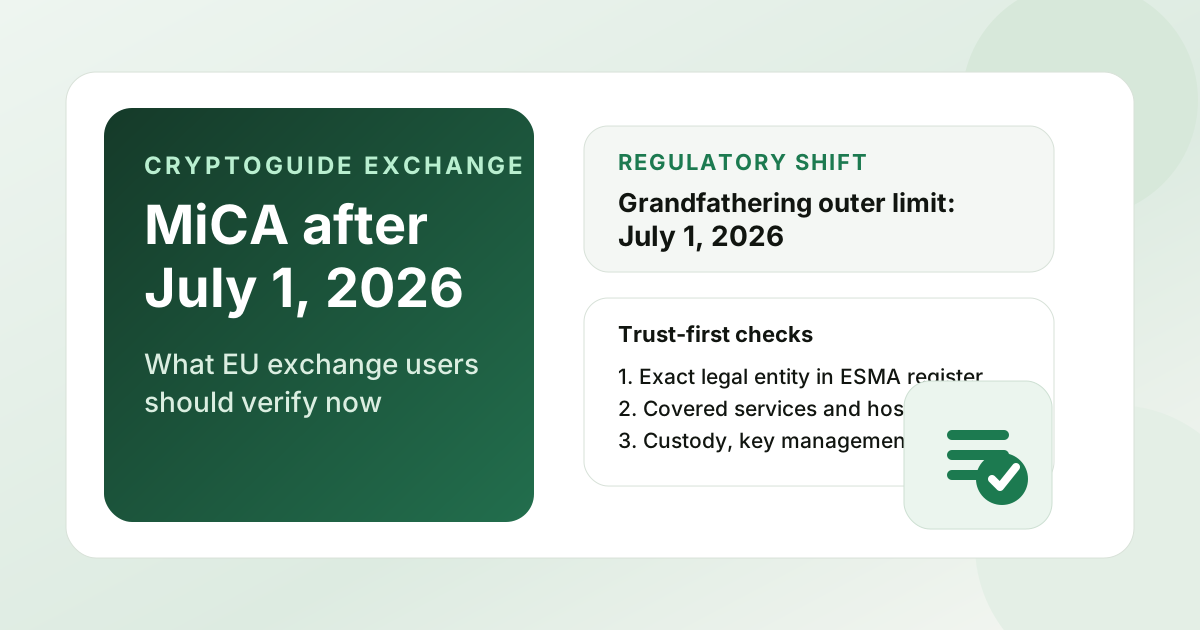
The biggest change is not a dramatic consumer launch. It is a cleaner legal dividing line. ESMA's MiCA materials explain that Member States could let firms already operating before December 30, 2024 continue under local regimes during the transition, but not beyond July 1, 2026. That date matters because it removes a common grey-zone explanation that many platforms could use during 2025 and the first half of 2026.
For users, that means the basic trust question gets simpler. If an exchange actively targets EU users and wants to present itself as operating under MiCA, you should now expect a clearer authorisation story rather than vague “transition” language.
Who is affected most
EU retail users are affected first because they are the ones reading marketing claims, opening accounts and deciding whether a platform deserves a bank transfer or a large balance. Exchanges and brokers are affected operationally, but users feel the consequences through onboarding rules, service availability, country restrictions and what products are still visible after local compliance filtering.
This also matters for firms that relied on fragmented national registrations or looser cross-border assumptions. ESMA has already said grandfathered entities did not gain a MiCA passport by default. That reduces the room for platforms to imply that one local foothold automatically meant seamless EU-wide coverage.
Practical explanation: what the ESMA register does and does not tell you
ESMA's MiCA page includes an interim public register for authorised CASPs, token issuers and non-compliant entities, with weekly updates and a latest update marker of July 16, 2026. That is useful, but it is not a shortcut past basic verification work.
| Check | Why it matters | What to verify |
|---|---|---|
| Legal entity | Large brands often use multiple entities. | Match the exact legal name on the ESMA register against the name in the exchange terms, KYC flow and local disclosures. |
| Service scope | MiCA authorisation is about defined crypto-asset services. | Check which services are covered, not just whether the brand says “regulated in Europe.” |
| Host countries | Cross-border availability is a regulatory fact, not a slogan. | Review which Member States the provider says it intends to serve and whether your country is included. |
| Product perimeter | Some products may still sit outside MiCA or under separate rules. | Check whether lending, staking, derivatives, tokenized stocks or rewards products are covered by the same legal entity and disclosure set. |
| Register timing | ESMA says the register is updated regularly, not instantly. | Use the register alongside the competent authority page and the provider's latest compliance notice. |
| Enforcement history | MiCA also contemplates publication of certain measures and withdrawals. | Check whether there are public restrictions, warnings or withdrawn permissions attached to the entity. |
Why custody is still the real trust test
Users often treat regulation as if it replaces operational risk. ESMA's own July 8, 2026 supervisory action points the other way. The authority said it will examine the digital operational resilience of CASPs providing custody, with focus areas including governance, key and storage management, transaction controls, incident detection and response, smart-contract risks and dependencies on third-party providers.
That is the right lens. A platform can have a better legal footing and still handle custody badly. MiCA raises the baseline, but it does not make private-key operations, hot-wallet segregation, outage management or withdrawal controls magically low-risk.
Comparison table: pre-July 1 transition logic vs post-July 1 user checks
| Question | During the transition period | After July 1, 2026 |
|---|---|---|
| Could a provider rely on national grandfathering? | In some Member States, yes, if it qualified under Article 143. | Not under the main outer-limit timeline described by ESMA. |
| Did grandfathering equal MiCA authorisation? | No. ESMA said grandfathered providers were not MiCA-authorised CASPs. | No. Users should expect actual authorisation evidence now. |
| Did grandfathering create EU passporting rights? | No. ESMA said cross-border service depended on relevant national laws unless MiCA authorisation was obtained. | Users should verify actual host-country coverage under the authorised entity. |
| Main user mistake | Assuming “operating legally somewhere” meant “fully authorised across the EU.” | Assuming a MiCA label covers every product and every risk layer. |
| Best trust check | Read local registration status and transition disclosures carefully. | Cross-check the ESMA register, entity name, covered services and custody quality. |
Decision checklist for EU exchange users
- Check the exact legal entity serving your account, not just the exchange brand name.
- Check whether that entity appears in ESMA's MiCA register and whether the relevant competent authority matches the provider's disclosures.
- Check whether your country is explicitly included in the entity's host-country coverage or local onboarding terms.
- Check whether the product you want is a spot crypto service, a stablecoin service, staking, lending, derivatives or some other category that may sit under different rules or restrictions.
- Check whether the exchange explains custody arrangements, outage handling, incident reporting and withdrawal controls in concrete language.
- Check whether the platform mixes regulated and unregulated offerings in one interface without clearly separating the protections that apply.
- Check whether fiat deposits and withdrawals still depend on third-party payment rails that can fail independently of MiCA status.
Risk notes
MiCA can create a halo effect
ESMA warned in July 2025 that investors may over-trust firms offering both regulated and unregulated products. That warning still matters after July 1, 2026. A regulated shell can make unrelated products look safer than they are.
The register is necessary, not sufficient
Being on a public register is better than not being there. It still does not answer whether a platform's withdrawal performance, support quality, banking resilience or incident response are good enough for your use case.
MiCA is still being refined
The European Commission's targeted review consultation, opened on May 20, 2026 and running until September 30, 2026, is a reminder that implementation questions are still surfacing. Users should expect more interpretation, more supervisory guidance and more product redesign.
CryptoGuide take
July 1, 2026 is a useful trust milestone because it makes lazy regulatory messaging harder. EU users should now be less tolerant of platforms that blur the difference between national legacy permissions, real MiCA authorisation and mere brand marketing. But the deeper lesson is not “MiCA solved exchange risk.” It is that legal status and operational trust must now be checked together. If a platform cannot explain both its authorisation path and its custody path cleanly, the problem is not your skepticism.
FAQ
What changed for EU crypto exchanges on July 1, 2026?
July 1, 2026 was the outer limit of MiCA's optional grandfathering period for many crypto-asset service providers that had been operating under national regimes before December 30, 2024. After that point, users should expect a sharper distinction between firms authorised under MiCA and firms that cannot lawfully present themselves as operating under that EU regime.
Does an exchange appearing in the ESMA register mean everything it offers is protected by MiCA?
No. ESMA has already warned about a halo effect where users may assume regulated status covers every product. Users still need to check which entity is authorised, which services are covered, and whether any products remain outside MiCA's scope.
Why are custody checks still important after MiCA?
Because authorisation does not remove operational risk. On July 8, 2026, ESMA launched a Common Supervisory Action focused on digital operational resilience for CASPs providing custody, including key management, transaction controls, incident response, smart-contract risks and third-party dependencies.
Conclusion
MiCA is no longer just a future framework for EU crypto users. The post-July 1 environment gives users a cleaner way to separate serious operators from vague compliance theater. That still leaves the hard part where it has always been: reading the entity disclosures, checking the register, understanding what products are actually covered and deciding whether the platform's custody and withdrawal behavior deserve trust.
Related pages
- Crypto regulation in Europe
- Crypto Trust Checker
- Compliance overview
- Security hub
- Coinbase July 2026 outage: what exchange users should check
Sources
- ESMA: Markets in Crypto-Assets Regulation (MiCA)
- ESMA Q&A 2295: status of entities providing crypto-asset services as part of the grandfathering regime
- ESMA Q&A 2086: passporting rights for entities benefiting from grandfathering
- ESMA: Common Supervisory Action on CASPs' digital operational resilience for custody
- European Supervisory Authorities warning on crypto-asset risks and limited protection
- European Commission: targeted consultation on the review of MiCA Regulation
- ESMA: risks of unregulated products offered by regulated crypto-asset entities