
TLDR summary
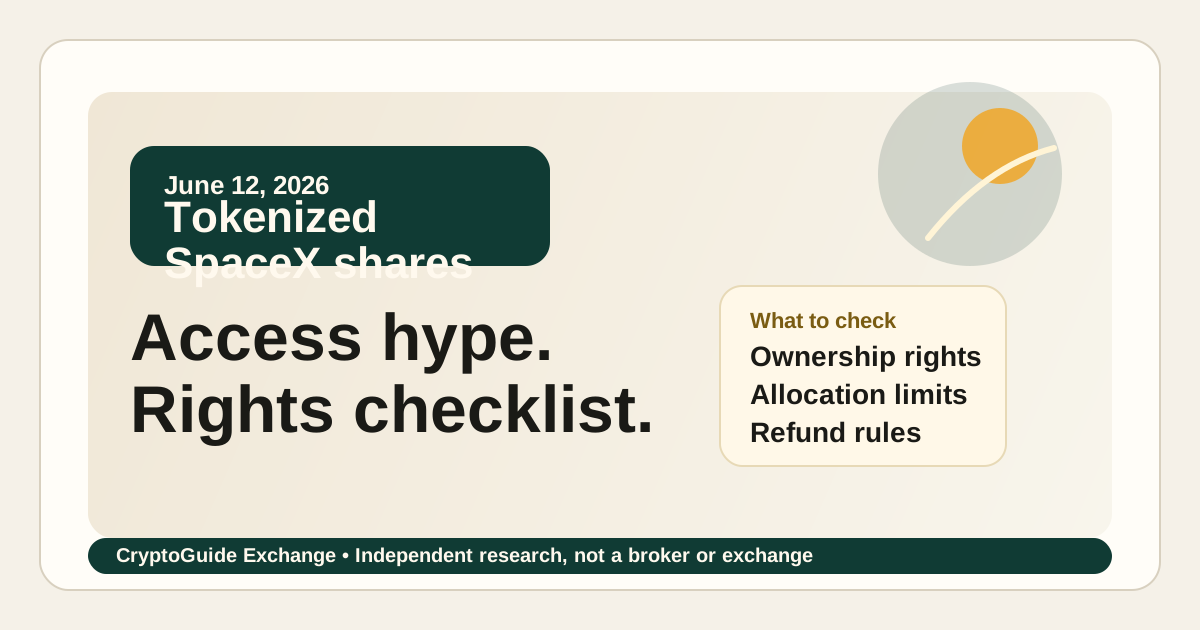
On June 12, 2026, the Wall Street Journal reported that xStocks saw more than $1 billion of demand for tokenized SpaceX shares under the ticker SPCXx, but partner platforms including Bybit and Bitget Wallet said they received no allocations. Kraken said requests that could not be fulfilled were refunded. The episode matters because tokenized-share products are often marketed like open market access, while the underlying rights, inventory, geography and cancellation rules remain tightly conditional.
Key takeaways
- The June 12, 2026 SPCXx launch turned into a practical allocation stress test, not just a tokenization headline.
- Kraken's xStocks disclosures say holders do not own the underlying shares, have no voting rights and can lose their full investment.
- Backed says xStocks are 1:1 backed, held by third-party licensed custodians and redeemable for cash value, but that still does not make them ordinary shares.
- Availability is geography-limited: Kraken says xStocks are not accessible in the U.S., Canada, UK or Australia.
- CryptoGuide Exchange is an independent research platform, not an exchange, broker, custodian, investment adviser or legal adviser.
What changed on June 12
The market context was pure hype: one of the highest-profile companies in the world, a crypto-native wrapper and the promise of around-the-clock access. The Wall Street Journal reported on June 12, 2026 that xStocks had already seen more than $1 billion in customer demand for SpaceX exposure before supply problems became obvious. Bybit said it received no allocations, Bitget Wallet said it got none either, and Kraken said unfilled client funds were returned.
That sequence is useful because it shows where tokenized-equity products get tested first. Not in the abstract claim that a token tracks a stock, but in whether inventory, partner distribution and user expectations hold up when demand spikes fast.
What users were actually offered
Kraken's June 30, 2025 xStocks launch post framed the product as tokenized U.S. equities for eligible non-U.S. clients, available 24 hours a day, five days a week, with withdrawal to self-custodial wallets. Kraken's xStocks product page says users can start with as little as $1 and that dividends are auto-reinvested into more of the same token.
Those are useful product features, but the legal framing matters more than the interface. Kraken's xStocks risk disclosure says holders do not own the underlying shares, do not have voting rights, do not have distribution entitlements and have no legal claims to the underlying stocks or residual assets if the company is liquidated. That is a very different user position from direct brokerage ownership.
Why this matters beyond one ticker
SpaceX was only the stress event. The deeper issue is category confusion. A tokenized-share screen can look cleaner, faster and more global than a brokerage account, but the user may be relying on a chain of separate promises: issuer solvency, custodianship of the underlying assets, partner allocations, platform uptime, jurisdiction rules and the venue's right to cancel or refuse orders.
Kraken's own disclosure states that it may refuse an offer to trade or cancel a previously accepted offer at its sole discretion. It also warns that xStocks expose users to platform, operational, liquidity and regulatory risks beyond the underlying company's market risk. When a launch faces an allocation shortfall, those warnings stop being boilerplate and become the main story.
Comparison table: tokenized share vs ordinary share vs pre-IPO derivative
| Check | Tokenized share product | Ordinary listed share | Pre-IPO derivative |
|---|---|---|---|
| Main user exposure | Economic exposure defined by issuer and platform terms. | Direct equity ownership through regular market infrastructure. | Price exposure through a venue-defined contract. |
| Ownership rights | Often no voting rights or legal claims to the underlying shares. | Shareholder rights depend on the share class and broker structure. | No share ownership. |
| Trading hours | Often extended, such as Kraken's 24/5 model. | Standard market hours with broker-specific extensions. | Often 24/7 or 24/5, depending on venue rules. |
| Main bottleneck | Inventory, redemption mechanics, partner allocations and jurisdiction limits. | Broker access, market hours and settlement cycles. | Reference pricing, leverage and contract-transition rules. |
| Main user mistake | Assuming the token is the same as owning the real share. | Assuming all brokers offer the same protections and access. | Confusing speculation with share access. |
Decision checklist before using a tokenized-share product
- Check whether you are buying legal ownership or only economic exposure. Kraken says xStocks holders do not own the underlying shares.
- Check geographic eligibility before funding. Kraken says xStocks are not available in the U.S., Canada, UK or Australia.
- Check who holds the underlying assets. Backed says third-party licensed custodians hold them.
- Check what happens if demand exceeds supply. The June 12 SPCXx launch showed that orders can go unfilled and be refunded.
- Check whether the token can be redeemed and on what terms. Backed describes redemption for the underlying asset's cash value, while Kraken says redemption may involve additional fees.
- Check platform discretion. Kraken says it may refuse or cancel offers to trade.
- Check whether your goal is speculation, long-term ownership or transferability into DeFi. Those are different use cases and not every tokenized-stock wrapper serves all three well.
Risk notes
The most important risk is not price volatility. It is rights clarity. If a product feels like direct stock access but contractually behaves like a wrapped exposure instrument, the user can misread what protection or recourse exists when something goes wrong.
There is also infrastructure risk. Kraken warns about platform malfunction, API failure, hacker attacks, insufficient purchase demand and regulatory restrictions. Backed adds another layer: while it says each token is 1:1 backed, users still depend on issuer operations and custodial arrangements. A trust-first user should read those dependencies before treating a tokenized equity as a cleaner version of a normal share.
CryptoGuide take
The June 12 SpaceX shortfall is a good reminder that tokenization is real market infrastructure work, not just a better wrapper for hype. The strongest part of the xStocks model is that Kraken and Backed provide detailed product disclosures rather than pretending the token is simply a stock. The weak point is that launch marketing and user excitement can still outrun the operational reality. If a tokenized-share product cannot explain rights, geography, inventory limits and order-cancellation rules in one clear screen, users should assume the product is earlier and riskier than the headline suggests.
FAQ
What happened with tokenized SpaceX shares on June 12, 2026?
The Wall Street Journal reported that xStocks saw more than $1 billion in demand for SPCXx, but partner platforms including Bybit and Bitget Wallet said they received no allocations, and Kraken said unfilled client funds were returned.
Do xStocks holders own the real shares?
No. Kraken's xStocks risk disclosure says holders do not own the underlying shares, have no voting rights and have no legal claims to those shares.
Why does this matter for exchange users?
Because tokenized-share products can look like direct stock access while relying on issuer terms, platform rules, eligible-country limits, liquidity and custody arrangements that differ from ordinary brokerage ownership.
Conclusion
Tokenized equities are moving from concept to real exchange distribution, and that is a meaningful market-structure shift. The June 12, 2026 SpaceX launch showed the opportunity and the weakness at the same time: huge demand, clear user interest and immediate pressure on allocation and rights understanding. The calm way to read that signal is simple. Tokenized shares may become useful exchange infrastructure, but users should treat them as disclosed financial products with very specific limits, not as frictionless stock ownership on-chain.
Related pages
- Tokenized stocks on crypto exchanges: what users should check first
- Pre-IPO perpetual futures on crypto exchanges: what users should check
- Wall Street crypto adoption: tokenized deposits, stocks and stablecoins
- Review Kraken exchange profile