
TLDR
On September 1, 2026, the U.S. Securities and Exchange Commission proposed its first substantive modernization of transfer-agent rules since the core framework was adopted in the late 1970s and early 1980s. The proposal explicitly accounts for electronic and blockchain-based recordkeeping, but it does not approve every tokenized stock product or turn an onchain balance into registered ownership. For users, the essential check remains structural: who maintains the official ownership record, what legal instrument does the token represent, and which intermediary must perform if the holder wants to transfer, redeem, vote or receive a distribution?
Key takeaways
- The proposal is not a final rule. SEC file S7-2026-30 has a comment period of 60 days after Federal Register publication.
- Transfer agents maintain an issuer's official ownership record and support issuance, cancellation and transfer of securities.
- The proposal recognizes blockchain-based recordkeeping while retaining responsibility, access and record-production requirements.
- Issuer-sponsored, custodial and synthetic tokenized securities can give holders materially different rights and counterparty exposure.
- A visible wallet balance is not enough evidence of shareholder status, redemption rights or bankruptcy treatment.
- CryptoGuide Exchange is an independent research and comparison platform, not an exchange, broker, custodian, investment adviser or legal adviser.
Market context: tokenization meets the official ledger
Tokenized-stock launches often lead with 24/7 transferability, fractional access or DeFi compatibility. The SEC proposal addresses a less glamorous layer: the registered transfer agent that maintains the official ownership record, processes transfers and helps keep the clearance and settlement system accurate.
The Commission says its current rules predate contemporary electronic operations. The proposed update would modernize Forms TA-1 and TA-2, turnaround and processing standards, recordkeeping, risk management, inactive-holder procedures and restrictive-legend handling. It also uses technology-neutral language and specifically contemplates blockchain records.
That is infrastructure reform, not a blanket endorsement of a particular exchange product, blockchain or token. Buyers still need product-level evidence.
What the proposal would change
| Area | Proposed change | Why a token holder should care |
|---|---|---|
| Electronic records | Modernized rules for electronic systems, third-party recordkeepers and blockchain-based records. | The transfer agent still needs reliable access and must be able to produce usable records. |
| Processing | Turnaround and master-file posting aligned with the current settlement cycle. | Onchain speed does not remove back-office posting and reconciliation duties. |
| Risk controls | Written controls to protect securities and funds, manage material risks, maintain a separate funds account and operate a business continuity plan. | Operational resilience matters when an intermediary controls the authoritative record or redemption route. |
| Inactive holders | Electronic notices and updated procedures for inactive securityholders and unresponsive payees. | Wallet activity alone may not satisfy offchain identity, contact or unclaimed-property processes. |
| Restrictive legends | A new Rule 17ad-31 would govern placement and removal and restrict facilitation of certain unregistered transactions. | A transferable token may still face legal transfer restrictions. |
Three structures that can look similar on an exchange screen
Issuer-sponsored tokenized security
The issuer or its agent may integrate a crypto network into the master securityholder file. In that structure, an onchain transfer can update the official ownership record. The issuer may also keep the authoritative file offchain and use onchain activity only as an instruction to update it.
Third-party custodial token
A separate company may hold the underlying security and issue a token representing a direct or indirect entitlement. The holder then depends on the custodian, its records and the terms linking the token to the asset.
Synthetic tokenized exposure
A third party may issue its own security whose return tracks another security. SEC staff notes that this structure may not confer equity, voting, information or other rights in the referenced issuer. It adds exposure to the product issuer as well as market risk in the referenced asset.
Decision checklist before using a crypto platform for tokenized securities
- Name the legal issuer of the token, not just the company whose stock or bond appears in the ticker.
- Identify whether the structure is issuer-sponsored, custodial or synthetic.
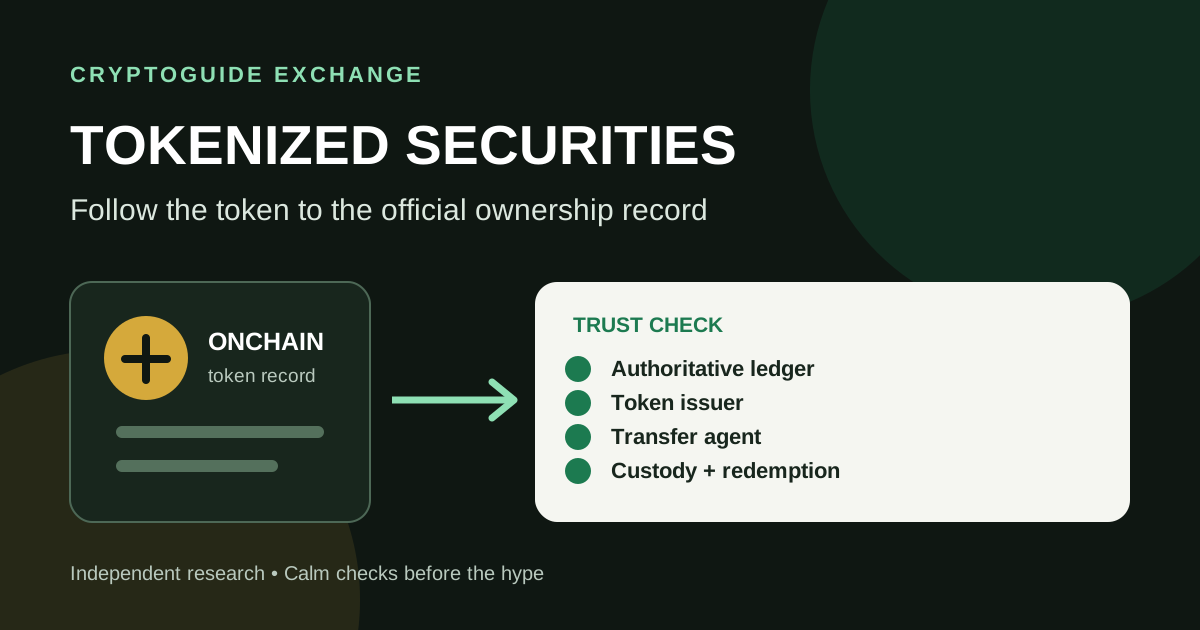
- Ask which record is legally authoritative: the blockchain, a transfer agent's offchain master file, or an intermediary's entitlement ledger.
- Verify the registered transfer agent, custodian, broker and trading-venue entities where applicable.
- Read the terms for voting, dividends or interest, corporate actions, forks and chain migrations.
- Check who can redeem into the underlying security and whether retail holders can do so directly.
- Confirm trading hours, settlement timing, transfer restrictions and geographic eligibility.
- Review what happens if the token sponsor, custodian, blockchain service provider or exchange fails.
- Test withdrawal support with a small amount only after confirming the exact contract address and network.
Risk notes
Proposal is not permission
The SEC proposal would govern registered transfer-agent operations if adopted. It does not certify that a tokenized product complies with securities law, carries the rights implied by its marketing, or is suitable for a particular buyer.
A public blockchain is not the whole control environment
The proposing release asks whether a transfer agent using distributed-ledger technology can independently access records, allow examination and promptly furnish copies. It also asks whether duplicate records should be kept separately. Those questions show why “it is onchain” is not a complete continuity or audit answer.
Third-party wrappers add failure points
Where a sponsor, custodian or synthetic issuer sits between the token holder and the referenced company, smart-contract performance is only one risk. Insolvency, reconciliation, transfer restrictions, market hours, corporate-action handling and redemption terms can matter more.
CryptoGuide take
The proposal is a meaningful sign that U.S. securities infrastructure is being rewritten for electronic and blockchain records. The trust-first reading is narrower than the hype: tokenization improves a format, not automatically the legal claim. Exchanges should disclose the authoritative ledger, transfer agent, token issuer, custody chain and retail redemption path beside every tokenized-security listing. If a buyer cannot identify all five, the product is not ready to be treated like an ordinary share.
FAQ
Has the SEC finalized blockchain transfer-agent rules?
No. The September 1 publication is a proposal under file number S7-2026-30. The comment period runs for 60 days after Federal Register publication.
Does holding a token automatically make me the registered shareholder?
No. The answer depends on the structure and authoritative ownership record. Some tokens represent issuer-recorded securities, some represent custodial entitlements, and others provide synthetic exposure without shareholder rights in the referenced company.
Does the proposal make tokenized stocks safe?
No. It proposes operational and compliance requirements for registered transfer agents. Product structure, market risk, intermediary failure, custody, liquidity, eligibility and legal rights still require separate review.
Conclusion
The SEC's proposal brings blockchain into a rulebook built for an earlier era, but it also reinforces a durable principle: securities ownership depends on accountable records and enforceable rights. Before buying a tokenized stock or bond through a crypto platform, trace the claim from the wallet to the official ledger and from the product sponsor to the underlying issuer.
Related pages
- Tokenized stocks on crypto exchanges: what users should check
- Coinbase tokenized stocks on Base
- LSEG and Payward xStocks plan
- How to choose a crypto exchange
- Run a trust check