
TLDR
Coinbase's tokenized-stocks push is no longer a vague roadmap item. On June 16, 2026 Coinbase said tokenized stocks for non-U.S. customers were coming; on August 11 it said its Abu Dhabi tokenization hub had Financial Services Permission from the FSRA; on August 24 a Coinbase-distributed press release said Chainlink would provide official pricing infrastructure for the newly launched tokens on Base. The trust-first reading is straightforward: this is a meaningful market-structure step, but users should still separate marketing claims about "real shares" and 24/7 utility from the actual rights, eligibility limits and redemption mechanics attached to the product.
Key takeaways
- Coinbase says its tokenized stocks are B20 tokens on Base backed 1:1 by underlying shares held in regulated custody.
- Coinbase's tokenized-stocks page says the product is offered under Regulation S and is unavailable to U.S. persons and other restricted jurisdictions.
- Coinbase says primary minting and redemption are limited to KYC-onboarded institutional partners and Authorized Participants, not ordinary retail users.
- Coinbase's August 11 Abu Dhabi announcement says token holders receive shareholder rights, but the same post's prospectus note narrows some rights such as voting and redemption to defined "Vested Holders."
- Coinbase's help documentation shows its conventional brokerage stocks in the US and UK still run through Coinbase Capital Markets and standard brokerage onboarding, which is a different product stack from onchain stock tokens.
- CryptoGuide Exchange is an independent research and comparison platform, not an exchange, broker, custodian, investment adviser, tax adviser or legal adviser.
Market context: why this matters now
Coinbase has spent 2026 trying to turn the "everything exchange" pitch into a real cross-asset product stack. The June 16 system update put tokenized stocks next to pre-IPO perpetuals, stock trading and global derivatives. The August 11 Abu Dhabi announcement gave the tokenized-securities side a named regulatory home. The August 24 Chainlink announcement added another practical signal: Coinbase is not only issuing stock tokens, it is building the price-data and DeFi-utility layer needed to make them usable as collateral, lending inventory and trading instruments across Base.
That is the hype side of the story. The trust side is that a stronger stack can also create a stronger illusion of simplicity. A token that looks like a stock ticker inside a Coinbase-adjacent experience can still carry different rights, a different redemption path and different failure modes than either a normal brokerage share or a normal spot-crypto balance.
What changed versus Coinbase's ordinary stock offering
Coinbase already offers conventional stock trading in the U.S. and UK through Coinbase Capital Markets onboarding. Its help documentation says customers in those markets can trade U.S.-listed stocks after creating a Coinbase Capital Markets brokerage account and completing onboarding. That is ordinary securities plumbing even if the front-end brand is familiar.
Coinbase Tokenized Stocks are a different route. Coinbase's tokenization page says the tokens are issued on Base, can be held in self-custodial wallets and can be traded across DeFi. In other words, this is not just "stocks inside the Coinbase app." It is a separate market-structure product that brings securities exposure into an onchain environment with different transfer, pricing and control assumptions.
Comparison: Coinbase tokenized stocks vs Coinbase brokerage stocks
| Check | Coinbase tokenized stocks on Base | Coinbase brokerage stocks |
|---|---|---|
| Access model | Onchain B20 token on Base with wallet-based use across DeFi. | Coinbase Capital Markets brokerage account with standard onboarding. |
| Availability | Coinbase says offered under Regulation S and not available to U.S. persons. | Coinbase help says stock trading is available to U.S. residents and UK residents who complete CCM onboarding. |
| Trading posture | Coinbase says tokens can trade around the clock including market holidays. | Coinbase help describes ordinary stock order types and market-session mechanics. |
| Primary redemption | Coinbase says minting and redemption are limited to institutional partners and Authorized Participants. | Users trade and hold through the brokerage account rather than an AP-only create-redeem flow. |
| Rights language | Coinbase markets a direct claim on real shares, but prospectus-linked notes narrow some rights to Vested Holders. | Traditional brokerage model with ordinary stock-account disclosures. |
| Main extra risk | Wrapper, oracle, off-hours pricing, issuer-structure and DeFi-composability risk. | Brokerage execution, session liquidity and standard securities-account risk. |
Decision checklist before trusting the wrapper
- Check whether you are looking at Coinbase's brokerage stock product or its onchain tokenized-stock product. They are not interchangeable.
- Check eligibility before anything else. Coinbase says tokenized stocks are not available to U.S. persons and other restricted jurisdictions.
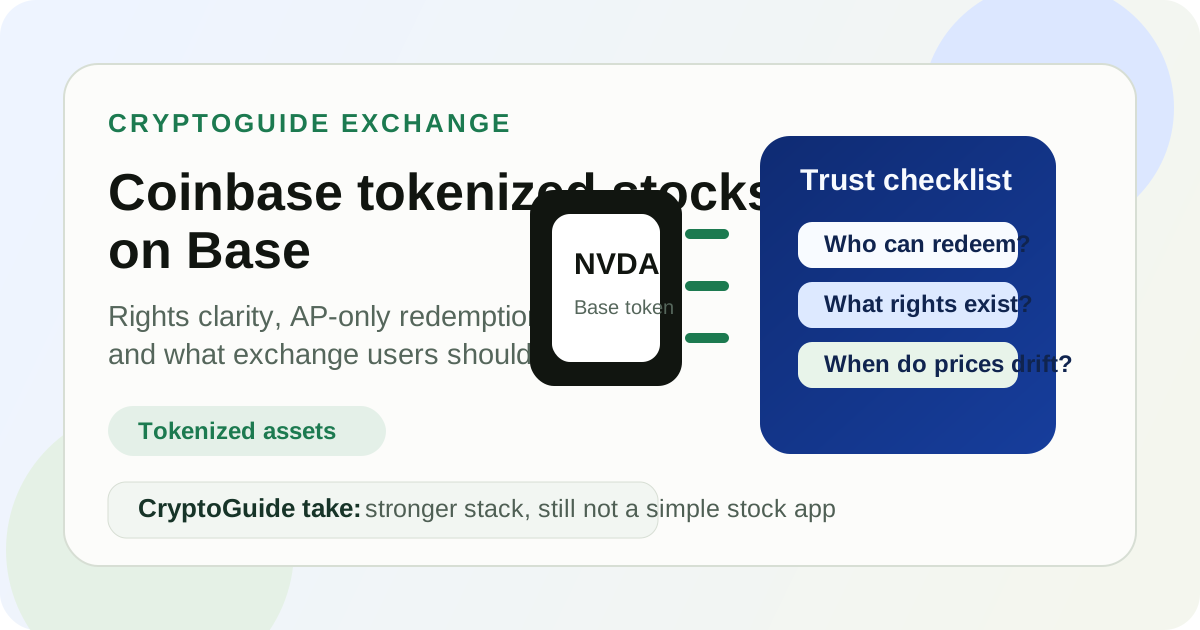
- Check who can redeem. If ordinary users cannot directly mint or redeem, secondary-market pricing can matter more during stress or off-hours.
- Check rights language in the product documentation, not only the headline page. Marketing copy and prospectus wording can differ in important ways.
- Check how dividends, splits and corporate actions are handled. Coinbase says these are reflected through an onchain multiplier rather than by changing token count.
- Check whether DeFi utility is being mistaken for lower risk. More composability usually means more dependency on oracles, protocols and collateral rules.
- Check what happens when traditional markets are closed. A token can trade 24/7 while the underlying stock does not.
Risk notes
Rights clarity is better, but not perfectly simple
Coinbase's tokenization page says holders have a direct, senior claim on the underlying equity. Its August 11 Abu Dhabi post says verified token holders receive shareholder rights including dividends and voting. But the same post's prospectus note says only Vested Holders may exercise certain rights including voting, and only Vested Holders may be eligible for redemption rights. That does not make the product invalid. It does mean users should read "real share backing" as the start of due diligence, not the end of it.
24/7 trading does not mean 24/7 ordinary price discovery
The tokens can trade onchain all day, including holidays. The underlying U.S. shares do not. As Coinbase pushes these tokens into lending, borrowing and trading on Base, off-hours pricing and liquidation behaviour become practical user risks, not theoretical footnotes.
AP-only redemption creates a market-structure bottleneck
Coinbase says only institutional partners and Authorized Participants can mint or redeem in the primary flow. That is familiar from ETFs and depositary-receipt-style structures, but it also means ordinary users may rely on market makers and protocol liquidity rather than a simple issuer window if prices disconnect.
CryptoGuide take
Coinbase's tokenized-stocks setup looks materially stronger than earlier exchange stock wrappers because it is trying to combine regulated custody, prospectus-backed issuance and live DeFi utility in one stack. The weak point is not obvious fraud or obvious hand-waving. The weak point is compression: rights, redemption, session behaviour and protocol dependencies can get compressed into one smooth interface. Users should welcome the infrastructure progress and still demand brokerage-level clarity on the parts that remain non-brokerage.
FAQ
Are Coinbase tokenized stocks the same as the brokerage stocks Coinbase offers in the US and UK?
No. Coinbase's brokerage stock product uses a Coinbase Capital Markets account and traditional securities plumbing, while Coinbase Tokenized Stocks are onchain B20 tokens on Base offered under a separate offshore structure.
Can ordinary users mint or redeem Coinbase tokenized stocks directly with Coinbase?
No. Coinbase says primary minting and redemption are limited to KYC-onboarded institutional partners and Authorized Participants.
Are Coinbase tokenized stocks available to U.S. users?
No. Coinbase says the product is offered under Regulation S and is not available to persons in the United States and other restricted jurisdictions.
Conclusion
As of Thursday, August 27, 2026, Coinbase tokenized stocks are one of the clearest examples of crypto exchanges trying to turn tokenized equities into real market infrastructure rather than a side experiment. That is significant. It also raises the standard for user verification. Before treating these tokens like ordinary shares, users should confirm entity scope, rights language, eligibility, redemption access and how off-hours pricing will behave when markets get messy.
Related pages
- Coinbase UK stock trading rollout: what crypto exchange users should check
- Tokenized stocks on crypto exchanges: what users should check first
- Wall Street crypto adoption: tokenized deposits, stocks and stablecoins
- Coinbase exchange review
- How crypto exchanges work
Sources
- Coinbase: System Update: Take Control of Your Money with Coinbase
- Coinbase: Coinbase establishes its tokenization hub in Abu Dhabi
- Coinbase Tokenize
- Coinbase Help: Stock order types
- ADGM FSRA: Approved Prospectuses
- Nasdaq / PR Newswire: Coinbase selects Chainlink to bring new tokenized stocks to millions of DeFi users