
TLDR
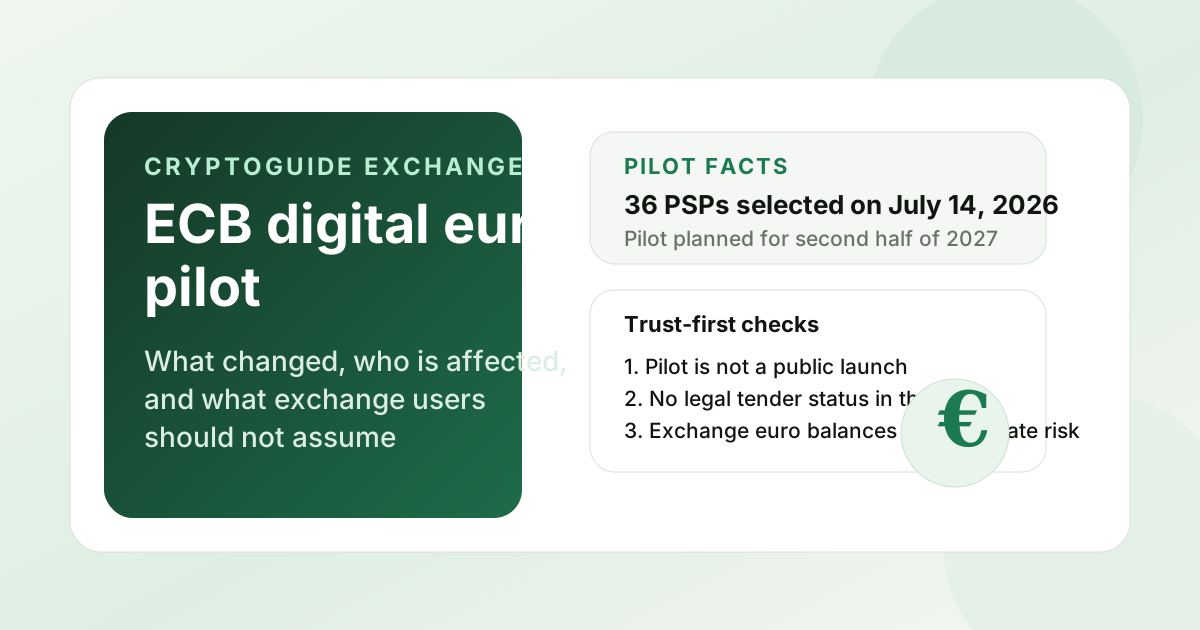
On July 14, 2026, the ECB said it had selected 36 payment service providers from more than 50 applicants to join a digital euro pilot. The pilot is due to start in the second half of 2027 and run for 12 months. It will use a beta digital euro with Eurosystem staff and selected merchants across the ECB and 19 euro-area national central banks. The ECB also says the beta digital euro will not have legal tender status and that no issuance decision will be taken until the EU legislative process is finished. For exchange users, the update matters because it shows Europe is building a possible public digital-money rail. It does not mean there is a new euro token to buy, a new exchange balance to hold or a reason to stop checking euro stablecoin, custody and withdrawal risk.
Key takeaways
- The ECB announced the pilot participant selection on July 14, 2026.
- Thirty-six payment service providers were selected from more than 50 applicants.
- The pilot is scheduled to start in the second half of 2027 and run for 12 months.
- The beta digital euro will be tested by Eurosystem staff and selected merchants for person-to-person and person-to-business payments, including online, offline and point-of-sale use cases.
- The ECB says the beta digital euro will not have legal tender status and will not be a direct account held with the ECB or another Eurosystem central bank.
- The ECB says it will only decide whether to issue a digital euro after the digital euro Regulation is adopted by EU co-legislators.
- CryptoGuide Exchange is an independent research and comparison platform, not an exchange, broker, custodian, investment adviser or legal adviser.
What changed on July 14
The practical change is selection, not launch. The ECB said on July 14 that it had chosen 36 payment service providers, including banks and non-bank payment firms, to participate in the pilot. The list includes names that traditional-finance and crypto users will both recognize, such as Adyen, Deutsche Bank, Revolut Bank UAB, Stripe Technology Europe, SumUp and Worldline.
That matters because it shows the project has moved beyond consultation language. The ECB is now naming participants, defining the operating timeline and preparing concrete testing around onboarding, merchant acceptance, person-to-person transfers and mobile payments. This is real infrastructure preparation even if it is still pre-launch.
Who is affected first
The first group affected is not retail crypto traders. It is the euro payments stack: banks, acquirers, fintechs, merchant-service providers and central-bank teams that might have to integrate or compete with a new public digital-money rail.
Exchange users are affected more indirectly. If a digital euro ever goes live, it could shape euro deposits, withdrawals, on-chain settlement alternatives, wallet expectations and the competitive position of euro stablecoins. But that is still a later-stage question. Today, the immediate takeaway is that Europe is trying to keep optionality in payments infrastructure while the law is still being negotiated.
Why the legislative timeline still matters
The ECB's own language is careful. Its pilot FAQ says preparing the pilot does not pre-empt any decision to issue the digital euro. Its governance page says the European Parliament adopted its position on the Single Currency Package on July 9, 2026, the Council adopted its position on December 19, 2025, and trilogue negotiations with the European Commission are ongoing.
That means users should separate two layers. Layer one is technical preparation: the ECB wants to be ready. Layer two is legal authorization: the project still depends on final legislation. Hype tends to collapse those layers into one headline. Trust-first research should not.
Practical explanation: what the beta digital euro actually is
The FAQ makes three details especially important. First, the pilot uses a beta digital euro rather than the final product envisaged in legislation. Second, the online beta digital euro is described as scriptural money under the current payment-law framework. Third, participants would use commercial bank money accounts with pilot payment service providers during the pilot, not direct accounts with the ECB.
For crypto users, this is a useful corrective. The pilot is not describing a permissionless token listed on exchanges. It is describing a supervised payment instrument inside a tightly scoped real-world test.
Comparison table: digital euro pilot vs euro stablecoin vs euro exchange balance
| Category | Beta digital euro pilot | Euro stablecoin | Euro on a crypto exchange |
|---|---|---|---|
| Main issuer layer | Eurosystem central banks in a pilot setting. | Private issuer under its own reserve and regulatory structure. | Commercial relationship with the exchange and its banking/payment partners. |
| Status today | Not live for the public; pilot planned for the second half of 2027. | Some products already exist, but usability varies widely. | Already common, but depends on each venue's fiat rails. |
| Legal position | No legal tender status during the pilot. | Not central bank money; rights depend on issuer and local rules. | Not central bank money; user rights depend on exchange terms and jurisdiction. |
| Main use case | Testing retail and merchant payments in controlled real-life scenarios. | Trading, transfers, settlement and some payment or DeFi use cases. | Deposits, trading balances, withdrawals and platform cash management. |
| Main trust question | Can Europe build a usable public digital payment rail? | Can the issuer maintain reserves, redemption and interoperability? | Can the venue process withdrawals, safeguard balances and keep banking access stable? |
| User mistake to avoid | Assuming the pilot means a live CBDC launch. | Assuming "euro stablecoin" automatically means low-risk cash equivalent. | Assuming a fiat balance on one exchange is portable or failure-proof. |
Decision checklist for exchange users
- Check whether a digital-euro headline refers to legislation, technical prep, pilot testing or a real launch.
- Check the date and phase. The selection announcement was July 14, 2026. The pilot is planned for the second half of 2027, not July 2026.
- Check whether the product described has legal tender status. The beta digital euro does not.
- Check whether the instrument is a central-bank liability, a private stablecoin claim or an exchange balance. Those are different risk layers.
- Check whether your exchange's euro rails depend on bank transfers, card processors, stablecoins or some mix of all three.
- Check whether a euro stablecoin actually offers direct redemption, clear reserve disclosures and useful exchange support before treating it as interchangeable with a future digital euro.
Risk notes
The pilot can be oversold as a launch
The clearest risk in coverage is timeline drift. The ECB is preparing a pilot, not opening public access. Users who read the announcement as an immediate launch will misread both product availability and legal status.
A public digital euro would not automatically solve exchange risk
Even if a digital euro is eventually issued, exchange users would still need to care about venue custody, withdrawal reliability, account freezes, fraud controls and local banking links. Public money design does not erase platform risk.
Competition with stablecoins could stay uneven
A future digital euro may improve public payment optionality in Europe, but euro stablecoins and exchange balances would still compete on speed, integrations, blockchain access and global transfer utility. Users should expect overlap, not a clean replacement.
Who this could matter to later
| User type | Potential upside | What still needs checking |
|---|---|---|
| Euro-area retail users | More direct public digital-payment optionality if the project becomes real. | Wallet access, privacy design, merchant support and daily usability. |
| Crypto exchanges | Possible future competition or integration pressure around euro on-ramps and payouts. | Which settlement rails get supported, at what cost and under which rules. |
| Euro stablecoin issuers | Clearer definition of where private euro tokens fit versus public digital money. | Whether they compete on trading and on-chain utility or on payment acceptance. |
| Merchants and PSPs | Potential new payment method with public-sector backing. | Integration workload, cost model, dispute handling and customer demand. |
CryptoGuide take
This is a meaningful Europe-payments story, not a crypto-trading story dressed up as one. The right signal is that the ECB now has named pilot participants and a clearer operational path. That raises the probability that the digital euro debate stays concrete rather than theoretical. But the trust-first reading stays strict: there is no public launch, no legal-tender beta, and no reason for exchange users to confuse a future central-bank payment rail with today's euro stablecoins or exchange cash balances.
FAQ
What changed in the ECB's digital euro project on July 14, 2026?
On July 14, 2026, the ECB said it had selected 36 payment service providers from more than 50 applicants to join a digital euro pilot. The pilot is due to start in the second half of 2027 for 12 months and will use a beta digital euro for testing payments and user experience.
Does this mean the digital euro is live?
No. The ECB says the pilot does not pre-empt a launch decision. The beta digital euro will not have legal tender status, and the ECB says it will only decide whether to issue a digital euro after the relevant EU legislation is adopted.
Why should crypto exchange users care?
Exchange users should care because a digital euro could eventually affect euro on-ramps, wallet expectations, payment competition and the role of euro stablecoins. But today it is mainly a payments-infrastructure signal, not a new exchange asset or a substitute for checking exchange custody and withdrawal risk.
Conclusion
The ECB's pilot update matters because it shows Europe is building optionality around public digital payments while legislation is still being finalized. That is worth watching if you use euro rails in crypto. Just keep the categories clean. A pilot is not a launch. A beta digital euro is not a listed exchange asset. And better public payments infrastructure, if it arrives, will still sit alongside the old user questions about stablecoin redemption, exchange reliability and who controls your exit path.
Related pages
- Bank of England stablecoin rule reset: what exchange users should check
- Circle National Trust and USDC: what exchange users should check
- Stablecoin plumbing risk after the GENIUS Act
- Crypto regulation in Europe
- Compliance overview