
TLDR
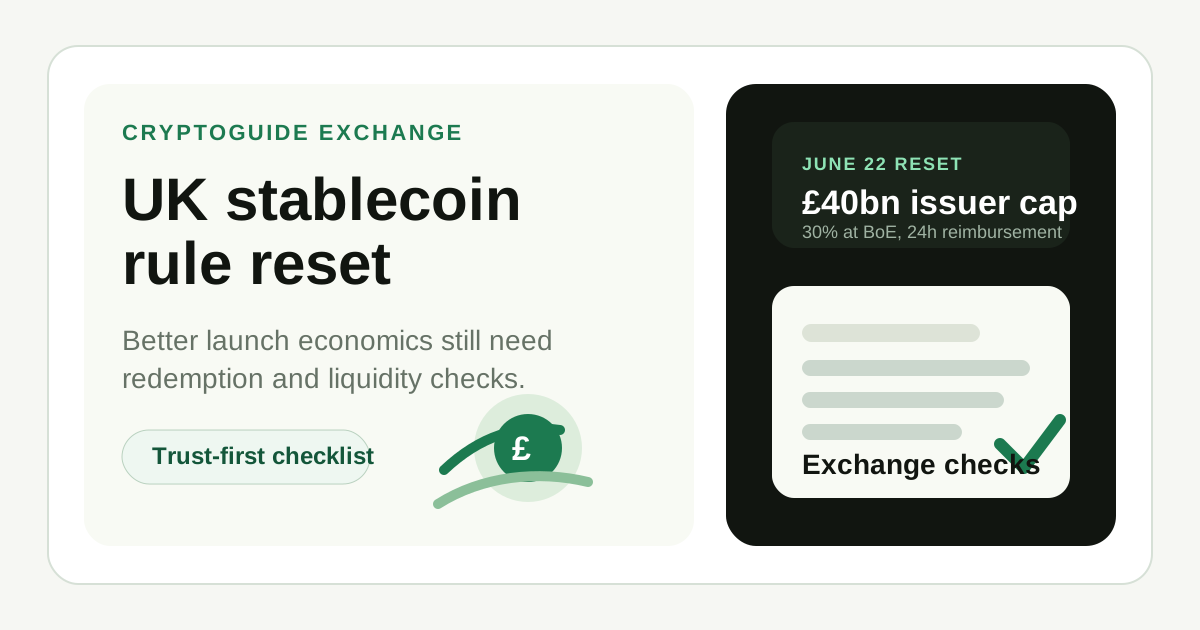
On June 22, 2026, the Financial Times reported that the Bank of England had softened key parts of its planned systemic stablecoin regime. The old idea of holder caps was replaced with a temporary £40 billion issuer limit. The share of backing assets that must sit in non-interest-bearing central bank deposits fell from 40% to 30%. The framework still requires reimbursement within 24 hours, bans interest on stablecoins and uses separate insolvency-remote entities. For exchange users, the shift matters because it makes a regulated GBP stablecoin more commercially plausible. It does not remove the need to check redemption rights, venue support, spreads or whether the product is usable outside a pilot or app-specific loop.
Key takeaways
- The June 22, 2026 rule reset makes a regulated pound stablecoin easier to launch than the earlier UK model.
- The Bank of England shifted from planned holder caps to a temporary £40 billion issuer cap per stablecoin.
- The proposed central-bank-deposit share for reserve assets dropped from 40% to 30%.
- Important trust conditions remain: 24-hour reimbursement, no interest payments and separate insolvency-remote issuer structures.
- CryptoGuide is an independent research platform, not an exchange, broker, custodian, investment adviser or legal adviser.
What changed
The new UK stablecoin angle is not that regulators suddenly “approved crypto.” It is that the commercial design got less punitive while the trust design stayed visible.
According to the Financial Times on June 22, 2026, the Bank of England replaced previously discussed holding caps for individuals and businesses with a temporary £40 billion issuance limit for each systemic stablecoin. The same report said the Bank also reduced the proportion of backing assets that must be held as non-interest-bearing deposits at the central bank from 40% to 30%.
That matters because reserve design decides whether a stablecoin can function as a real product instead of a regulatory demonstration. If too much of the backing has to sit idle in zero-yield central bank deposits, the economics become much harder for issuers. The Bank appears to have accepted that point without dropping the broader trust framing.
Why the change fits the earlier sandbox story
This is not a standalone headline. On February 25, 2026, the Financial Times reported that the Financial Conduct Authority selected Revolut, Monee Financial Technologies, ReStabilise and VVTX from 20 applicants for a stablecoin sandbox covering payments, settlement and crypto trading. That earlier step showed there was already regulatory willingness to test real use cases.
The June 22 change is the next layer: moving from “we will let firms test” to “we may build a more usable regime for systemic sterling stablecoins.” Together, those dates matter more than either headline on its own.
Who is affected first
The earliest beneficiaries are likely to be exchanges, market makers, fintech apps and institutional users that care about sterling settlement friction. Retail users only benefit if a token becomes liquid, transferable and redeemable beyond a closed product environment.
That distinction matters. A stablecoin can be well-designed for treasury or settlement use and still be awkward for ordinary exchange customers if it trades on only one venue, has weak order-book depth or cannot be redeemed directly by smaller holders.
What stays risky
| Headline signal | What users may assume | What to check instead |
|---|---|---|
| £40bn issuer cap | “UK stablecoins are ready now.” | Whether a specific token is live, listed and usable beyond internal app balances. |
| 30% at the central bank | “Reserve risk is solved.” | Full reserve mix, custodian setup, attestation cadence and redemption mechanics. |
| 24-hour reimbursement rule | “Everyone can redeem directly.” | Whether retail users qualify, minimum sizes, fees and blackout terms. |
| No interest rule | “No marketing confusion remains.” | Whether the product is still bundled with rewards, loyalty features or app-only balances that change its risk profile. |
Decision checklist for exchange users
- Check whether the token is live beyond sandbox or pilot status.
- Confirm which exchanges support deposits, withdrawals and direct GBP pairs for the exact token and chain.
- Read the redemption policy and verify whether smaller or retail users can redeem with the issuer directly.
- Look for reserve disclosures, named custodians and attestation frequency.
- Compare spreads and depth against major dollar stablecoins if you plan to trade around it.
- Check whether the stablecoin works across the wider crypto ecosystem or only inside one app.
- Separate “regulated product” language from “practically useful market infrastructure.” Those are not the same thing.
CryptoGuide take
Our view: this is a better signal than a hype launch because it changes the structure underneath the product. The Bank of England is showing it may allow a sterling stablecoin model that can actually function, while still insisting on reimbursement speed, separation of issuer assets and no interest. That is constructive. But the trust test remains operational, not rhetorical. Until users can see direct redemption, consistent venue support and real liquidity, a GBP stablecoin is still a research object before it is a default exchange tool.
Comparison table: what a good launch would need
| Category | Minimum useful signal | Weak signal |
|---|---|---|
| Redemption | Clear 24-hour route with published eligibility and fees. | Only exchange sale, no direct issuer access for most users. |
| Liquidity | Multiple reputable venues with active GBP pairs and tight spreads. | One venue, thin order books and wide spread jumps under stress. |
| Reserves | Frequent disclosures with named institutions and plain reserve language. | Generic “1:1 backed” marketing without usable detail. |
| Interoperability | Support across common wallets, chains and exchange workflows. | App-only balance or ecosystem lock-in. |
| User clarity | Clear separation between stablecoin, rewards and deposit-like features. | Mixed product language that makes risk hard to read. |
FAQ
What changed in the Bank of England's June 22, 2026 stablecoin reset?
The Bank replaced planned holder caps with a temporary £40 billion issuer limit, reduced the share of backing assets that must sit in non-interest-bearing central bank deposits from 40% to 30%, and kept rules such as 24-hour reimbursement and separate insolvency-remote issuer structures.
Does the rule reset mean a GBP stablecoin is ready for everyday exchange use?
No. The rule reset makes launch economics more realistic, but users still need to verify exchange listings, spreads, direct redemption access, supported blockchains and whether the product is still limited or pilot-stage.
What should exchange users compare first?
Compare whether the token is live beyond a pilot, who can redeem directly, what reserve disclosures exist, how many exchanges support it, how tight the GBP pairs are and whether the token behaves more like open-market infrastructure or an in-app balance.
Conclusion
The UK's stablecoin path looks more serious on June 26, 2026 than it did a week earlier. The February 25 sandbox decision showed regulatory intent. The June 22 rule reset showed practical compromise. That combination could produce a stronger sterling stablecoin market, but only if product design, liquidity and redemption access follow through. Users should treat that as progress, not as a reason to skip due diligence.
Related pages
- UK stablecoin sandbox: what exchange users should check before the hype
- Stablecoin plumbing risk after the GENIUS Act
- MoneyGram, Kraken and MGUSD: what changed for crypto cash-out rails
- Crypto regulation in Europe
- Compare exchanges