
TLDR summary
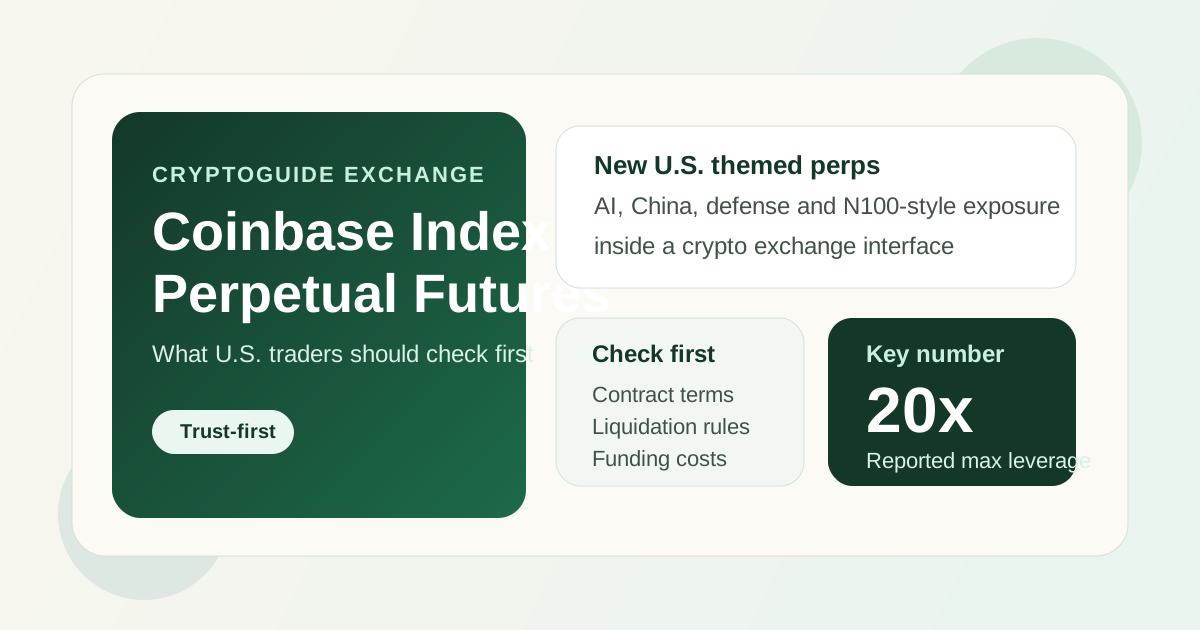
On June 16, 2026, the Wall Street Journal reported that Coinbase launched index-linked perpetual futures for U.S. traders, with contracts tied to four themes: artificial intelligence, China, defense and the top 100 Nasdaq-listed companies. The practical takeaway is not that Coinbase suddenly became a normal brokerage. It is that crypto exchanges are trying to become broader trading venues, and users now need to compare derivative structure, leverage rules and product rights as carefully as they compare coins or fees.
Key takeaways
- The June 16, 2026 launch expanded Coinbase's U.S. perpetual futures push from crypto exposure into macro and equity-theme exposure.
- The Wall Street Journal said the new contracts allow as much as 20x leverage.
- MarketWatch reported earlier in June that U.S. investors could legally trade perpetual futures for the first time on approved venues, which helps explain why exchanges are moving quickly.
- CME sued the CFTC on June 18, 2026 over perpetual futures approvals, showing that the U.S. rule path is still contested even as products launch.
- CryptoGuide Exchange is an independent research and comparison platform, not an exchange, broker, custodian, investment adviser or legal adviser.
What changed this week
The newer point is not only that U.S. perps exist. CryptoGuide covered that regulatory change on May 31. The new point is that Coinbase is using the opening to widen the menu beyond bitcoin-style exposure. According to the Wall Street Journal's June 16 report, Coinbase introduced perpetual futures tied to four thematic indexes and positioned the move as part of its broader effort to become a one-stop trading destination for Americans.
That matters because it moves the perp conversation from crypto-native hedging into something closer to a financial-super-app pitch. Barron's described the same June 2026 product event as part of Coinbase's attempt to become a broader financial platform with AI advice, more securities features and expanded derivatives access.
Market context: why this is bigger than one product
Perpetual futures grew up in offshore crypto markets, where they became one of the dominant forms of speculative trading. Investors.com noted in early June that derivatives account for about 80% of crypto trading volume globally, and that Coinbase framed the market as a multitrillion-dollar category U.S. users previously could not reach through regulated channels.
Now the expansion logic is clear. If a large U.S. crypto exchange can keep users on-platform for spot crypto, options, perps and thematic index trading, it becomes harder to separate a crypto exchange from a general trading app. That is the hype-aware reading. The trust-first reading is narrower: each added product introduces new rules, new failure modes and new user assumptions that need checking.
What users are actually trading
An index-linked perpetual future is still a perpetual future. The underlying reference may be an equity-themed basket rather than bitcoin, but the user is not simply buying a stock ETF and holding it. They are trading a leveraged derivative that does not expire, can trade around the clock and can liquidate quickly if margin rules are breached.
That distinction matters because many retail users understand Coinbase as a place to buy assets. A theme-based perp is closer to a leveraged exposure tool than an ownership product. The interface may feel familiar, but the risk model is not the same as buying spot bitcoin or an ordinary brokerage fund.
Comparison table: spot exposure vs crypto perp vs index-linked perp
| Check | Spot crypto purchase | Crypto perpetual future | Index-linked perpetual future |
|---|---|---|---|
| Main purpose | Direct asset exposure. | Leveraged directional or hedging exposure to a crypto asset. | Leveraged directional exposure to a themed index through a crypto venue. |
| Ownership | You hold the asset on the platform or withdraw it. | No direct ownership of the underlying asset. | No share or ETF ownership; only derivative exposure to the index. |
| Leverage risk | Usually none unless margin is added. | High if margin is used. | High if margin is used, plus underlying theme volatility. |
| Key costs | Spread, trading fee, withdrawal fee. | Trading fee, funding, spread and liquidation costs. | Trading fee, funding, spread, liquidation risk and product-specific rules. |
| Main user mistake | Ignoring custody and withdrawal rules. | Treating leverage like a larger spot trade. | Assuming it behaves like a normal stock or ETF account. |
Decision checklist before using Coinbase's new index perps
- Check the exact contract terms, not only the product headline. A theme label such as AI or defense does not tell you how the index is built, rebalanced or priced.
- Check leverage and liquidation thresholds. The Wall Street Journal said traders can use up to 20x leverage, which is enough to make a modest move painful.
- Check whether the product is better matched to your goal than spot exposure, an ETF or a traditional futures venue.
- Check trading-hour assumptions. Perps can trade 24/7, but the reference assets do not all trade on that schedule, which can affect pricing gaps and weekend behavior.
- Check fees beyond the ticket price. Funding, spread and liquidation mechanics can matter more than the visible trading commission.
- Check eligibility and regulatory limits in your jurisdiction. U.S. product access is opening, but it is still rule-driven and not necessarily uniform for every customer type.
- Check whether you are being pulled by novelty rather than by a real need. A crypto app offering equity-theme leverage is still a high-risk instrument, not a convenience feature.
Risk notes users should not skip
The most important risk is category confusion. A user may think, "I already understand Coinbase, so I probably understand this product." That is weak logic. Product familiarity does not transfer automatically from spot crypto to leveraged thematic derivatives.
There is also live policy risk. On June 18, 2026, the Wall Street Journal reported that CME sued the CFTC over perpetual futures approvals, arguing that the regulator misclassified the products and weakened protections. CryptoGuide is not taking a legal position on that dispute, but users should recognize what it signals: the U.S. framework is active, but not settled.
CryptoGuide take
Coinbase's new index-linked perps are important because they show where exchange competition is going: toward all-in-one trading interfaces that mix crypto, derivatives and eventually more stock-like exposure. The useful question for users is not whether that future sounds exciting. It is whether the product gives a cleaner solution than the alternatives. In many cases, the answer will depend less on the theme and more on leverage discipline, pricing transparency and whether the user actually wanted a derivative in the first place.
FAQ
What did Coinbase launch on June 16, 2026?
The Wall Street Journal reported that Coinbase launched index-linked perpetual futures for U.S. traders tied to four themes: artificial intelligence, China, defense and the top 100 Nasdaq-listed companies.
Are Coinbase index perpetual futures the same as buying stocks?
No. They are leveraged derivatives that track indexes rather than direct ownership of shares. Users should not assume shareholder rights, ordinary settlement or the same protections as a brokerage stock account.
Does U.S. regulatory approval make index perps low risk?
No. A regulated venue can improve oversight, but perpetual futures still carry leverage, liquidation, fee, liquidity and product-structure risk.
Conclusion
Coinbase's June 2026 product push is a useful signal for crypto-market structure: major exchanges are trying to become broader trading platforms, not just coin marketplaces. For users, that means one extra discipline. Before treating a new perp contract like a convenient way to trade AI or Nasdaq themes, check what it is, what it costs and what can force you out of the trade. CryptoGuide Exchange remains an independent research and comparison platform, not an exchange, broker, custodian, investment adviser or legal adviser.
Related pages
- Regulated crypto perpetual futures in the US: what changes
- Tokenized stocks on crypto exchanges: what users should check first
- Coinbase exchange profile
- Compare crypto exchanges
Sources
- Wall Street Journal: Coinbase launches index-linked perpetual futures for U.S. traders
- MarketWatch: What to know before trying perpetual futures
- Investor's Business Daily: Coinbase and Kalshi's new crypto futures
- Wall Street Journal: CME sues U.S. regulator over perpetual futures
- Barron's: Coinbase plans to become a financial super app