
TLDR
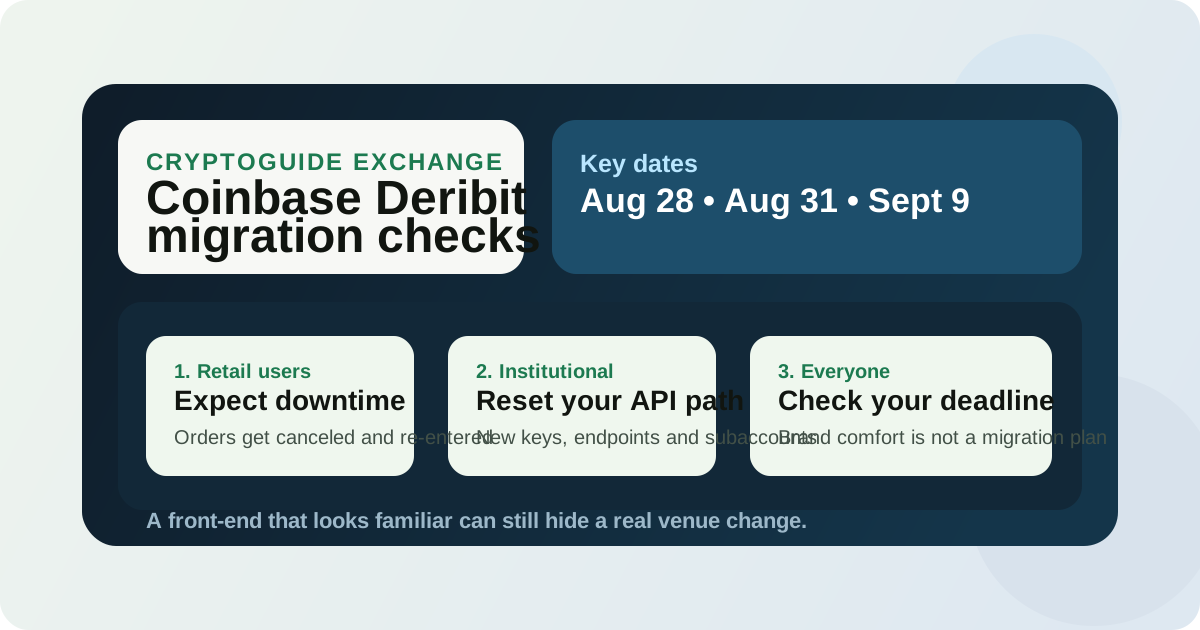
Coinbase says the venue powering perpetual futures on its app and website will move from Coinbase International Exchange to Deribit on September 9, 2026, subject to change. Retail users on the Coinbase app generally do not need to open a new account, but they should expect about 30 minutes of downtime and open perpetual orders being canceled during migration. Coinbase also says users who do not want to migrate must close their account before August 28, 2026. For institutional Coinbase International Exchange clients, August 31, 2026 is the key readiness date to verify Deribit account access, create new API keys and check new subaccount mappings before the September 9 cutover.
Key takeaways
- September 9, 2026 is Coinbase's currently scheduled migration date for moving perpetual futures infrastructure to Deribit.
- Coinbase says app and website users do not need to re-verify identity or open a separate account for the migration.
- Open perpetual futures orders will be canceled during the migration window and must be entered again afterward.
- Coinbase says users who do not want to migrate must close their account before August 28, 2026.
- Institutional Coinbase International Exchange clients are told to verify Deribit access by August 31, 2026 and create new API keys because old International Exchange keys will not work on Deribit.
- Coinbase says options trading will become available in the app and website for eligible users in select jurisdictions, while product availability remains jurisdiction-specific.
- CryptoGuide Exchange is an independent research and comparison platform, not an exchange, broker, custodian, investment adviser or legal adviser.
Market context
The larger story is Coinbase trying to turn derivatives into a deeper part of its "everything exchange" model after acquiring Deribit. In Coinbase's February 12, 2026 shareholder materials, the company said it had closed the Deribit acquisition internationally in 2025 and described itself as a global leader in crypto derivatives by open interest and options volume. The September 9 migration is where that acquisition turns into a user-facing infrastructure change.
That makes this less about one new contract listing and more about venue concentration, product expansion and risk transfer. Deeper liquidity and options access may be positives. But when one platform changes the matching engine, venue, subaccount structure and API path beneath active derivatives users, the trust-first move is to check the operational details before you assume "same app" means "same risk."
What changes for retail Coinbase users
Coinbase's retail FAQ says perpetual futures on the Coinbase app and website will keep looking familiar, but the underlying venue will move to Deribit. Users do not need to create a new account, and Coinbase says KYC will not need to be repeated for the migration itself. That is the smooth story.
The operational story is less smooth. Coinbase says there will be about 30 minutes of downtime on September 9, 2026 and that all open perpetual futures orders will be canceled during that window. Positions and balances are expected to carry over automatically, but Coinbase also says users may see temporary unrealized PnL differences caused by settlement and reopening mechanics. The company explicitly frames that as a normal migration artifact rather than a fee or a realized loss.
What changes for institutional users
The institutional side is where the migration becomes a real systems project. Coinbase says Coinbase International Exchange clients will be migrated to Deribit, with August 28, 2026 as the last day to opt out and August 31, 2026 as the readiness date to confirm access. If a client does not already have a Deribit account, Coinbase says one will be created automatically. If a client already has a Deribit account, Coinbase says International Exchange portfolios will map into new Deribit subaccounts.
Coinbase also says existing International Exchange API keys will not work on Deribit. That matters because operational failures here are not cosmetic. New API keys, endpoint changes, subaccount permissions, limit requests and workflow testing need to be done before migration day, not during the downtime window.
Decision checklist
| User type | Main check | Why it matters |
|---|---|---|
| Retail app or website user | Know the September 9 downtime window and order-cancel behavior. | Open perpetual orders will not survive the cutover and must be re-entered manually. |
| Retail user considering options | Check whether your jurisdiction is eligible. | Coinbase says options will launch only for eligible users in select jurisdictions at first. |
| User who does not want to migrate | Act before August 28, 2026. | Coinbase says that date is the deadline to close the account instead of accepting migration. |
| Institutional trading team | Verify Deribit access by August 31, 2026. | Missing access verification increases operational risk on migration day. |
| Institutional API team | Create new Deribit API keys and test endpoints. | Coinbase says old International Exchange API keys will not work after migration. |
| Operations and treasury team | Review subaccount mapping, limits and collateral workflow. | Venue changes can affect approvals, withdrawals, balances and internal reporting. |
Comparison: same front end, different trust questions
| Claim | What it probably means | What it does not remove |
|---|---|---|
| "The app experience stays the same" | Retail users keep trading through the Coinbase surface they already know. | It does not remove venue risk, migration downtime or order-cancel risk. |
| "Positions transfer automatically" | Coinbase intends to preserve exposure through settlement-and-recreate mechanics. | It does not remove the need to review records, average-entry resets and temporary PnL artifacts. |
| "Deeper liquidity and faster execution" | The combined venue may improve product depth and market quality. | It does not prove your account setup, access controls or API workflows are ready. |
| "No action required" | That applies mainly to ordinary app and website users. | It does not apply in the same way to institutional clients, API traders or anyone who wants to opt out. |
Practical user checks before migration day
- If you use Coinbase perpetuals casually, reduce surprise risk by checking whether you have any open orders or position-management habits that depend on always-on access during the September 9 window.
- If you may not want to accept the Deribit migration, review the August 28, 2026 deadline immediately instead of waiting until the last week.
- If you need clean tax or reporting records, Coinbase says to save a copy of your perpetual futures trading activity before migration.
- If you are eligible for new options access, confirm whether that product is actually live for your jurisdiction and account type instead of assuming the rollout is global.
- If you trade through APIs or manage institutional portfolios, test Deribit access, permissions, new API keys and endpoint updates before August 31, 2026.
- If your internal controls depend on specific subaccounts, withdrawal limits or approval chains, validate the mapped Deribit structure before migration day.
Risk notes
Venue consolidation can improve depth while increasing dependency
Coinbase is pitching the combined venue as broader, deeper and faster. That may be true. It also means more derivatives activity depends on one combined operational stack, so outages or migration mistakes can affect a larger user base at once.
Temporary PnL differences can confuse users
Coinbase says users may see small unrealized PnL differences after positions are recreated. Even if that is a normal migration artifact, it is exactly the kind of detail that can spook users who were not prepared for it.
Jurisdiction and product scope still matter
Coinbase repeatedly says dates, features and product availability remain subject to change and depend on supported jurisdictions. Users should not treat a Coinbase headline as proof that perpetuals or options are available everywhere.
CryptoGuide take
The useful way to read this story is not "Coinbase adds Deribit" but "Coinbase is asking users to trust a derivatives venue change without treating it like an ordinary venue change." Retail users probably do not need to panic. But they do need to understand that September 9 is not a cosmetic update if they keep open perpetual orders. Institutional users should treat the late-August dates as real operational deadlines. When an exchange tells you the front end stays familiar while the derivatives engine, API path and account mapping change underneath, the right reaction is preparation, not brand comfort.
FAQ
What changes on September 9, 2026 for Coinbase perpetual futures users?
Coinbase says the underlying venue for perpetual futures on its app and website will move from Coinbase International Exchange to Deribit on September 9, 2026, subject to change. Open perpetual orders will be canceled during an expected downtime window and need to be re-entered after migration.
What are the main deadlines before the Coinbase Deribit migration?
Coinbase says users who do not want to migrate must close their account before August 28, 2026. Institutional Coinbase International Exchange clients are also told to verify Deribit account access by August 31, 2026 ahead of migration day on September 9, 2026.
Does the migration mean users need to trust Deribit in the same way they trusted Coinbase?
Users should treat this as a venue and workflow change, not only a branding change. Retail users should check downtime, order cancellation and product availability. Institutional users should also check new API keys, new endpoints, subaccount mapping, limits and operational readiness on Deribit.
Conclusion
The Coinbase Deribit cutover is a good example of why exchange infrastructure changes deserve user attention even when the consumer interface stays mostly the same. The main facts are concrete: August 28 for opt-out, August 31 for institutional readiness and September 9 for migration day. If you use Coinbase derivatives, those dates now matter more than the marketing line about a unified world-class platform.
Related pages
- Kraken vs Coinbase
- How crypto exchanges work
- What makes an exchange trustworthy
- Coinbase index perpetual futures: what U.S. traders should check first
- Coinbase July 2026 outage: what exchange users should check
Sources
- Coinbase Help: Coinbase International Exchange and Deribit are coming together
- Coinbase Help: Coinbase user FAQs for the International Exchange and Deribit integration
- Coinbase Help: institutional client FAQs for the migration to Deribit
- Coinbase investor relations: February 12, 2026 shareholder update