
TLDR
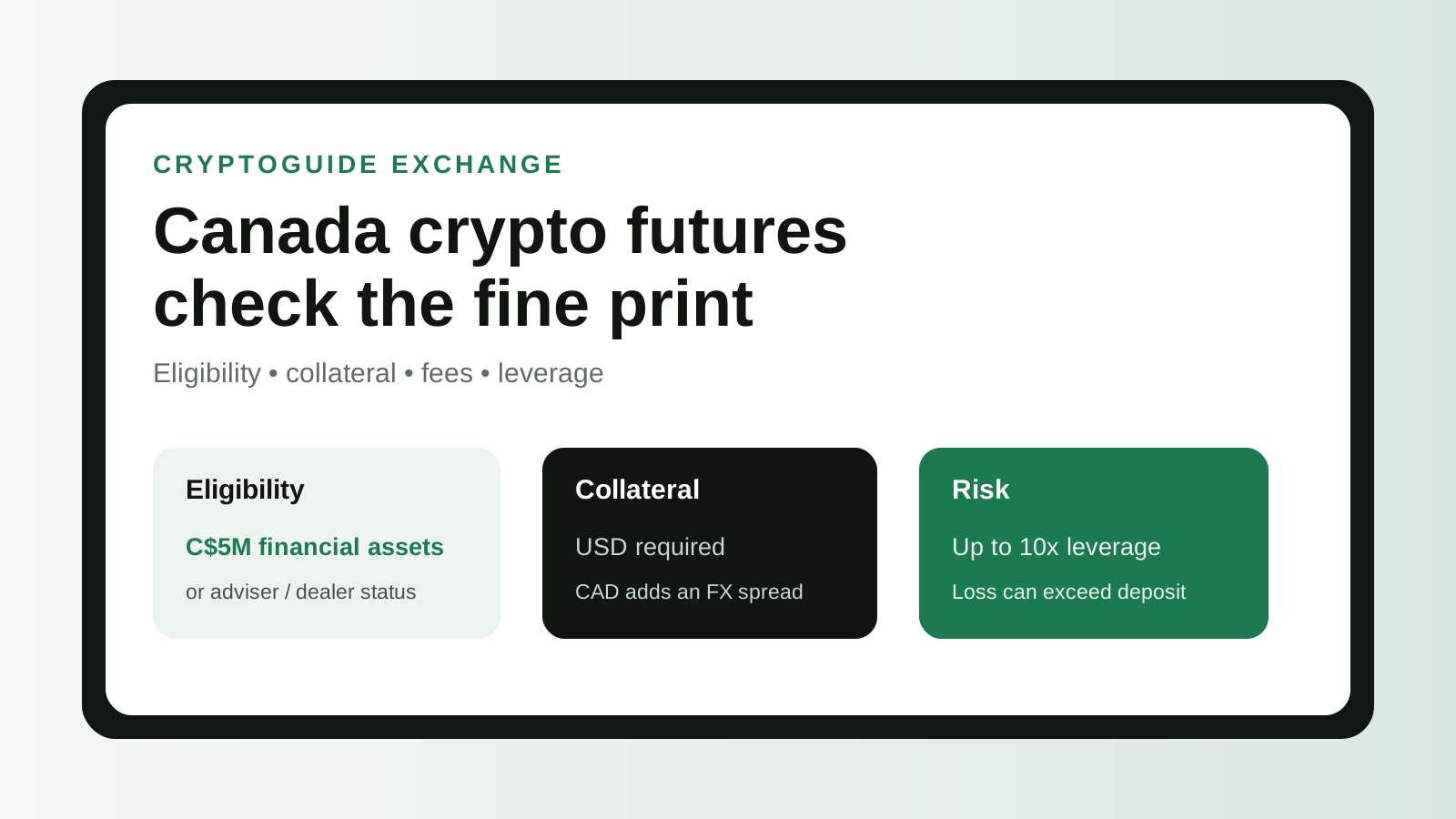
Coinbase announced the Canadian launch on September 2, 2026 through Coinbase Financial Markets (CFM), a CFTC-registered futures commission merchant and NFA member. Its post highlights up to 10x leverage, 23 crypto contracts and limited-time pricing of 0.02% per trade plus US$0.11 per contract. The constraints matter more: Coinbase's Canadian help page says users generally need at least C$5 million in net financial assets excluding real estate, or registered adviser/dealer status; CAD is not accepted directly as collateral; and leveraged losses can exceed the initial investment.
Key takeaways
- Coinbase announced access for eligible Canadian customers on September 2, 2026.
- The lineup includes 23 perpetual and dated crypto futures, five commodity futures and index products including COIN50.
- CFM provides derivatives under Canadian foreign-dealer and futures-commission-merchant exemptions; Coinbase Canada Inc. separately handles spot balances.
- Canadian eligibility is narrow: C$5 million in net financial assets excluding real estate, or registered investment adviser/dealer status.
- Futures collateral must be USD. USDC can convert automatically; converting CAD adds an FX spread.
- CryptoGuide Exchange is an independent research and comparison platform, not an exchange, broker, custodian, investment adviser or legal adviser.
Market context: a regulated route with a narrow door
The launch moves some Canadian derivatives demand from offshore platforms toward a U.S.-regulated intermediary. CFM is CFTC-registered and an NFA member, and Coinbase says futures customer assets are segregated under CFTC customer-protection rules. That is a meaningful market-structure change.
Regulatory status does not make the product simple or broadly available. The financial-assets test excludes most ordinary retail accounts. It also does not remove contract, margin, currency-conversion or liquidation risk. “Available in Canada” and “available to most Canadians” are different claims.
What launched—and what the headline leaves out
Coinbase lists nano-sized, perpetual-style and dated futures. Its announcement names Bitcoin, Ether and Solana among 23 crypto contracts, alongside gold, silver, oil and COIN50. Nano sizing lowers one contract's notional value; it does not cap percentage losses. Coinbase says one nano Bitcoin contract represents 0.01 BTC and one nano Ether contract represents 0.1 ETH.
Decision table
| Check | Headline | Account reality |
|---|---|---|
| Eligibility | Eligible Canadians | Province-specific access plus C$5 million in financial assets excluding real estate, or adviser/dealer registration. |
| Provider | Coinbase | CFM provides derivatives; Coinbase Canada Inc. retains the separate spot relationship. |
| Collateral | Capital-efficient | USD required; CAD-to-USDC conversion can add an FX spread. |
| Pricing | 0.02% + US$0.11 per contract | Limited-time rate; also check spread, FX, funding and liquidation costs. |
| Leverage | Up to 10x | Loss can exceed the initial investment. |
| Protection | CFTC/NFA-regulated | Futures protections apply to the CFM account, not automatically to spot balances. |
Pre-trade decision checklist
- Confirm your province is supported and you meet the exact eligibility test.
- Identify the legal entity holding each balance before moving funds.
- Calculate total contract notional value, not only displayed margin.
- Measure the CAD-to-USDC-to-USD conversion cost before comparing fees.
- Check expiry, daily breaks, weekends and holiday hours for the contract.
- Read the liquidation disclosures; do not assume losses stop at posted margin.
- Verify the live fee in the order preview because the announced rate is promotional.
- Understand the W-8BEN request and seek qualified Canadian tax advice if needed.
Risk notes
Leverage can create losses beyond the deposit
Coinbase explicitly warns that leverage can work for or against users and that losses may exceed the amount initially invested. A small contract and regulated venue do not neutralize that risk.
CAD adds another cost layer
CAD cannot directly satisfy margin. Coinbase says it must be converted to USDC, with an FX spread, before USDC converts to USD. The effective cost therefore differs from the advertised commission.
Spot and futures protections differ
Canadian derivatives balances sit with CFM; spot balances remain with Coinbase Canada Inc. Users should not extend the futures-account protection description to every asset visible in the same app.
CryptoGuide take
This is a credible regulated-access story, but not a mass-retail breakthrough. The trust signal is the clearer legal and customer-protection framework around the futures account. The counterweight is a high eligibility threshold, USD collateral, promotional fee framing and losses that may exceed posted funds. Entity separation and all-in cost are core product facts, not footnotes.
FAQ
Can every Canadian Coinbase user trade these futures?
No. Coinbase says Canadian customers must meet provincial criteria, including at least C$5 million in net financial assets excluding real estate, or registered adviser/dealer status.
Can Canadians use CAD as futures collateral?
No. USD is required. USDC can convert automatically to USD, while CAD conversion involves an FX spread.
Are these futures the same as spot crypto?
No. CFM provides derivatives, while Coinbase Canada Inc. handles spot balances. Futures add contract, margin and leverage risks.
Conclusion
As of September 7, 2026, the launch adds a regulated route for a limited class of sophisticated Canadian customers. Before treating it as an exchange upgrade, verify eligibility, provider, collateral currency, full costs and maximum-loss mechanics.
Related pages
- Regulated crypto perpetual futures
- Coinbase index perpetual futures checks
- Coinbase exchange review
- Kraken vs Coinbase
- Margin trading glossary