
TLDR
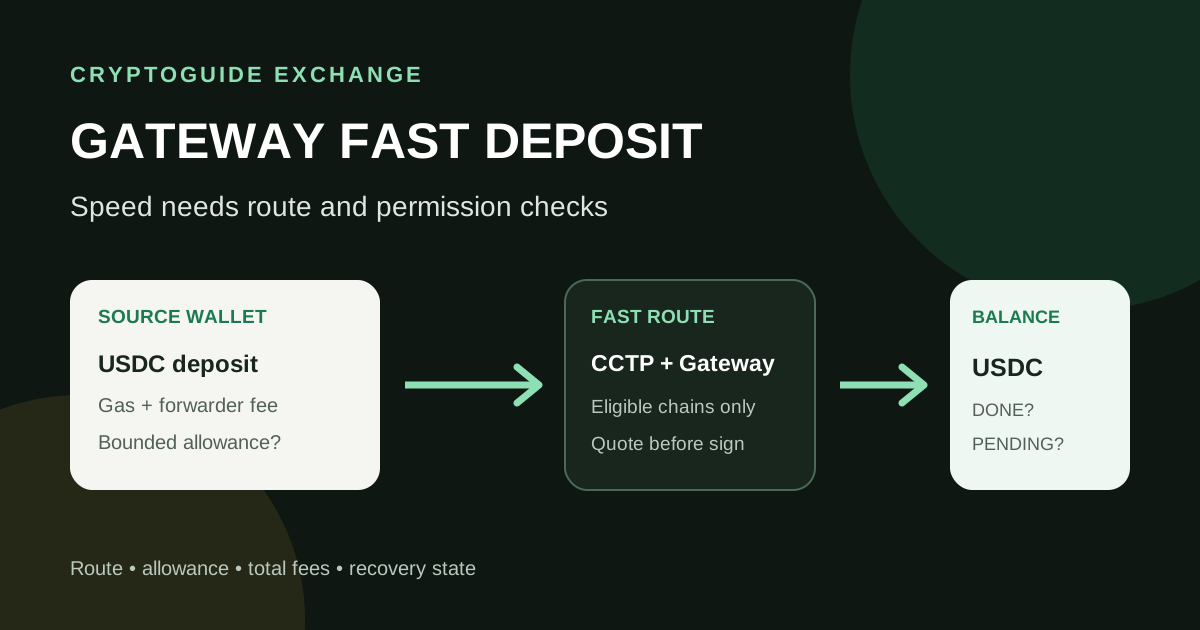
Circle launched Gateway Fast Deposit on September 9, 2026 through its Unified Balance Kit. The feature uses CCTP Fast Transfer to make deposited USDC usable in seconds on eligible routes while source-chain finality completes in the background. At launch, Circle lists nine mainnet source chains and two destinations: Avalanche and Polygon PoS. It is an infrastructure feature for apps—not a new USDC token, exchange account or guarantee of instant settlement. Users should verify the exact route, source gas, USDC forwarder fee, token allowance and status handling before treating “up to 40x faster” as the complete product description.
Key takeaways
- Circle says Fast Deposit can reduce an approximately 15-minute finality wait to seconds on eligible routes; actual times and fees are not guaranteed.
- The nine launch sources are Arbitrum, Codex, Ethereum, Ink, Linea, OP Mainnet, Plume, Unichain and World Chain.
- Avalanche and Polygon PoS are the only mainnet Fast Deposit destinations listed at launch. Arc mainnet support is planned.
- Fast Deposit is opt-in. Circle's implementation documentation says an invalid route is rejected rather than silently changed to a standard deposit.
- The wallet pays source-chain gas plus a USDC forwarder fee on top of the deposit amount.
- Fast Deposit uses a USDC token allowance. A maximum allowance can shorten later deposits but remains active until changed or revoked.
- CryptoGuide Exchange is an independent research and comparison platform, not an exchange, broker, custodian, investment adviser or legal adviser.
Market context: the deposit wait was the weak link
Gateway is designed to present USDC held across supported blockchains as one balance. Circle documents sub-500-millisecond transfers after that balance is established, but the initial funding step still depends on source-chain finality. On slower chains, that can mean roughly 15 minutes before deposited USDC becomes available.
Fast Deposit combines two Circle systems: CCTP Fast Transfer moves USDC before finality is complete, while Unified Balance Kit coordinates the transfer and Gateway deposit. That is relevant to wallets, trading apps, prediction markets and other products where a user may abandon a session while funds are pending. It does not mean every deposit, withdrawal or exchange credit now completes in seconds.
Standard deposit or Fast Deposit?
| Decision point | Standard Gateway deposit | Gateway Fast Deposit |
|---|---|---|
| When funds become usable | After source-chain finality; Circle says this can take 15 minutes or longer. | Seconds on eligible routes while source settlement continues in the background. |
| Route coverage | Gateway's supported deposit blockchains. | Nine mainnet sources to Avalanche or Polygon PoS at launch. |
| Fees shown by Circle | Source-chain gas and any app-level costs. | Source gas plus a USDC forwarder fee paid on top of the deposit. |
| USDC permission | Depends on the app's deposit workflow. | The TokenMessengerWithFees contract spends the deposit and forwarder fee under a USDC allowance. |
| Best fit | When finality delay is acceptable. | When quicker access is worth the extra fee and narrower routing. |
What the user approves
A source-chain USDC spend
Circle's documentation says the TokenMessengerWithFees contract spends both the deposit and forwarder fee. If the remaining allowance is too small, the kit submits an approval transaction before the burn transaction. A well-designed app should identify the spender, allowance amount and chain—not show a generic “enable USDC” prompt.
Two different fee assets
The source transaction consumes the chain's native gas token, such as ETH. The forwarder fee is charged in USDC on top of the amount deposited, so a 1,000 USDC deposit requires more than 1,000 USDC in the wallet. Circle says the fee quote is locked when estimated, while gas can still vary with network conditions.
An irreversible crosschain flow
Circle's launch disclosure says source-chain burns are irreversible and deposits may be delayed or fail. Non-custodial describes who controls the funds; it does not remove smart-contract, interface, routing or operational risk.
Decision checklist before using a fast deposit
- Confirm the app actually uses Circle Gateway Fast Deposit, not an unrelated bridge with similar language.
- Match the source and destination networks against the current supported-route list.
- Verify that the destination is Avalanche or Polygon PoS at launch; do not infer support from Gateway's broader chain list.
- Read the deposit amount, USDC forwarder fee and source-chain gas estimate separately.
- Inspect the USDC spender and allowance. Prefer a bounded allowance when repeated unlimited access is unnecessary.
- Check the quote age; Circle says an expired quote causes the deposit call to fail and must be refreshed.
- Save the source transaction hash and the destination or relay hash when provided.
- Understand the app's labels for
DONE,PENDINGandFAILED. - Do not retry a pending deposit until the source transaction receipt is resolved.
- Use a small test amount before relying on an unfamiliar app or route.
Risk notes
“Up to 40x” is route-dependent
The comparison is based on slower-finality chains where the standard wait may be about 15 minutes. Circle explicitly says time and fee estimates can vary. A speed claim is not a service-level guarantee, and it says nothing about how quickly a receiving exchange credits a user's account.
Pre-approval trades latency for standing permission
Circle documents an optional maximum uint256 allowance that avoids waiting for a new approval on later deposits. That allowance stays active until the user changes or revokes it. Convenience should be weighed against how much a contract could spend if the signing wallet, interface or approval context is compromised.
Pending is not failed—and failed is not automatically lost
Circle's result model distinguishes a completed relay, a roughly 60-second timeout and a terminal destination failure. A PENDING result does not confirm that the source succeeded. A FAILED result means the source burn completed but the relayer reported a destination failure. In either case, duplicate submission can create a second transfer rather than repair the first.
CryptoGuide take
Fast Deposit closes a real mismatch in Circle's stack: an “instant” unified balance was less useful when initial funding could take a quarter of an hour. The launch deserves attention, but the trust signal is not the headline speed. It is whether an integrating wallet or exchange exposes the route boundary, contract spender, allowance size, fee breakdown and recovery state without making users hunt through developer documentation.
FAQ
Is Fast Deposit available on every Gateway network?
No. Circle warns that the Fast Deposit list differs from Gateway's general supported-blockchain list. At launch, nine mainnet sources can route to Avalanche or Polygon PoS.
Does Fast Deposit eliminate fees?
No. The documented flow includes source-chain gas in the native token and a forwarder fee in USDC. The full deposit amount reaches the destination, but the wallet needs the deposit amount plus the USDC fee.
What if the app reports a pending deposit?
Check the source transaction hash and wait for its receipt before retrying. Circle says PENDING can reflect a timeout and does not by itself prove that the source transaction succeeded.
Conclusion
Gateway Fast Deposit can make crosschain USDC funding feel closer to the speed users expect from an exchange interface. Use it as a route-specific paid acceleration feature: verify the networks, permission, full cost and recovery path before approving the transfer.
Related pages
- CCTP upfront fees: read the full USDC quote
- USDC route checks before CCTP V1 shutdown
- Stablecoin plumbing risk
- How to choose a crypto exchange
- Run a trust check