
TLDR
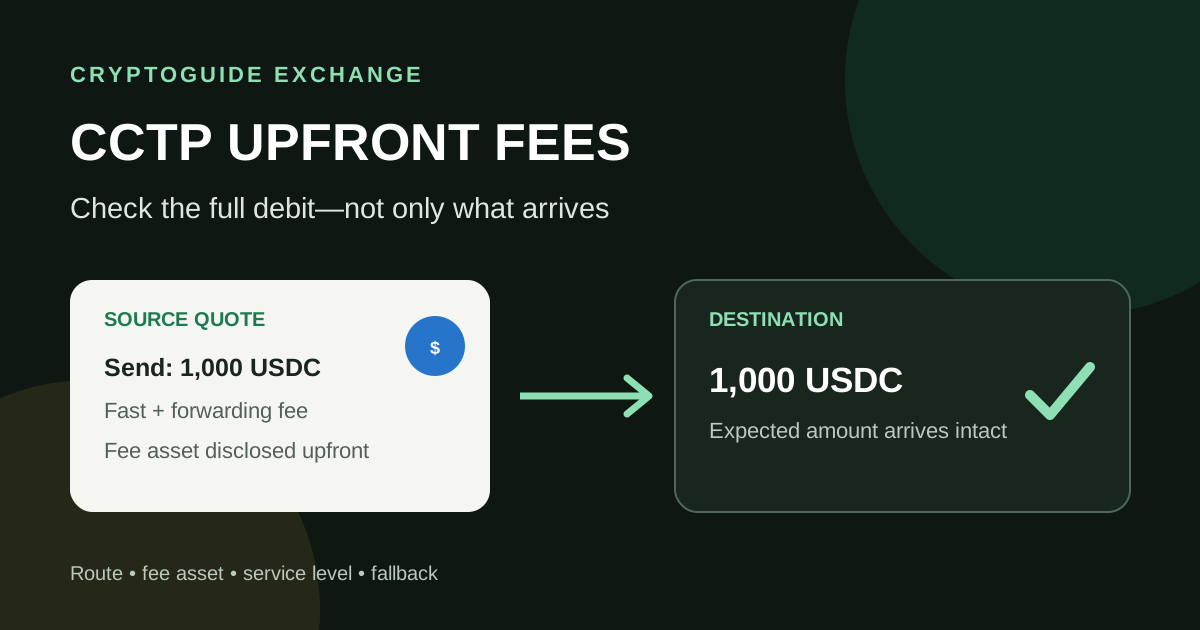
On September 8, 2026, Circle added upfront fee payment for CCTP Fast Transfers originating on supported EVM chains. An integrating wallet, exchange or payment app can use Circle's Quote API to bundle Fast Transfer and Forwarding Service fees, then collect the quoted cost in USDC or the source chain's native gas token. The intended USDC amount can therefore arrive intact instead of having a protocol fee deducted when USDC is minted on the destination chain. Users still need to compare the total cost, confirm both networks and understand whether a transfer can fall back to the slower Standard Transfer path.
Key takeaways
- The launch changes fee presentation and collection; it does not guarantee cheaper transfers.
- Circle says the Quote API can combine Fast Transfer and forwarding fees in one quote.
- The fee can be collected in USDC or the source EVM chain's native gas token.
- The launch supports transfers from CCTP-supported EVM chains. Transfers to Solana are supported, but transfers originating from Solana are not.
- CCTP Fast Transfer fees vary by source chain and can change. Circle's documentation says not to hardcode them.
- A destination amount that looks exact does not remove exchange deposit support, address, smart-contract, liquidity or recovery risk.
- CryptoGuide Exchange is an independent research and comparison platform, not an exchange, broker, custodian, investment adviser or legal adviser.
Market context: crosschain USDC has a quote problem
A user moving 1,000 USDC may care less about the protocol architecture than a basic question: how much will arrive? Under the existing CCTP Fast Transfer model, the protocol fee is normally deducted when USDC is minted on the destination chain. An interface that starts with the send amount can therefore produce a slightly smaller receive amount.
That difference matters for exact-value payments, exchange deposits, treasury sweeps and wallet rebalancing. Circle's new option lets an integrator price the fee before the burn transaction and leave the intended destination amount untouched. It is a user-experience improvement, provided the app shows every part of the quote clearly.
What changed in the transfer flow
| Check | Destination-deducted flow | New upfront-payment option |
|---|---|---|
| USDC received | Fast Transfer fee is deducted during destination minting. | The intended USDC amount can arrive intact. |
| Fee timing | Reflected at the destination. | Quoted and collected before execution. |
| Fee asset | Comes out of transferred USDC. | Integrator can collect USDC or the source chain's native gas token. |
| Quote components | An app may need to explain protocol and forwarding costs separately. | Quote API can bundle Fast Transfer and forwarding fees. |
| Route scope at launch | Depends on the selected CCTP service and supported chains. | Originating EVM routes only; Solana destination is supported, Solana source is not. |
How to read a crosschain USDC quote
Separate “receive amount” from “total paid”
Receiving exactly 1,000 USDC does not mean the transfer cost 1,000 USDC. If the fee is paid in ETH or another native token, the interface should show that asset and amount beside the USDC debit. Compare the full economic cost, including source gas and any app fee.
Identify the service level
Circle documents Standard Transfer and Fast Transfer separately. Standard Transfer generally waits for finality and carries no CCTP Fast Transfer fee; Fast Transfer uses Circle's allowance to move faster and charges a route-dependent fee. “Fast” should appear as a service choice, not as an unexplained surcharge.
Check forwarding as its own service
The Circle Forwarding Service can submit the destination transaction for the user. Circle's documentation lists a $0.20 service fee plus dynamically quoted destination gas. A bundled quote is convenient, but the app should still identify what is included and whether the recipient needs destination-chain account setup, especially for Solana.
Decision checklist before approving
- Confirm the source and destination networks—not just the USDC ticker.
- Verify the receiving exchange or wallet supports native USDC on that exact destination network.
- Read the quoted USDC receive amount and the total amount charged in every asset.
- Check whether the route is Standard or Fast Transfer and whether forwarding is included.
- Look for a quote expiry or refresh; route fees can change.
- Confirm what happens if the Fast Transfer allowance or quoted maximum fee is insufficient.
- For a Solana destination, verify that the recipient USDC associated token account exists or that setup is included.
- Check transaction status through the app and an independent block explorer.
- Use a small test transfer before a material exchange deposit when the route is unfamiliar.
Risk notes
Predictable output is not the same as low cost
Moving the fee upfront can make the received amount easier to understand while leaving the total cost unchanged—or adding costs that are paid in a different asset. Interfaces should not market “full amount received” without displaying the complete debit.
A fast route can become a standard route
Circle's fee guidance says an insufficient maxFee can degrade a Fast Transfer to Standard Transfer. For transfers using the Forwarding Service, forwarding execution is prioritized. Users should know whether a time-sensitive transfer can become slower and how the interface reports that state.
Crosschain and exchange errors remain
CCTP burns native USDC on the source chain and mints it on the destination chain. It does not make an unsupported exchange deposit recoverable, validate a pasted address or protect a user from a malicious interface. Transfers are irreversible, so network and recipient checks remain the control that matters most.
CryptoGuide take
Upfront CCTP fees are a worthwhile piece of stablecoin plumbing because “what arrives” should not be a surprise. The trust-first standard is stronger than a single clean number: wallets and exchanges should display source debit, fee asset, destination amount, service level, forwarding status, quote expiry and fallback behavior together. If any of those fields is hidden, exact-output marketing is doing more work than the disclosure.
FAQ
Does upfront fee payment make CCTP cheaper?
Not necessarily. It changes where the fee is collected so the intended USDC amount can arrive intact. Compare total debits across USDC, native gas and any app fee.
Can I pay the upfront fee in USDC?
Circle says integrators can collect it in USDC or the source EVM chain's native gas token. The available choice and presentation depend on the wallet, exchange or application implementing the feature.
Can I use this flow from Solana?
Not at launch. Circle says transfers to Solana are supported, but transfers originating from Solana are not currently supported for upfront fee payment.
Conclusion
Circle's update makes a common crosschain UX failure easier to fix: the number promised can match the USDC delivered. Before treating a route as predictable, verify what leaves the wallet, what arrives, which service executes the transfer and what happens when the fast path is unavailable.
Related pages
- USDC route checks before CCTP V1 shutdown
- EURC on CCTP: crosschain checks
- Stablecoin plumbing risk
- How to choose a crypto exchange
- Run a trust check