
TLDR
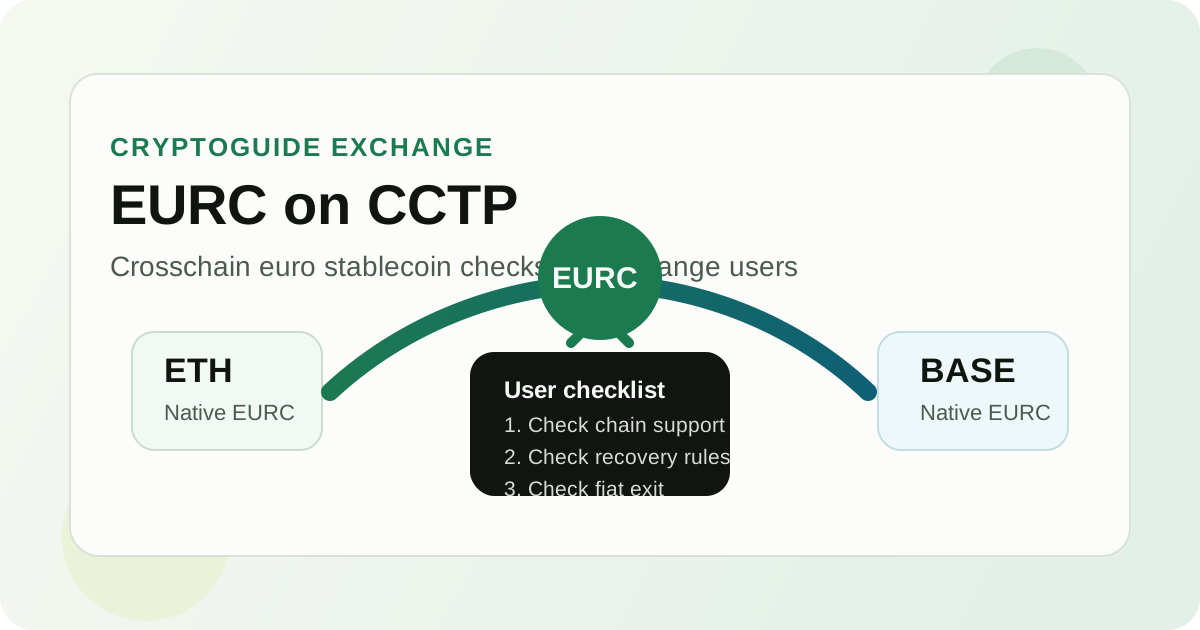
Circle said on September 2, 2026 that Cross-Chain Transfer Protocol now supports native EURC, starting with Ethereum and Base. Circle's CCTP materials say supported transfers burn the token on the source chain and mint it on the destination chain, which is cleaner than relying on wrapped bridge inventory and can help unify liquidity across chains. That is a real infrastructure improvement for exchanges, market makers, wallets and treasury users that want euro-denominated onchain settlement. It is not a blanket signal that every exchange now offers seamless EURC routing. Users still need to check whether their platform supports EURC on the exact chain they want, whether deposits are open, whether mistaken sends are recoverable, and whether the final euro cash-out path is actually strong.
Key takeaways
- Circle said on September 2, 2026 that CCTP now supports native EURC, with Ethereum and Base as the first supported routes.
- Circle says CCTP transfers work by burning on the source chain and minting on the destination chain, which helps avoid wrapped-token fragmentation.
- Circle's developer docs say CCTP is now available for both USDC and EURC, but token and network support still depend on the exchange, wallet or app sitting on top of the rail.
- Circle's MiCA EURC white paper says EURC is an e-money token issued by Circle SAS and redeemable at par value in euros, while also noting that EMT holders are not covered by deposit guarantee or investor compensation schemes.
- CryptoGuide Exchange is an independent research and comparison platform, not an exchange, broker, custodian, investment adviser or legal adviser.
What changed
The practical change is that euro stablecoin transfers now have a cleaner issuer-level route between two major networks. Before this launch, exchange users could see EURC listed on multiple venues and still run into awkward crosschain choices: keep funds where they are, bridge into a wrapped version, or route through a dollar stablecoin instead because the euro path was not operationally smooth enough. Circle's September 2 launch reduces that mismatch.
It also matters because the launch is narrow in a useful way. Circle did not announce "crosschain EURC everywhere." It said native EURC support on CCTP starts with Ethereum and Base. That is the right detail to focus on. Specific supported rails are more important than broad ecosystem marketing because route mistakes happen at the chain level, not the press-release level.
Who is affected first
Exchanges, OTC desks, market makers, wallets and payment operators are affected first because they can integrate the new route directly and decide whether users ever see the benefit. If they support native EURC deposits and withdrawals on both chains, users may get cleaner euro transfer paths with fewer wrapped-asset assumptions.
Retail users feel the benefit later. They only experience "better infrastructure" when their venue actually exposes it clearly: correct network labels, open deposit routes, transparent recovery rules and a usable EUR off-ramp. If those pieces are missing, native CCTP support exists in the background while the user experience stays fragmented.
Decision checklist before sending EURC crosschain
- Check whether your exchange supports native EURC on the source chain and destination chain, not just EURC trading in general.
- Check whether deposits and withdrawals are live on the exact network you plan to use today. Exchange support can lag issuer support.
- Check whether the venue or wallet distinguishes between native and wrapped versions of EURC. Do not assume a ticker alone answers that.
- Check the recoverability policy for unsupported deposits. Native rails do not protect users from platform-level "cannot recover" rules.
- Check whether your end goal is trading, self-custody, treasury settlement or a euro bank exit. The best route changes with the use case.
- Check whether a direct fiat withdrawal would be safer than forcing a multi-step onchain route to save a small fee.
Comparison: stronger route, same user discipline
| Question | What improved | What still needs checking |
|---|---|---|
| Crosschain transfer design | Circle says EURC can now move through native burn-and-mint routing on CCTP between Ethereum and Base. | Your exchange still has to expose the route correctly and support both sides operationally. |
| Liquidity fragmentation | Native routing can reduce the need for wrapped bridge inventory and split liquidity pools. | Order-book depth and withdrawal availability still vary by venue. |
| Issuer clarity | Circle's white paper gives named issuer, redemption and MiCA-related disclosures for EURC. | Issuer disclosures do not remove exchange solvency, outage or custody risk. |
| User safety | A canonical transfer rail can reduce some avoidable routing confusion. | Wrong-chain sends, paused deposits and non-recoverable platform policies still exist. |
| Euro usefulness | Cleaner multichain EURC support can make euro-denominated liquidity more practical. | The final fiat off-ramp and local banking experience still decide whether it feels useful in practice. |
Practical explanation: why this matters without solving everything
Native crosschain transfers matter because stablecoin infrastructure often breaks at the edges. One venue supports one chain, another supports a different chain, and a user reaches for a bridge because the asset name looks familiar enough. That is how operational mistakes happen. A canonical issuer-supported route lowers one class of friction by making the transfer object itself more consistent.
For euro stablecoins, that consistency matters more than it might for dollars. Dollar rails already dominate crypto trading and settlement. Euro users often operate in thinner liquidity conditions and face more conversion decisions. Cleaner EURC routing can improve market structure even if it does not immediately produce deeper books everywhere.
The limit is that native routing is only one layer in a longer chain of trust. Users still depend on exchange listings, wallet UX, custody controls, incident response and fiat withdrawals. Even the legal structure needs careful reading: Circle's EURC white paper says redemption is at par value in euros, but also says EMT holders do not benefit from deposit guarantee schemes or investor compensation schemes. Better plumbing is not the same thing as insured cash.
Risk notes
Native does not mean universally supported
A user can read the launch headline correctly and still send to an exchange that has not enabled that exact chain route. Exchange support should be checked independently every time.
Wrapped-asset risk can fall while operational risk stays high
CCTP lowers dependence on some bridge wrappers, but users can still lose funds through wrong-chain deposits, unsupported routes or hurried assumptions about what the venue accepts.
MiCA framing helps the issuer layer, not every counterparty layer
EURC's disclosed legal structure and par-redemption language are useful trust signals. They do not turn an exchange balance into protected bank money, and they do not replace venue-level due diligence.
CryptoGuide take
This is the kind of stablecoin upgrade that deserves measured optimism. Native EURC on CCTP is real infrastructure progress because it makes euro-denominated transfers less dependent on workaround logic. But users should resist the usual crypto shortcut from "better rail exists" to "my route is safe." The only trustworthy interpretation is operational: verify the chain, verify the venue, verify the exit.
FAQ
What changed for EURC on September 2, 2026?
Circle said on September 2, 2026 that CCTP now supports native EURC, starting with Ethereum and Base. That means supported integrations can move EURC by burning on the source chain and minting on the destination chain instead of relying on a wrapped bridge token.
Does EURC on CCTP mean every exchange supports crosschain euro transfers?
No. Circle can make the issuer-level rail available, but exchange users still need to check whether their venue supports EURC deposits and withdrawals on the exact chain they plan to use, and whether the destination route is recoverable if something goes wrong.
Is native CCTP transfer safer than any bridge?
Native burn-and-mint routing removes some wrapped-asset and fragmented-liquidity risk, but it does not remove exchange custody risk, chain-selection mistakes, paused deposits, or weak fiat exit support. The safer route is still the one your venue clearly supports end to end.
Conclusion
As of Thursday, September 3, 2026, the better way to read Circle's EURC-on-CCTP launch is as a routing improvement with real but bounded user value. It is good news for euro stablecoin market structure, especially where exchanges and wallets support both Ethereum and Base cleanly. It is not a reason to stop doing network checks. For exchange users, the safest habit remains the same: treat every stablecoin send as chain-specific, venue-specific and recoverability-specific.
Related pages
- EURC at €400 million: what euro stablecoin users should check
- USDC crosschain changes before CCTP V1 shutdown
- Crypto off-ramp guide
- Stablecoin glossary
- Compare exchanges