
TLDR
Visa said on July 16, 2026 that its new Visa Stablecoin Platform gives financial institutions, fintechs and payment providers a single Visa-managed environment to mint, redeem, hold and transfer stablecoins, beginning with Open USD. That follows other 2026 signals: Visa said on April 29 that its stablecoin settlement pilot had reached a $7 billion annualized run rate across nine supported blockchains, and on March 3 it said Bridge-enabled stablecoin-linked cards were live in 18 countries with plans to expand to more than 100 by year-end. None of that means exchange users suddenly get frictionless exits or safer balances. It does mean stablecoins are becoming more embedded in payments infrastructure, so users should get stricter about checking redemption rights, card geography, wallet controls and exchange-layer custody risk.
Key takeaways
- Visa launched the Visa Stablecoin Platform on July 16, 2026 as a Visa-managed environment for stablecoin operations, starting with Open USD.
- Visa said the platform includes wallet infrastructure, bank-account linking, user approvals and policy controls, plus mint, burn and transfer workflows.
- On April 29, 2026 Visa said its stablecoin settlement pilot supported nine blockchains and had reached a $7 billion annualized run rate.
- On March 3, 2026 Visa and Bridge said stablecoin-linked cards were live in 18 countries with planned expansion to more than 100 countries by year-end.
- On July 1, 2026 Circle said Circle Mint France partners could automate compliant payouts in USDC and EURC, including embedded Travel Rule transmission.
- Better payment rails do not remove exchange custody risk, redemption bottlenecks, service outages or country-level product limits.
- CryptoGuide Exchange is an independent research and comparison platform, not an exchange, broker, custodian, investment adviser or legal adviser.
What changed
For most of crypto's history, stablecoin talk was split between trading venues and issuer marketing. Visa's July 16 launch pushes the conversation further into mainstream payments infrastructure. The new platform is aimed at institutions, not retail users, but the direction matters because exchanges increasingly depend on the same plumbing layers that power cards, merchant settlement, cross-border payouts and treasury movements.
The sharper point is that this is no longer just about a token listing or a wallet integration. Visa is packaging stablecoin access, wallet operations, governance controls and bank connectivity into one managed layer. That makes stablecoins more usable for platforms. It also raises the bar for users who want to know whether an exchange's new stablecoin feature is real infrastructure or just a front-end badge.
Why exchange users should care
Exchange users do not interact directly with Visa Stablecoin Platform, but they may feel its effects indirectly if exchanges and wallet providers use the stack for settlement, card spending, payouts or treasury flows. In practice, users care about four things: whether deposits and withdrawals get more reliable, whether stablecoin cards actually work in their country, whether redemptions become clearer, and whether a large brand's involvement is being used as a shortcut around harder trust questions.
| Infrastructure signal | What it could improve | What it does not prove |
|---|---|---|
| Visa-managed wallet and policy controls | Cleaner operational workflows for approved partners. | That your exchange has strong custody design, segregated risk controls or low outage risk. |
| Stablecoin mint and burn access | Potentially smoother treasury and liquidity management. | That retail users can redeem directly or exit at par whenever they want. |
| Card and settlement integration | More ways to spend or settle stablecoin balances. | That card availability, fees or local support are live for your account and country. |
| Travel Rule and compliance tooling | Less manual compliance friction for providers. | That transfers will always be fast, privacy-preserving or interruption-free for end users. |
Decision checklist before trusting a new stablecoin feature
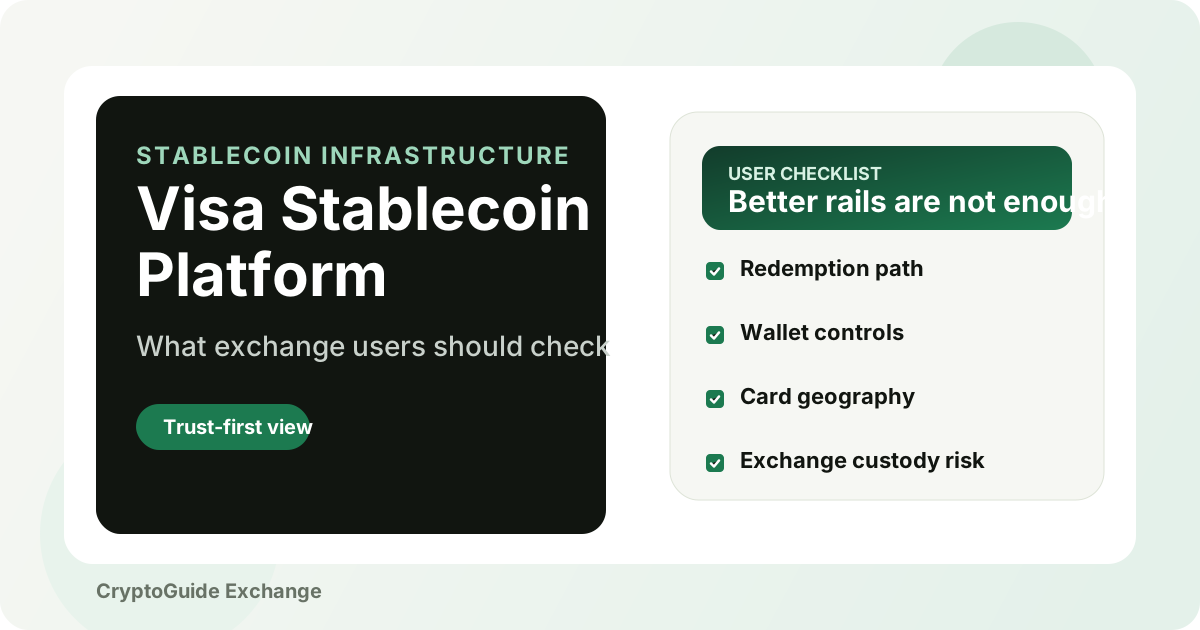
- Check which stablecoin actually sits underneath the feature, and whether it is widely redeemable or mainly useful inside a closed partner stack.
- Check whether your exchange explains who holds the wallet keys, who approves transfers and what happens if the service is paused.
- Check whether spending, cash-out or payout features are live in your country today rather than merely announced for future expansion.
- Check whether the exchange can explain the redemption path clearly: direct issuer redemption, partner redemption, or exchange-only conversion.
- Check whether fees, card FX, off-ramp timing and limits are disclosed before you move funds.
- Check whether the platform distinguishes payment-rail convenience from custody protection and insolvency risk.
- Check whether support documentation explains failure handling for rejected transfers, compliance holds and blockchain-specific delays.
Comparison: useful infrastructure progress vs hype-heavy user messaging
| Question | Stronger signal | Weaker signal |
|---|---|---|
| Is the product live? | The provider names countries, counterparties, asset support and current beta or production status. | The provider says only that stablecoin payments are "coming soon everywhere." |
| Can users exit cleanly? | The provider explains redemption, cash-out, limits and fallback routes in plain language. | The provider focuses on onchain speed but says little about off-ramp friction. |
| Who controls the wallets? | The provider documents wallet governance, approvals, allow lists and audit controls. | The provider treats big-brand involvement as a substitute for operational detail. |
| Does card access help users? | The provider shows country coverage, supported merchants, fees and settlement model. | The provider implies a card partnership means universal consumer availability. |
| Is the stablecoin itself clear? | The provider explains which token is used, who issues it and how redemption works. | The provider markets "stablecoin access" without describing the underlying asset path. |
Practical explanation: what this means for cash-out rails
Stablecoin infrastructure gets interesting when it shortens the distance between a user's exchange balance and an actual usable payment or withdrawal outcome. Visa's 2026 announcements suggest that major payment networks now see stablecoins as part of settlement, card issuance and treasury design rather than an isolated crypto side project. Circle's July 1 launch in France points in the same direction by combining payouts, compliance tooling and euro-area access for USDC and EURC.
That does not guarantee better user outcomes. Many exchange pain points happen at the last mile: a card is not available locally, a withdrawal is manually reviewed, a stablecoin can circulate but not redeem easily for the user, or the exchange itself has weaker custody and support than the payment rail beneath it. This is why payment infrastructure progress should be read as a positive signal for market maturity, not as automatic proof of end-user trustworthiness.
Risk notes
Infrastructure progress can create a halo effect
When a large payments brand appears in the stack, users may over-trust the exchange layer sitting on top. The safer reading is narrower: a major brand can improve settlement options without guaranteeing that your exchange handles support, custody, withdrawals or disclosures well.
Redemption paths still matter more than slogans
A stablecoin is most useful when users understand who can redeem it, where they can exit, and under what conditions. If that path stays vague, the stablecoin may be operationally helpful for the platform while remaining awkward for the user.
Country coverage is never implied
Visa and Bridge described expansion plans to more than 100 countries, but rollout language is not the same as live eligibility for every user. Region, issuer setup, partner status and compliance rules still decide what actually works.
CryptoGuide take
Visa's stablecoin push is a real market-structure milestone because it moves stablecoins deeper into ordinary payment plumbing instead of treating them as a trading-only niche. The trust-first lesson is that infrastructure maturity and user safety are related but not identical. Exchange users should welcome better rails while becoming more demanding about redemption rights, wallet governance, off-ramp clarity and country-level availability. If a platform celebrates the Visa headline but cannot explain the user exit path, the research is not finished.
FAQ
What is Visa's Stablecoin Platform?
Visa announced the Visa Stablecoin Platform on July 16, 2026 as a Visa-managed environment for financial institutions, fintechs and other payment providers to mint, redeem, hold and transfer stablecoins, starting with Open USD.
Does Visa's stablecoin platform make exchange balances safer?
No. It may improve payment and settlement plumbing for some partners, but it does not remove exchange custody risk, service outages, redemption bottlenecks or product-level legal differences.
What should users verify before trusting stablecoin payment features on an exchange?
Check which stablecoin is used, who can redeem it, what wallet controls exist, whether card spending and fiat cash-out are live in your country, and whether the exchange clearly explains custody and failure handling.
Conclusion
As of Monday, August 10, 2026, the Visa Stablecoin Platform is one of the clearest signs that stablecoin infrastructure is being folded into mainstream payment operations. For exchange users, that is useful context, not a shortcut. Better rails can improve the crypto experience over time, but trust still depends on the exact exchange, the exact product, and the exact exit path available to you when you need it.
Related pages
- MoneyGram, Kraken and MGUSD: what changed for crypto cash-out rails
- Circle National Trust and USDC: what exchange users should check
- Stablecoin plumbing risk after the GENIUS Act
- Crypto banking risks guide
- Crypto Trust Checker
Sources
- Visa: Visa Introduces Platform for Stablecoin Minting, Movement and Management
- Visa: Visa Accelerates Stablecoin Momentum by Adding Five Blockchains for Settlement
- Visa: Visa and Bridge Expand Collaboration, with Plans to Bring Stablecoin-Linked Cards to Over 100 Countries
- Circle: Stablecoin Payouts Now Available Through Circle Mint France
- Visa: Stablecoin-linked cards and money movement
- Visa: Stablecoins as a Money Movement Rail: What's Real and What's Next