
TLDR
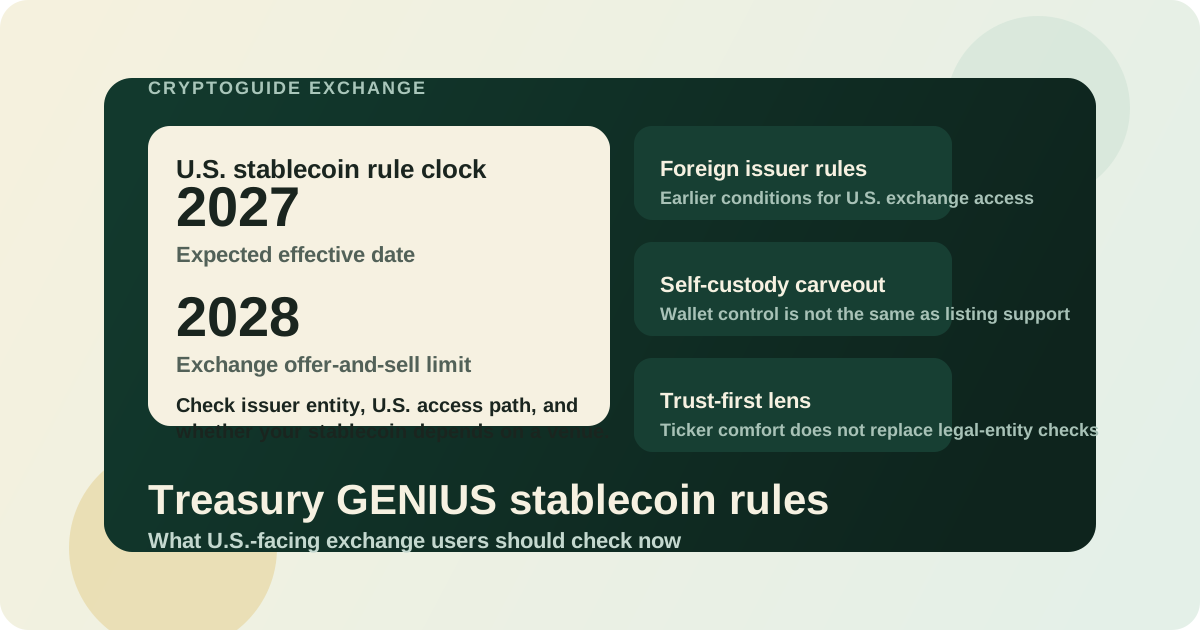
On August 17, 2026, the U.S. Treasury proposed rules to implement section 3 of the GENIUS Act. The proposal says the Act's expected effective date is January 18, 2027. From that date, foreign-issued payment stablecoins face a U.S. market-access condition: Treasury says digital asset service providers generally may not offer or make them available in the United States unless the foreign issuer can comply with lawful orders and any reciprocal arrangement under section 18. The next big date is July 18, 2028, when Treasury says digital asset service providers generally may not offer or sell any payment stablecoin in the United States unless it is issued by a permitted payment stablecoin issuer. For exchange users, this is a listing, access and counterparty-structure story, not just a policy story.
Key takeaways
- Treasury published the GENIUS Act section 3 proposal on August 17, 2026 and opened a 60-day public comment window after Federal Register publication.
- The proposal says January 18, 2027 is the expected effective date of the GENIUS Act.
- Treasury describes digital asset service providers broadly enough to include exchanges, custodians and other intermediaries operating in the United States.
- Foreign-issued payment stablecoins face an earlier access condition than the 2028 deadline if they are made available in the United States through a digital asset service provider.
- Beginning July 18, 2028, Treasury says U.S.-facing digital asset service providers generally may not offer or sell payment stablecoins unless those tokens are issued by a permitted payment stablecoin issuer.
- The proposal also preserves statutory carveouts for direct peer-to-peer transfers and for software or hardware wallets used for an individual's own custody.
- CryptoGuide Exchange is an independent research and comparison platform, not an exchange, broker, custodian, investment adviser or legal adviser.
What changed
The practical shift is that Treasury stopped speaking in generalities and started mapping the stablecoin perimeter in exchange language. The GENIUS Act proposal says section 3 governs who may issue, offer, sell or otherwise make available payment stablecoins in the United States. It also says the law is intended to have extraterritorial effect when the conduct involves offering or selling a payment stablecoin to a person located in the United States.
That matters because many exchange users still think stablecoin access is mostly a question of ticker availability or chain support. Treasury's framing is different. The relevant unit is the service provider, the legal issuer and whether the U.S. customer is inside the rule's perimeter.
Who is affected
Retail users are affected indirectly through what exchanges choose to list, restrict, geo-block or migrate before January 18, 2027 and before July 18, 2028. Institutional users are affected more directly because stablecoin programs, custody arrangements, treasury workflows and settlement products often run through named exchange or broker agreements rather than an informal wallet balance.
Treasury's proposal is explicit that a digital asset service provider can include a person such as a digital asset exchange, a custodian, a transfer provider or a participant in financial services related to digital asset issuance. That is why this is not just an issuer-compliance story. It touches exchange operations and product design.
Decision checklist
| Question | Why it matters now | What to verify |
|---|---|---|
| Is your stablecoin issuer U.S.-permitted or foreign? | Treasury sets different risk timing for foreign-issued payment stablecoins in U.S. markets. | Read the issuer legal entity, not just the ticker symbol or wallet label. |
| Are you accessing the token through an exchange or in self-custody? | The proposal keeps statutory carveouts for direct transfers and self-custody wallets while focusing restrictions on issuance and service-provider activity. | Separate wallet freedom from exchange-listing freedom. |
| Does your exchange serve U.S. persons? | The rule targets activity in the United States and activity involving persons located in the United States. | Check country terms, entity disclosures and whether the product is offered through a U.S.-facing affiliate. |
| Could a stablecoin pair disappear or migrate later? | The July 18, 2028 date can change listing economics and product menus. | Watch for advance notices on delistings, pair consolidation, redemption-path changes or issuer swaps. |
| Do you rely on exchange-native stablecoin programs? | Institutional rebate, conversion or treasury programs are contract-driven and may re-paper faster than retail spot markets. | Review updated terms, eligible entities, program scope and termination rights. |
Risks users can misread
A listed stablecoin is not the same as a stablecoin you can always keep using
Users often over-trust continuity. A token can trade normally today and still face a changed issuer, a changed venue policy or a jurisdiction-specific restriction later. The main risk is not a dramatic overnight ban. It is operational drift: pair changes, support changes, conversion changes and platform-specific access rules.
Foreign-issued does not automatically mean unavailable, but it does mean more conditions
Treasury's proposal says foreign-issued payment stablecoins may not be offered, sold or otherwise made available in the United States through a digital asset service provider unless the foreign issuer can comply with lawful orders and any reciprocal arrangement required by the Act. That is a narrower and more technical issue than a social-media claim that "all foreign stablecoins are banned." Users should avoid both extremes.
Self-custody and exchange access are different risk layers
The proposal's statutory exemptions matter because they keep a line between personal wallet activity and intermediary activity. That does not make every stablecoin safe in self-custody, and it does not mean exchange access will stay unchanged. It means users should stop treating wallet transfers, exchange listings and issuer compliance as one blended question.
Comparison
| Topic | Expected from January 18, 2027 | Expected from July 18, 2028 |
|---|---|---|
| U.S. issuance | Treasury says a person generally may not issue a payment stablecoin in the United States unless it has the appropriate federal or state licence. | Still restricted to permitted issuers. |
| Foreign-issued stablecoins on U.S.-facing exchanges | Already constrained if the foreign issuer cannot comply with lawful orders and reciprocal-arrangement requirements under section 18. | Still constrained, with the broader 2028 service-provider restriction layered on top. |
| Any payment stablecoin offered by a digital asset service provider to a person in the United States | Transition period before the general 2028 offer-and-sell restriction fully hits. | Treasury says the provider generally may not offer or sell the token unless it is issued by a permitted payment stablecoin issuer. |
| Direct self-custody transfers | Statutory carveouts remain for direct transfers and own-custody wallet activity. | Those carveouts are still separate from exchange restrictions. |
CryptoGuide take
The market will try to reduce this story to a scoreboard for favored stablecoins. That is too shallow. The useful reading is that Treasury is forcing a cleaner separation among issuer quality, exchange access and self-custody rights. Users should welcome the clarity and stay skeptical of simplified messaging from platforms that keep the stablecoin ticker visible while changing the actual legal or operational path underneath. A trust-first user should now pay more attention to the serving entity, the issuer entity and the date attached to the product than to the brand comfort of "still listed."
Practical steps now
- If you use stablecoins on a U.S.-facing exchange, note the two concrete dates: January 18, 2027 and July 18, 2028.
- Check whether your main dollar token is issued by a U.S. permitted issuer, a foreign issuer or a structure you cannot easily identify.
- Review exchange notices for stablecoin pair changes, conversion policy updates or revised issuer disclosures, especially on USD pairs.
- If you rely on a stablecoin for off-ramping, keep a backup route in case your preferred pair or venue changes policy before the 2028 deadline.
- If you use self-custody, do not confuse wallet control with guaranteed exchange support when you later want to deposit or redeem.
FAQ
What changed on August 17, 2026 under Treasury's GENIUS Act proposal?
Treasury proposed rules implementing section 3 of the GENIUS Act. The proposal explains when payment stablecoins may be issued, offered or sold in the United States and clarifies future restrictions for digital asset service providers such as exchanges.
When do the main GENIUS Act stablecoin dates hit exchanges?
Treasury says the GENIUS Act's expected effective date is January 18, 2027. The proposal also says that beginning July 18, 2028, digital asset service providers generally may not offer or sell payment stablecoins in the United States unless those stablecoins are issued by a permitted payment stablecoin issuer.
Does the Treasury proposal ban self-custody wallet transfers?
No. The proposal describes statutory exemptions for direct transfers between individuals acting on their own behalf and for transactions using software or hardware wallets that facilitate an individual's own custody of digital assets. The tighter restrictions apply to issuance and to exchange or service-provider activity in the United States.
Conclusion
Treasury's August 17 proposal is one of those regulatory updates that looks technical until an exchange changes a listing, an issuer changes a distribution plan or a user discovers that wallet control and platform access are not the same thing. The stablecoin market is getting clearer, not simpler. Users should treat this as a timing and structure signal, then check whether their exchange setup depends on assumptions that stop being safe after January 18, 2027 or July 18, 2028.
Related pages
- Stablecoin plumbing risk after the GENIUS Act
- Tether full audit: what crypto exchange users should check
- Circle National Trust and USDC: what exchange users should check
- Crypto regulation in Europe
- Crypto off-ramp guide
Sources
- U.S. Treasury: Treasury Seeks Public Comment on GENIUS Act Proposed Rulemaking
- U.S. Treasury: GENIUS Act Regulations on Payment Stablecoin Issuance, Offer, and Sale (NPRM PDF)
- U.S. Treasury: Proposed rule on GENIUS Act illicit-finance requirements
- Coinbase: Institutional Stablecoin Programs Terms of Use