
TLDR
On May 27, 2026, The Wall Street Journal reported that SoFi had opened its dollar stablecoin, SoFiUSD, to nearly 15 million app users, with the token available on Ethereum and Solana and a reported market capitalization of about $100 million. Barron's added that retail users could buy, sell, hold and convert SoFiUSD inside the app, while a separate April 3, 2026 Barron's report tied Bullish, BitGo, Galaxy Digital and Mastercard to the institutional launch around SoFi's business banking push. The trust-first read is that this is a real infrastructure move, but not yet proof that SoFiUSD functions like ordinary exchange cash for every user. Exchange users still need to verify where redemption happens, whether tokenized deposits are actually live, and what Bullish or app access means for their exact region and account type.
Key takeaways
- SoFi moved SoFiUSD from enterprise-only positioning to direct retail app access on May 27, 2026.
- The same reporting framed Bullish as the exchange venue for institutional SoFiUSD trading, not as proof of universal retail liquidity.
- SoFi also said users would later be able to convert SoFiUSD into interest-bearing tokenized deposits covered by FDIC insurance, which is a different product layer from a standard stablecoin balance.
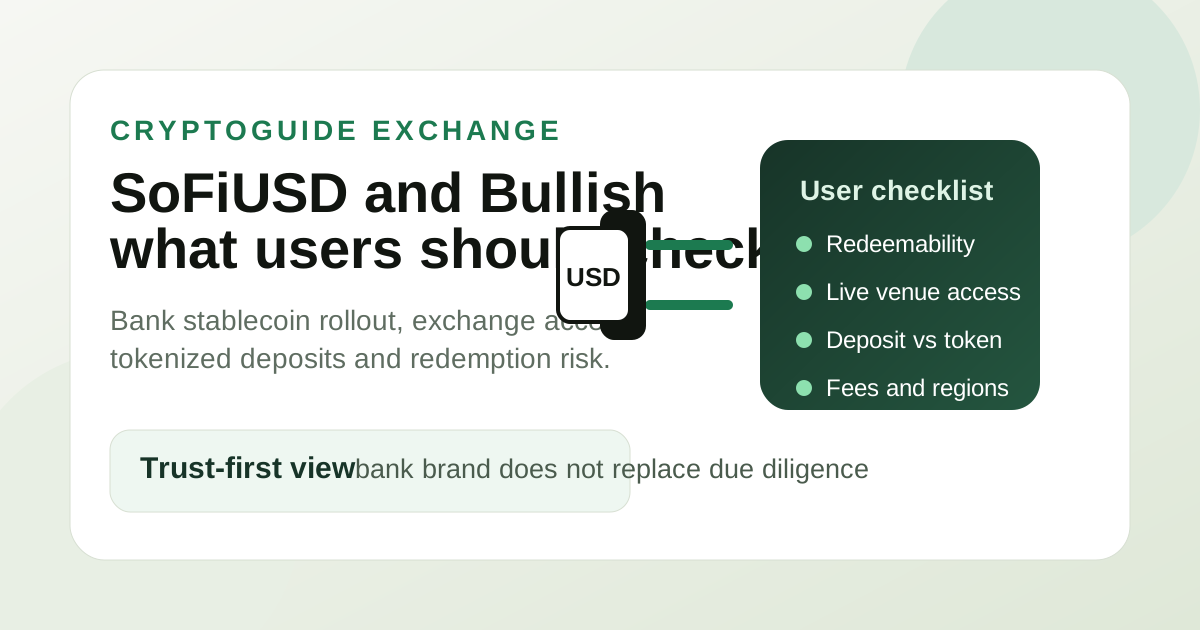
- For exchange users, the main checks are redemption path, network support, live venue access, fees and whether the product behaves like a token, a bank deposit or a mix of both.
- CryptoGuide is an independent research platform, not an exchange, broker, custodian, investment adviser or legal adviser.
Market context: why this product matters
Crypto users already know dollar stablecoins. What changed here is the issuer profile. SoFi is a nationally chartered U.S. bank, and the May 27 rollout turned SoFiUSD into a direct consumer app feature rather than a business-only or pilot-stage instrument. That matters because it pulls a bank-issued token into the same decision zone as exchange balances, payment rails and self-custody transfers.
It also matters because the narrative is easy to overread. “Bank-issued” can sound like risk has been solved. It has not. Users still need to understand which promise belongs to the stablecoin itself, which belongs to a future tokenized deposit product, and which belongs to an exchange venue such as Bullish.
What changed between April 3 and May 27, 2026
On April 3, 2026, Barron's reported that SoFi's new Big Business Banking service would support fiat and stablecoin settlement around the clock and that initial SoFiUSD partners included Bullish, BitGo, Galaxy Digital and Mastercard. That signaled an institutional distribution strategy, not just a consumer wallet feature.
Then on May 27, 2026, the story moved closer to ordinary users. The Wall Street Journal said SoFi had made SoFiUSD available to nearly 15 million users in its app, and Barron's said users could buy, sell, hold and convert the token directly. Those same May 27 reports also described planned next steps: tokenized deposits, 24/7 international transfers and Bullish exchange support for institutional trading.
That sequence matters. April 3 was about infrastructure and partners. May 27 was about consumer distribution. As of June 27, 2026, those sources support the claim that SoFiUSD moved meaningfully closer to exchange-style use. They do not, on their own, prove that every advertised path is already fully live for every user.
Why exchange users should care
This is not only a banking story. It is an exchange usability story. If a bank stablecoin can move between a consumer app, an institutional trading venue and a tokenized deposit rail, it starts competing with conventional exchange dollar balances and with established stablecoins such as USDC.
The practical upside is obvious: a tighter on-ramp and off-ramp loop between bank money and crypto rails. The practical risk is also obvious: users may blur distinct products together. A stablecoin balance, a tokenized deposit and an exchange wallet entry can all look like “digital dollars” while offering different legal claims, redemption routes and protections.
Comparison table: what users may actually be holding
| Product layer | What it sounds like | What to verify |
|---|---|---|
| SoFiUSD stablecoin | A dollar token on Ethereum or Solana. | Direct redemption rules, network support, transfer fees and where it can be used outside SoFi. |
| Exchange venue access via Bullish | Tradable liquidity for institutions. | Who can access the venue, what pairs exist, and whether retail users see the same liquidity or none at all. |
| Tokenized bank deposit | Digital dollars with deposit-style protections. | Whether the feature is live, who qualifies, how conversion works and where FDIC coverage begins and ends. |
| App balance inside one platform | Simple cash equivalent. | Whether you can withdraw onchain, redeem directly or only move value within the app's own rules. |
Decision checklist before treating SoFiUSD like exchange cash
- Confirm whether your account can actually withdraw or receive SoFiUSD on the chain you plan to use.
- Separate the live feature from the announced roadmap. Retail app access is not the same thing as a live tokenized deposit or universal exchange liquidity.
- Check whether Bullish access matters to you at all. The reporting described institutional trading support, not a blanket retail promise.
- Verify conversion rights between SoFiUSD, U.S. dollars and any tokenized deposit product before assuming a 1:1 operational workflow.
- Review fees and spreads across app conversion, onchain transfer and external exchange usage.
- Check whether your jurisdiction and account type are eligible for the feature set you want, especially if you expect cross-border or 24/7 payment utility.
- Test small transfers first instead of assuming a bank-issued token will behave exactly like a major exchange-listed stablecoin.
Risk notes
Brand familiarity is not the same as product clarity
Users may trust a bank brand faster than a crypto-native issuer. That can be reasonable, but it should not replace reading the actual operational terms. The key question is not who issued the token in marketing language. It is what claim the user actually holds at each step.
Roadmaps can outrun user access
The May 27 reporting described tokenized deposits and institutional exchange distribution as planned or expanding features. That is useful context, but not a substitute for checking whether the exact path you want is live now.
Liquidity can be segmented
A stablecoin may be liquid in one app or on one institutional venue and still be awkward in broader crypto workflows. Users should treat venue support, wallet support and redemption support as separate checks.
CryptoGuide take
Our view: SoFiUSD is more interesting as a distribution test than as a stablecoin novelty. The real signal is that a federally regulated bank wants one product family to span retail app users, institutional trading and tokenized deposit rails. That could reduce friction between banking and exchange workflows. But the trust hurdle is still practical. Until users can clearly see where SoFiUSD behaves like a transferable token, where it behaves like an app balance, and where it converts into a deposit-style claim, the safer stance is curiosity with verification, not automatic confidence.
FAQ
What changed for SoFiUSD on May 27, 2026?
According to The Wall Street Journal and Barron's, SoFi opened SoFiUSD to retail users in its app, letting members buy, sell, hold and convert the stablecoin directly instead of keeping it limited to enterprise use.
Did the May 27 announcements prove SoFiUSD already works like normal exchange cash?
No. The sources describe a retail rollout and planned next steps such as tokenized deposits and Bullish exchange access, but users still need to verify redemption mechanics, supported jurisdictions, liquidity and operational limits.
What should exchange users compare first?
Check whether you are holding a redeemable stablecoin, an exchange balance or a tokenized bank deposit; then verify network support, direct conversion rights, venue access, fees and whether the product is actually live for your user type.
Conclusion
SoFi's April 3 and May 27, 2026 announcements are worth reading together. First came the partner and infrastructure map. Then came the retail app rollout. That makes SoFiUSD a serious product signal for exchange users, especially those watching the line between bank money and crypto rails. It still does not justify skipping the usual checks on redemption, venue access and product scope. A bank-issued token can be promising infrastructure and still require ordinary crypto due diligence.
Related pages
- Bank-issued stablecoins are reaching exchanges
- MoneyGram, Kraken and MGUSD: what changed for crypto cash-out rails
- Stablecoin plumbing risk after the GENIUS Act
- Crypto off-ramp guide
- Compare exchanges