
TLDR
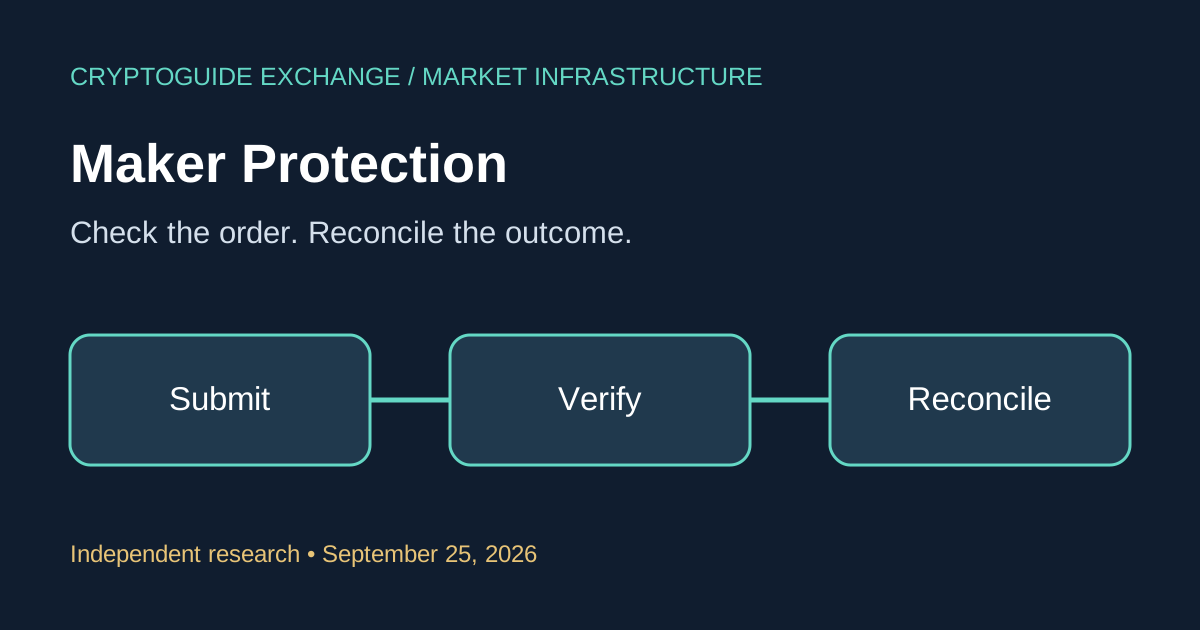
Kraken's September 24 derivatives maintenance introduced Maker Protection. The status page reported completion at 09:34 UTC after a staged rollout. For users, the important issue is how an order behaves between submission and execution—not whether a feature has a reassuring name. Kraken status: September 24 maintenance
Key takeaways
- Identify the exact contract and order instruction before interpreting execution speed.
- A cancellation response deserves a check against actual fills.
- Keep execution records when an order's outcome is unclear.
- Compare platforms using documented behavior rather than protection labels alone.
Market context: a new execution rule
Kraken's guide describes a 20 ms launch delay on selected derivatives markets, with spot unaffected. Non-post-only orders wait; post-only placements and cancellations do not. The live makerProtectionMillis instrument field identifies affected markets. A limit order without post-only waits even if it would have rested. Queue position is assigned at release. Kraken says this gives resting makers time to react to information.
The cancellation distinction is material: a held limit placement becomes immediate-or-cancel, so it can still fill at release. A trigger's resulting order can also be delayed. Kraken says the window is a minimum, not an exact execution-time promise. These are documented mechanics, not evidence of better prices for every customer. Kraken developer guide: Maker Protection
Decision checklist before placing another order
- Confirm the market. Record the full contract symbol. Similar asset names can refer to different products; a screenshot that omits the contract is weak evidence during troubleshooting.
- Read the instruction. Check whether the order requests immediate execution, permits resting or explicitly requires post-only behavior. Choose instructions for their intended execution behavior, not simply to avoid a delay.
- Review automation. Ask the provider of any trading software how it handles an order that has no final response yet. Automatic retries should not depend on the assumption that silence means failure.
- Plan reconciliation. Know where the interface shows fills, outstanding orders and current exposure. A support conversation is easier when these records are saved together.
- Check readiness. If you cannot explain what your next order does, pause submission and consult the official documentation or support route.
Compare what each check tells you
| Check | Evidence to retain | Decision it supports |
|---|---|---|
| Product identity | Contract symbol and account product | Which documentation applies |
| Order instruction | Order type, flags, size and price | Whether the request reflects your intent |
| Cancellation | Cancel response plus original order outcome | Whether replacement would duplicate exposure |
| Execution | Fill records and resulting position | Whether the account matches your records |
| Platform comparison | Execution rules and support procedures | Whether a service is understandable enough to use |
Risk notes: the label has a narrow meaning
Execution uncertainty. Consider a user who clicks cancel and immediately sends a replacement because the interface appears quiet. If the first request subsequently executes, the replacement may create unintended exposure. This is an illustrative risk scenario, not a report of a customer loss. Resolve the first order's outcome before assuming that a second request is harmless.
Price and leverage risk. A market-structure feature does not remove the underlying risks of derivatives. A clearer understanding of order handling is useful, but it does not establish that a product is suitable or that a position cannot lose money.
Evidence limits. A rollout notice establishes an operational change. Assessing its effects on spreads, fill quality or different user groups would require execution data and a defined comparison period. We have not performed that study, so this article makes no claim that the change improves or worsens customer outcomes overall.
If an order outcome looks wrong
Stop sending speculative replacement requests. Save timestamps, the contract symbol, client or exchange order identifiers, responses and fill history. Compare the current position with those records, then contact support through the authenticated platform if the discrepancy remains. Do not share API secrets, passwords or recovery phrases in a support ticket or public forum.
CryptoGuide take
The strongest reason to read this release is the gap between an everyday word—cancel—and a specific execution rule. Exchanges earn user trust when those distinctions are easy to find before an order is sent. Users comparing venues should ask whether their interface and software make final outcomes clear. A new protection label is a starting point for that review, not a substitute for it.
FAQ
Does Maker Protection cover Kraken spot trading?
No. Kraken describes it as a feature of selected derivatives markets; spot is unaffected.
Does cancelling a held limit order guarantee no fill?
No. Kraken says a held limit placement is converted to immediate-or-cancel and can still execute at release.
What should I check after an uncertain cancellation?
Reconcile the original order response, fills and current position before submitting a replacement.
Does this feature protect my account from theft?
The documented feature concerns order execution. It should not be treated as account-loss protection.
Conclusion
Before using an affected derivatives market, understand the order instruction, confirm how your software handles uncertain responses and keep a route to reconcile fills. Focus on the resulting account state when deciding whether an order is finished.
Related pages
- Kraken trust checker
- Regulated crypto perpetual futures explained
- Crypto security research
- CryptoGuide research methodology
Sources
Primary sources reviewed September 25, 2026. Market configurations and documentation may change.
CryptoGuide Exchange is an independent research and comparison platform, not an exchange, broker, custodian, investment adviser or legal adviser. This is educational research, not investment or legal advice.