
TLDR
Kraken marked its second Maker Protection rollout complete on October 8, 2026, at 07:01 UTC. For users of affected derivatives markets, the important check is whether the final execution record agrees with what their trading interface appears to say. Rollout record
Key takeaways
- Verify the exact contract before applying assumptions from another market.
- Keep cancellation responses and execution records together.
- Test automation changes before relying on them with live exposure.
Market context: a small delay with operational consequences
Kraken documents a launch delay of 20 milliseconds for non-post-only orders on selected derivatives markets. Post-only submissions and cancellations are exempt. A limit order without post-only still qualifies for the delay even if it would rest. Maker Protection mechanics
The October 7 notice announced 61 additional perpetuals and said the total would be 100. The developer guide separately lists 59 Phase 1 markets and 61 Phase 2 markets. Those totals do not reconcile. We therefore do not present a verified coverage count. Kraken identifies makerProtectionMillis in the instruments feed as the live source of market coverage. Dated notice · Developer guide
Why a cancellation needs a second check
According to Kraken, cancelling a held limit placement converts it to immediate-or-cancel at release: it may fill, while any unfilled remainder cannot rest. The cancellation response and the order outcome are separate messages. Cancellation behaviour
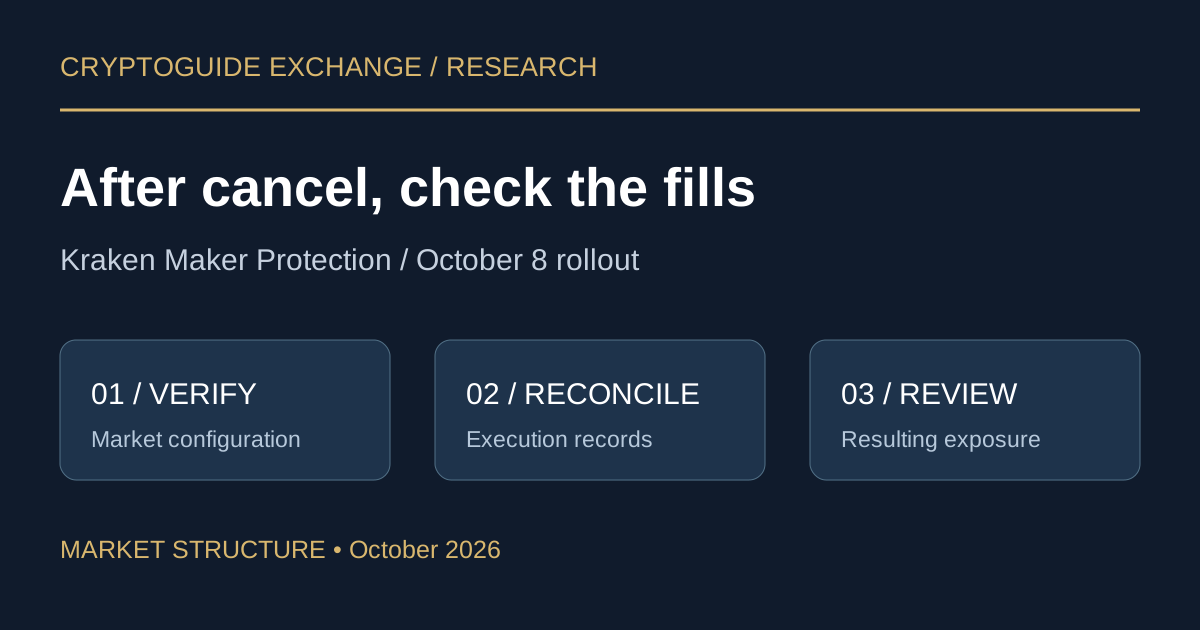
For an operator, this creates a reconciliation problem. A dashboard can show a successful action without answering the question that matters to the account owner: what position exists now? Our recommendation is to treat the cancellation as one record in a sequence and retain the sequence until the final exposure is understood.
Consider a hypothetical interface that turns an order row grey as soon as a cancel response arrives. If the same interface offers an immediate replacement button, a user may act before reviewing subsequent execution records. The interface review should ask whether those later records remain visible and whether the replacement workflow warns about unresolved activity. This is a design example, not a reported Kraken interface defect.
Decision checklist before updating an integration
These are CryptoGuide's operational review questions, not additional exchange requirements or a trading strategy.
- Name the affected workflow. Record the contract, account, protocol and software version. A general note saying “Kraken orders” is too broad for a reproducible review.
- Preserve a complete audit trail. Keep request identifiers, timestamps, responses and fills in one searchable record. Exclude API secrets from logs.
- Test a cancellation sequence. Ask the integration owner to demonstrate how the application reconciles a cancel response with a later execution result in a test environment.
- Review retries. A missing response should trigger investigation of the original request before another submission. Document who can authorize a manual retry when the automation cannot resolve the outcome.
- Define the stop condition. If positions cannot be reconciled, pause new automated submissions and use official support to investigate. Preserve existing records rather than repeatedly changing settings.
Compare the evidence your workflow retains
| Review point | Evidence to request | Reason to investigate |
|---|---|---|
| Market configuration | A timestamped contract configuration record | The application assumes every contract behaves identically. |
| Cancellation handling | The original order and later execution records | The interface hides the order immediately. |
| Retry control | A documented response to an unresolved request | A timeout automatically creates a replacement. |
| Position reconciliation | An account-level result checked against fills | The application infers exposure from button feedback. |
Risk notes: do not turn timing into a safety promise
Kraken also documents that trigger-fired orders can wait longer than the configured interval on quiet markets. Its guide flags a limitation where sibling order-group cancellation does not see a held leg. Lifecycle and order-group limitations
These details deserve explicit review by anyone maintaining automated execution. A system should not label exposure resolved solely because a timer expired. Ask for demonstrated reconciliation, including unusual message ordering, before accepting an integration update.
Leverage, liquidation and custody remain separate risks. Neither a completed maintenance notice nor a successful software test establishes that derivatives are appropriate for a particular user. This article evaluates operational evidence; it does not recommend opening a position or changing an order to obtain different execution treatment.
CryptoGuide take
The useful measure of this change is whether users can reconstruct what happened to an order. A short delay is easy to describe; a reliable cancellation and retry workflow takes more care. Exchanges and integration providers earn trust by making final fills and remaining exposure clear, especially when an acknowledgement sounds more conclusive than it is.
FAQ
Is this a spot-market change?
Kraken describes Maker Protection as a selected derivatives-market feature; spot is unaffected.
What should I check after cancelling?
Reconcile the original request, cancellation response, fills and resulting position before sending a replacement.
Does Maker Protection make derivatives safe?
No. An execution mechanism does not remove leverage, liquidation, custody or operational risks.
Conclusion
Review the contract configuration, test the cancellation sequence and reconcile fills before treating an order as finished. If your software cannot explain the resulting position, resolve that visibility gap before expanding its use.
Related pages
- Kraken exchange research
- Checks before retrying a rejected order
- Exchange security checks
- CryptoGuide Trust Checker
Sources
Primary sources reviewed October 11, 2026. The checklist, interface example and editorial assessment are CryptoGuide analysis. Market coverage should be checked against live configuration; the published totals above conflict.
- Kraken status: Derivatives Maker Protection — Phase 2, October 7–8, 2026
- Kraken Developers: Maker Protection, including lifecycle, cancellation and order-group limitations
CryptoGuide Exchange is an independent research and comparison platform, not an exchange, broker, custodian, investment adviser or legal adviser. This is educational research, not investment or legal advice.