
TLDR summary
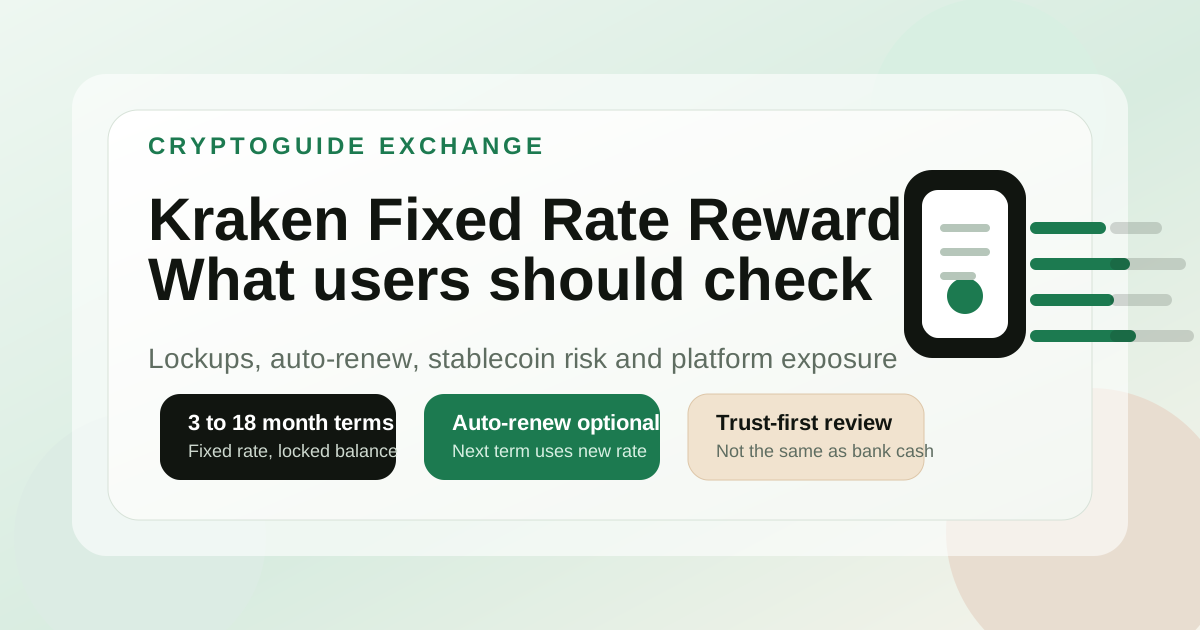
On July 28, 2026, Kraken launched Fixed Rate Rewards for eligible U.S. accredited investors. The product lets users lock USD, EUR, USDT, USDC and USDG balances for 3, 6, 12 or 18 months at a fixed rate, with weekly compounding and optional auto-renew. That makes it more structured than ordinary exchange rewards, but it also adds a real liquidity decision. Users should read it as a platform and product-risk choice, not as a simple high-yield cash feature.
Key takeaways
- Kraken's launch is limited to eligible U.S. accredited investors, which narrows the audience and signals that this is not a mass-market cash product.
- The main product change is certainty of term and rate: users choose a 3, 6, 12 or 18 month lockup instead of leaving balances in a flexible rewards bucket.
- Kraken's support documentation says fixed-rate allocations stay locked until maturity, with auto-renew rolling into the prevailing rate for the same term if enabled.
- Exchange rewards should not be confused with insured bank deposits or ordinary savings accounts.
- CryptoGuide is an independent research and comparison platform, not an exchange, broker, custodian, investment adviser or legal adviser.
Market context: why this launch matters now
Exchange competition in 2026 is shifting from pure trading features toward balance-sheet products: stablecoin rewards, fixed-rate borrowing, tokenized cash substitutes and app-level “everything finance” bundles. Kraken's new product fits that pattern. It is trying to make parked exchange balances feel more intentional and predictable, especially for users who already keep cash or stablecoins on-platform between trades.
The trust question is whether fixed yield makes the product clearer or simply makes custody risk easier to ignore. A locked term can reduce rate uncertainty, but it does not remove platform exposure, stablecoin issuer risk or the user's need for exit flexibility.
What Kraken launched on July 28, 2026
Kraken said Fixed Rate Rewards gives eligible U.S. accredited investors fixed APYs of up to 7% on cash and stablecoin balances. According to Kraken's launch post, users can choose 3, 6, 12 or 18 month terms, with weekly compounding and optional auto-renew. The company said the feature is available on USD, EUR, USDT, USDC and USDG balances across Kraken Consumer and Pro on web and mobile.
Kraken's support documentation adds the operational detail that matters more than the headline rate: fixed-rate allocations stay locked until maturity. If auto-renew is turned on, the allocation rolls into a new term of the same length at the prevailing rate at that time. That means the user is making two choices, not one: the first lockup decision and the default behavior at maturity.
Who is affected first
The product is targeted at a narrower user group than a normal exchange feature because Kraken says it is for eligible U.S. accredited investors. The SEC's investor education materials explain that accredited-investor status is tied to income, net worth or certain professional credentials, and that these investors are generally permitted to participate in offerings without the same disclosure framework as registered products. That status does not make a product low-risk. It mainly changes who can access it.
In practice, the launch matters most for users who already treat an exchange account as a treasury layer between trades, transfers or withdrawals. It matters less for users who need daily liquidity or who do not want exchange custody exposure to sit on top of a stablecoin position.
Comparison table: three ways the same balance can behave
| Balance setup | What users get | What users should verify |
|---|---|---|
| Kraken Fixed Rate Rewards | Term-based rate certainty, weekly compounding and optional auto-renew. | Lockup length, maturity access, next-term auto-renew behavior and continued platform exposure. |
| Flexible stablecoin rewards on exchange | More liquidity and easier repositioning. | Whether rates can change at Kraken's discretion, payout timing and whether the balance can be withdrawn at any time. |
| Bank cash savings product | Conventional cash framework and easier comparison to benchmark deposit products. | Deposit protection, withdrawal conditions, jurisdiction and whether the product is actually a bank account rather than a fintech wrapper. |
Decision checklist before locking a balance
- Confirm eligibility first. If the feature is limited to eligible U.S. accredited investors, do not assume the same workflow or protections apply elsewhere.
- Check whether the balance is fiat or a stablecoin. USD and USDC may both look like dollars in the interface, but they do not carry the same issuer and redemption structure.
- Decide whether you are comfortable losing liquidity for the full term. Kraken's support page says fixed-rate allocations stay locked until maturity.
- Check the exact term you are choosing. A higher headline rate can hide a much longer lockup than you actually need.
- Review auto-renew before you enable it. Renewal happens at the prevailing rate later, not the original rate you liked on day one.
- Check tax and reporting implications in your jurisdiction before treating weekly compounding as “set and forget.”
- Keep a separate emergency liquidity path outside the locked allocation in case you need to withdraw or reposition funds before maturity.
Risk notes
Accredited-investor access is not a trust badge
Users often misread gated access as a signal that a product is safer or institutionally cleaner. It is better understood as a legal and distribution boundary. The SEC's investor bulletin says accredited-investor access exists partly because some offerings do not come with the disclosure regime of registered offerings.
Fixed rate does not remove counterparty or custody risk
The rate may be fixed for the term, but the user is still exposed to the platform they leave the assets with and, in the case of stablecoins, to the asset's own issuer and market structure. ESMA's MiCA rulebook is explicit that crypto-assets are not covered by deposit guarantee schemes and, where relevant, not covered by investor compensation schemes either.
Auto-renew can turn a temporary parking decision into a default strategy
If users enable auto-renew at signup and forget it, a tactical hold can become a repeated long-term allocation. That is convenient operationally, but it can be a poor match if market conditions, personal cash needs or platform trust signals change during the term.
Stablecoin yield language can blur cash and crypto risk
Kraken's own support pages separate flexible rewards, fixed-rate rewards and other opt-in reward products. Users should do the same mentally. “Cash and stablecoins” in one headline does not mean every balance has the same legal treatment, liquidity profile or risk path.
CryptoGuide take
Kraken's launch is more credible than generic exchange-yield marketing because the company is at least being clear about the core tradeoff: fixed term in exchange for fixed rate. That is the right product frame. The problem is that many users will still read the interface as a safer savings layer than it really is. Our view is that this feature is useful only if you deliberately want exchange exposure for the full term and can afford to keep separate liquidity elsewhere.
Current rate examples worth checking
Kraken's July 14, 2026 support page for opt-in rewards listed example fixed-rate tiers for some stablecoins, including 4.75% to 6.00% for USDG and 4.50% to 5.55% for USDC and USDT depending on term length. Those figures matter because they show the real comparison users should make: not only “up to 7%,” but which asset, which term and which balance type actually gets which rate on the day you allocate.
FAQ
What did Kraken launch on July 28, 2026?
Kraken launched Fixed Rate Rewards for eligible U.S. accredited investors, offering fixed-term rewards on USD, EUR, USDT, USDC and USDG balances with 3, 6, 12 or 18 month lockups.
Is Kraken Fixed Rate Rewards the same as a bank savings account?
No. It is an exchange rewards product with lockup terms, platform exposure and crypto-specific risk. Users should not treat it as insured bank cash.
What should users check before enabling auto-renew?
Check the next term's rate, whether you may need liquidity at maturity, which asset is being rolled over, and whether you still want exchange exposure for another full term.
Conclusion
Kraken's July 28, 2026 launch is a clean example of where exchange products are heading: less pure trading, more packaged balance management. That can be useful, but it raises the cost of sloppy assumptions. Before locking cash or stablecoins for months, users should compare the term, the asset, the liquidity tradeoff and the platform risk as separate decisions. The headline APY is only the first number in the story.
Related pages
- Stablecoin plumbing risk after the GENIUS Act
- Circle National Trust and USDC
- Crypto off-ramp guide
- What makes an exchange trustworthy
- Kraken exchange profile