
TLDR
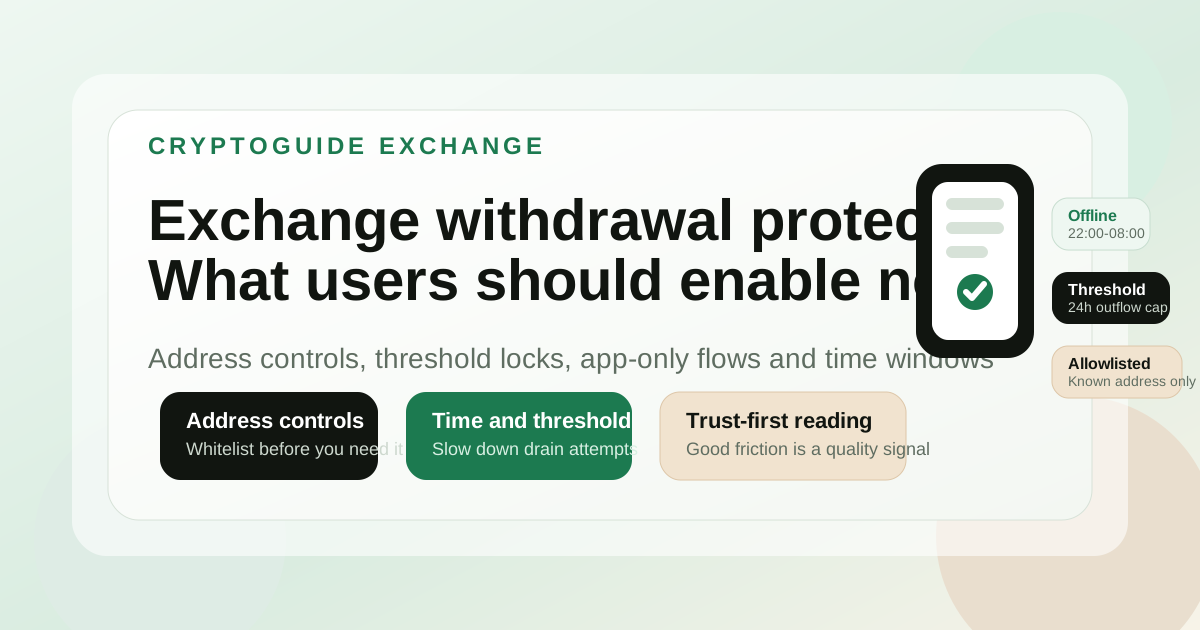
On July 13, 2026, OKX launched Large Withdrawal Protection, letting eligible users set a 24-hour cumulative withdrawal threshold that triggers facial verification once reached. On July 14, 2026, it launched Offline Mode, which can block withdrawals outright during a user-defined protection window of up to 12 hours. Those launches matter because they show where exchange security is getting more practical: not only login protection, but destination control, time-based friction and behavior-based withdrawal limits. Coinbase Exchange, Kraken and Bybit already document parts of that same model through address allowlisting, 24 to 48 hour holds, address-book-only withdrawals, new-address locks and app-only restrictions. The trust-first takeaway is simple: good withdrawal friction is now a real exchange quality signal.
Key takeaways
- OKX added two notable withdrawal controls in July 2026: Large Withdrawal Protection on July 13 and Offline Mode on July 14.
- Bybit now documents a broader scenario-based stack including address whitelists, daily whitelist limits, new-address locks, app-only withdrawals and location-based checks.
- Coinbase Exchange still relies heavily on address whitelisting, including an initial 8-hour setup window and a 48-hour hold for later-added addresses.
- Kraken applies a 24-hour hold to withdrawals to new addresses after password changes if certain stronger protections are not enabled.
- The best exchange security flow is usually layered: strong sign-in controls first, then withdrawal destination controls, then time or threshold friction.
- CryptoGuide Exchange is an independent research and comparison platform, not an exchange, broker, custodian, investment adviser or legal adviser.
Why this matters now
Exchange users have spent years hearing that security means a strong password, an authenticator app and maybe a withdrawal confirmation email. That model still matters, but it is incomplete. The real damage in many incidents happens after the attacker gets through the first gate, whether through a compromised email inbox, a hijacked browser session, a fake support flow or a social-engineering attack that tricks the user into approving access.
Once that happens, the next question is not whether the attacker can log in. It is whether they can change a withdrawal destination, empty the account quickly or route funds through a path the user never intended. That is where modern withdrawal protection becomes more valuable than a generic security badge.
What changed at OKX in July 2026
OKX's July rollouts are the clearest recent example of this shift. According to its official help materials, Large Withdrawal Protection lets KYC-verified main-account users define a personal 24-hour cumulative withdrawal threshold from 10,000 to 10,000,000 USD equivalent. Once the threshold is reached, a covered withdrawal requires immediate Eagle Eye facial verification. The same help page says the control covers on-chain withdrawals, P2P selling, Pay top-ups and API withdrawals, and notes that API withdrawals cannot be resumed through API if the threshold is triggered.
One day later, OKX published Offline Mode. That feature allows eligible users to set a daily protected window with hour-level precision, up to 12 hours, during which covered withdrawals are blocked outright regardless of amount. The page says the window applies across crypto withdrawals, C2C selling, API withdrawals and Pay top-ups. That is a different philosophy from ordinary 2FA. It assumes the safest outcome during certain hours is not more verification but no withdrawal at all.
Comparison table: what major exchange controls actually do
| Exchange | Documented control | Why it matters | Limitation to understand |
|---|---|---|---|
| OKX | Large Withdrawal Protection | Adds a user-set 24-hour cumulative threshold before higher-risk outflows continue. | It only helps if the user enables it before the incident. |
| OKX | Offline Mode | Blocks covered withdrawals during a user-defined time window, which is useful for sleep hours or routine offline periods. | It can reduce flexibility if the user genuinely needs emergency access during the protected window. |
| Bybit | Withdraw via Address Book and New Address Withdrawal Lock | Separates known destinations from newly added ones and slows down fast drain attempts. | It still depends on the quality of the address book the user has already set up. |
| Bybit | Only Allow Withdrawals via App and On the Move Protection | Adds channel restriction and location-aware friction for suspicious withdrawal context. | It does not solve a fully compromised phone or app environment. |
| Coinbase Exchange | Address whitelisting | Restricts withdrawals to approved addresses and uses time delays for new destinations. | The 8-hour setup window means users should configure it carefully, not during a panic. |
| Kraken | New-address hold after password changes | Limits fast damage after account changes when stronger security layers are missing. | It is narrower than a full scenario-based protection suite. |
Decision checklist for users
- Enable destination control first: address allowlisting, address-book-only withdrawals or the nearest equivalent on your exchange.
- If the exchange supports it, add a delay or threshold layer for new withdrawals or large cumulative outflows.
- If you mostly use one device, consider app-only withdrawal restrictions or location-based verification for unfamiliar environments.
- Review which channels are covered. Some exchanges count P2P selling, API withdrawals or payment top-ups as withdrawal-like activity, and some users miss that.
- Check whether changing or disabling the security feature itself requires stronger verification, such as facial checks or a hold period.
- Treat email security as part of exchange security, because password resets and approval links often route through your inbox first.
- Keep a small operational balance on the exchange and move longer-term holdings to safer custody if they do not need to stay there.
Who benefits most from these controls
These features are most useful for users who keep meaningful balances on centralized exchanges, use APIs, trade during defined hours or regularly receive phishing attempts and impersonation messages. They also matter for teams and power users who work across multiple devices, where one compromised browser session can become a much bigger problem than a stolen password alone.
Beginners benefit too, but in a different way. For them, the main value is not optimization. It is simple damage containment. If a new user is tricked by a fake support email or a cloned login page, an address hold or a blocked overnight withdrawal window can buy time to react before funds leave the platform.
What the best setups look like in practice
| Layer | Best use | Example from source materials |
|---|---|---|
| Destination control | Stop withdrawals to fresh attacker addresses. | Coinbase Exchange whitelisting and Bybit address-book restrictions. |
| Cooling-off delay | Slow down account-drain attempts after account changes or new address additions. | Coinbase's 48-hour hold for later-added addresses and Kraken's 24-hour hold on certain new-address withdrawals after password changes. |
| Threshold friction | Catch unusually large or cumulative outflows. | OKX Large Withdrawal Protection and Bybit's daily whitelist withdrawal limit. |
| Channel restriction | Narrow the places from which a withdrawal can start. | Bybit's app-only withdrawal mode. |
| Time or context lock | Reduce risk during sleeping hours or unfamiliar locations. | OKX Offline Mode and Bybit's On the Move Protection. |
Risk notes users should not miss
More friction is not the same as better custody
A strong withdrawal-security menu does not prove anything about reserves, internal key segregation, response quality during outages or whether customer support will be useful in a real incident. These controls improve one layer of user safety. They do not replace broader trust checks.
Overcomplication can backfire
If a user enables every available restriction without understanding the recovery path, they may create their own lockout problem. Security settings should be intentional. You need to know what happens if your phone breaks, your travel pattern changes or you need to withdraw during the protected window.
Attackers adapt to the visible controls
If an exchange makes address changes or large withdrawals harder, attackers may focus more on stealing approved sessions, compromising the email layer or socially engineering the victim into turning protections off. That is why changing or disabling the feature should itself require strong friction.
CryptoGuide take
The best recent exchange-security progress is not a louder promise about safety. It is more intelligent withdrawal friction. OKX deserves attention for making this shift explicit in July 2026, and Bybit's scenario-based controls show the same direction. Users should read that as a quality signal, but not a full trust verdict. The better exchange is not the one with the most dramatic security marketing. It is the one that makes it harder to lose funds after a realistic compromise, while still giving the user a clear recovery path.
FAQ
What changed in exchange withdrawal security in 2026?
July 2026 brought a more explicit shift toward scenario-based withdrawal friction. OKX launched Large Withdrawal Protection on July 13, 2026 and Offline Mode on July 14, 2026, while Bybit's 2026 help materials documented layered controls such as address-book-only withdrawals, new-address locks, app-only withdrawals and geofencing checks.
Is two-factor authentication enough to protect exchange withdrawals?
No. Two-factor authentication still matters, but exchange account-takeover risk often appears after a session hijack, phishing incident, compromised email account or social-engineering event. Address allowlisting, time delays, withdrawal thresholds and app-only restrictions can add a second line of defense.
What is the best withdrawal protection to enable first?
The best first layer is usually destination control, such as address allowlisting or address-book-only withdrawals. After that, users should add a delay or threshold control where the exchange supports it, and keep a clean recovery path through strong email security and hardware-based two-factor authentication where possible.
Conclusion
Exchange security in 2026 is becoming more realistic. The important question is no longer only whether a platform lets you turn on 2FA. It is whether the platform assumes users can still get compromised and has designed withdrawal controls that slow down the damage. That is the standard worth comparing now.
Related pages
- Best exchanges for security
- How to verify a legitimate exchange
- How to avoid crypto scams
- Fake Zoom crypto meetings and ClickFix scams
- Coinbase support-agent breach: what exchange users should do