
TLDR summary
On May 15, 2025, Coinbase said cybercriminals bribed a small group of overseas support agents to copy customer data from internal tools. Coinbase said passwords, two-factor codes, private keys, Coinbase Prime accounts and customer funds were not exposed. The real danger was follow-on social engineering: attackers wanted enough personal data to sound believable when contacting users as fake support.
Key takeaways
- This was a support and identity-data breach, not an exchange hot-wallet or private-key compromise.
- Coinbase said the affected population was less than 1% of monthly transacting users.
- Exposed data included government-ID images, masked bank information, balance snapshots and transaction history.
- The scam path matters more than the headline: attackers wanted to pressure users into sending funds voluntarily.
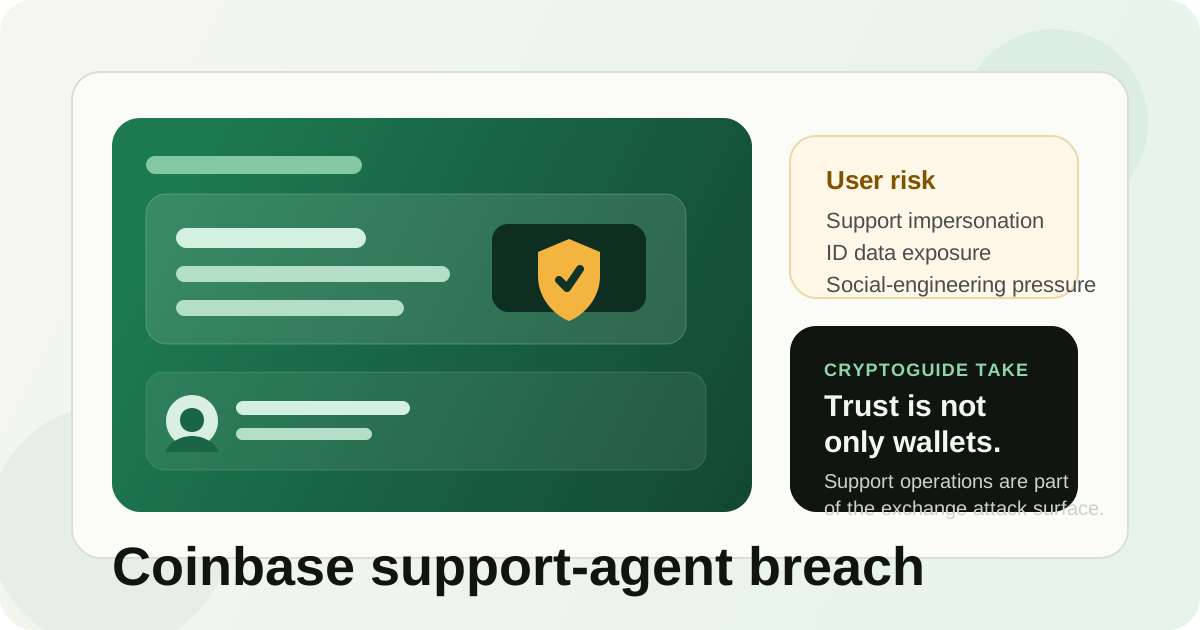
- Trust in an exchange depends on operational controls around people and internal tools, not only custody architecture.
What happened
Coinbase disclosed the incident on May 15, 2025, saying criminals had bribed and recruited rogue overseas support agents to steal customer data. The company said the attackers then tried to extort Coinbase for $20 million. Coinbase said no, announced a $20 million reward fund for information leading to arrests and said it would reimburse retail customers who had been tricked into sending funds as a direct result of the incident before the date of the disclosure.
Multiple reports on the same day said Coinbase expected the financial impact to land between $180 million and $400 million, covering remediation and voluntary reimbursements. That range matters less for ordinary users than the attack model: this incident targeted trust in support channels.
How the attack flow worked
- Attackers paid support staff outside the United States for access to customer-support tools.
- Those insiders copied data for a small subset of Coinbase users.
- The goal was to build convincing impersonation campaigns, not to drain wallets directly from Coinbase infrastructure.
- Attackers then demanded $20 million from Coinbase to avoid public exposure.
- Users faced the highest risk when scammers used the stolen context to pose as Coinbase and ask for transfers.
What data was exposed and what was not
| Category | Coinbase said attackers got | Coinbase said attackers did not get |
|---|---|---|
| Identity data | Name, address, phone, email, government-ID images. | Full control of identity systems or Prime account access. |
| Financial context | Masked bank-account details, balance snapshots, transaction history. | Passwords, 2FA codes or private keys. |
| Funds access | No direct wallet access disclosed. | Any ability to move customer funds, hot wallets or cold wallets. |
| Corporate data | Limited internal documents and support material. | Evidence of a broad custody-system compromise. |
Why this matters beyond Coinbase
Users often think exchange security begins and ends with proof of reserves, cold storage and onchain wallet controls. Those are important, but this incident shows a different weak point: support systems that contain enough personal information to make a scam call look real. A user who hears the correct balance range, account history or last-four identity details may trust the caller more than they should.
User checklist if you have a Coinbase account
| Check | Why it matters | What to do |
|---|---|---|
| Support calls and texts | The main follow-on risk is impersonation. | Assume unsolicited calls are hostile until verified inside the official app or website. |
| 2FA strength | SMS is weaker than hardware-based options. | Use a hardware security key or the strongest available app-based 2FA. |
| Withdrawal allow-listing | It slows emergency transfer fraud. | Only allow withdrawals to wallets you control and have already verified. |
| Identity monitoring | ID images and personal details raise account-recovery and fraud risk. | Watch for unusual support tickets, reset attempts or identity-theft alerts. |
| Account lock path | Fast action matters during a live scam. | Know how to lock the account in-app before you need it. |
Risk notes users should not miss
- "Funds were not exposed" does not mean "users are safe from scams."
- A data breach can be dangerous even when exchange wallets remain untouched.
- Public-company visibility and transparency help, but they do not remove insider-risk exposure.
- Any exchange with large support operations should be judged on access controls, monitoring and recovery design, not brand familiarity alone.
How Coinbase responded
Coinbase said it fired the insiders involved, notified affected users, added extra ID checks on large withdrawals, introduced mandatory scam-awareness prompts, increased insider-threat detection and planned a new U.S. support hub. Those are meaningful steps, especially the focus on fraud-monitoring and internal controls, but the incident still deserves to be remembered as an exchange-trust case study.
CryptoGuide take
Crypto exchanges usually market security through custody language: cold storage, reserves, insurance language and wallet architecture. That is only half the picture. The calmer lesson from the Coinbase breach is that customer-support operations are part of the attack surface. Coinbase deserves some credit for refusing the ransom and describing what was and was not exposed, but users should update their own model too: no support call should ever be trusted just because the caller knows personal account details.
Sources and further reading
- Coinbase: Protecting Our Customers - Standing Up to Extortionists
- Associated Press: Coinbase said cyber crooks stole customer information and demanded $20 million ransom payment
- MarketWatch: Coinbase says cyberattack cost up to $400 million after bribed overseas employees stole customer data
FAQ
Was the Coinbase incident a wallet or private-key hack?
No. Coinbase said passwords, 2FA codes, private keys and customer funds were not exposed. The incident was primarily a data-exposure and social-engineering attack enabled by rogue support access.
What information did attackers get in the Coinbase breach?
Coinbase said attackers obtained customer identity and account data including contact details, government-ID images, masked bank details, balance snapshots and transaction history for a small subset of users.
What should exchange users do after a support-led breach?
Treat support calls and messages with suspicion, enable strong 2FA, use withdrawal allow-listing where available, lock the account if something feels wrong, and verify all communication through the official app or website.
Conclusion
The Coinbase breach is worth studying because it looked different from a classic exchange hack. No dramatic wallet drain was needed. Attackers instead tried to turn support access into persuasive scam material. For users comparing exchanges, that is a reminder that trust depends on the quality of human controls as much as technical custody controls.