
TLDR
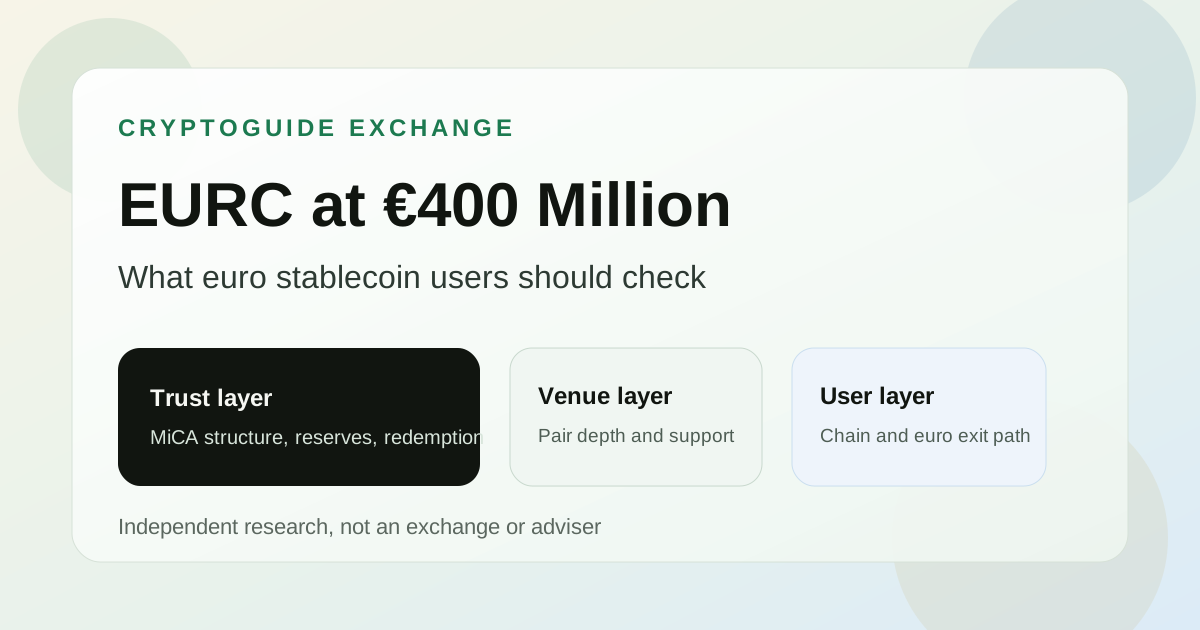
Circle said on August 17, 2026 that EURC surpassed €400 million in circulation. The company framed that as a sign of stronger euro-denominated liquidity across exchanges, payment rails and institutional workflows. The underlying point is credible. Circle says EURC is now listed on exchanges including Bitpanda, Bitstamp, Bybit, Coinbase and Kraken, while its MiCA materials say EURC is an e-money token issued by Circle's French e-money institution under ACPR supervision with monthly independent attestations and direct 1:1 euro redemption for authorized Circle Mint users. Still, exchange users should keep the practical limits in view: retail access usually depends on secondary-market liquidity, not direct issuer redemption; order-book depth still varies by venue and pair; chain support remains fragmented; and a euro stablecoin balance on an exchange is never the same thing as insured bank cash.
Key takeaways
- Circle said on August 17, 2026 that EURC surpassed €400 million in circulation.
- Circle's August 17 post says EURC is listed on Bitpanda, Bitstamp, Bybit, Coinbase and Kraken, and Circle's MiCA white paper names Coinbase, Bitstamp, Bitvavo, Kraken and ZBX as supported trading platforms.
- Circle says EURC operates as a MiCA e-money token issued by its French e-money institution, supervised by the ACPR, with reserves segregated from corporate funds and attested monthly by independent third parties.
- Circle's MiCA page says EURC and USDC can be redeemed 1:1, but direct redemption is a Circle relationship, not the normal path for most retail exchange users.
- Circle's August 18 Mint update says eligible account holders can move between local currency and USDC in eight currencies without separate prefunding, which improves the broader stablecoin infrastructure around exchange and treasury flows.
- CryptoGuide Exchange is an independent research and comparison platform, not an exchange, broker, custodian, investment adviser or legal adviser.
What changed
The simple version is that euro stablecoins are becoming less theoretical. For years, EUR-denominated crypto workflows often meant one of three compromises: hold euro on an exchange and accept banking-hour friction, convert into dollar stablecoins for deeper liquidity, or move through extra FX and bridge steps. Circle's August 17 milestone matters because it points to a better middle path. More supply, more listings and more regulatory framing make EURC easier to take seriously as market infrastructure instead of just a niche instrument.
The more careful reading is that the milestone strengthens the issuer and distribution story, not every user outcome. A stablecoin can be well structured and still be annoying in practice if your venue has weak EURC books, poor withdrawal support or confusing network options. Exchange users do not experience "circulating supply." They experience slippage, transfer friction, banking cutoffs and venue policy.
Who is affected first
The first clear winners are institutions, market makers, payment firms and exchanges that need euro-native liquidity without routing everything through dollars. Circle's August 17 post ties EURC growth to settlement, FX, treasury and payments use cases. That makes sense. These are the users who care most about reducing intermediary conversions and holding a euro-denominated onchain unit that fits MiCA-era compliance expectations.
Retail users benefit later and less evenly. If their exchange supports EURC well, the upside is real: cleaner EURC/EUR or EURC/USD pairs, a possible reduction in forced USD stablecoin detours and better weekend transfer flexibility. If their exchange does not support deposits, withdrawals or meaningful EURC depth, the headline barely changes their day-to-day experience.
Decision checklist before you treat EURC like a euro cash rail
- Check whether your exchange actually supports EURC deposits and withdrawals, not just spot trading.
- Check the exact pair liquidity you will use: EURC/EUR, EURC/USDC or EURC/USD can behave differently across venues.
- Check the supported blockchain. Circle says EURC is live across Avalanche, Base, Ethereum, Solana and Stellar, but your destination platform may not support the same network.
- Check your real redemption path. Circle says authorized Circle Mint users can redeem 1:1 for euros directly, while many retail users will rely on exchange sales or secondary-market exits instead.
- Check whether your venue's fiat off-ramp is actually strong in euros. A euro stablecoin is less useful if the final bank exit is slow or unreliable.
- Check whether you are using EURC for storage, trading collateral, transfer speed or treasury parking. The right venue and chain depend on the use case.
- Check whether a dollar stablecoin still has deeper liquidity for your specific trade. Better euro infrastructure does not automatically mean EURC is the best pair for everything.
Comparison: where the milestone helps, and where it does not
| Question | What improved | What still needs checking |
|---|---|---|
| Issuer trust | Circle says EURC operates under MiCA as an EMT issued by its French e-money institution with segregated reserves and monthly attestations. | You still need to separate issuer quality from exchange solvency and operational quality. |
| Exchange distribution | Circle says EURC is now supported on several major exchanges, which should deepen access. | Support is not the same as deep liquidity on your exact pair at your exact venue. |
| Euro market structure | A larger circulating supply and broader listings can reduce some dollar-conversion friction. | EURC may still be thinner than USDC or USDT for many active-trading workflows. |
| Redemption confidence | Circle's MiCA materials emphasize 1:1 redeemability and EEA redemption policy. | Most retail users do not redeem directly with Circle and remain dependent on exchange routes. |
| Operational convenience | Circle's latest Mint rollout shows local-currency stablecoin infrastructure is getting more usable for eligible institutions. | That improvement may take time to flow through to retail exchange UX and local bank exits. |
Practical explanation: why this is useful without being magic
Good euro stablecoin infrastructure matters because crypto users in Europe often get pushed into awkward choices. They may prefer euro accounting, euro liabilities and euro spending, but the deepest crypto liquidity often sits in dollar stablecoins. That gap creates friction and hidden risk. Users make extra conversions, accept FX spread leakage or park value in instruments that do not match their actual currency needs.
EURC getting bigger and more broadly supported helps narrow that gap. It also fits the MiCA moment. Post-MiCA, "regulated" stablecoin narratives are not enough on their own; users want to know which issuer, which entity, which reserve framework and which redemption structure is in play. Circle is offering answers on those points. That is a real advantage.
But an issuer-level advantage does not flatten everything else. If you hold EURC on an exchange, your counterparty is still the exchange for most practical purposes. If the books are thin, if withdrawals pause or if your bank off-ramp is clumsy, the user experience still breaks at the platform layer rather than the stablecoin layer.
Risk notes
MiCA compliance does not equal universal user protection
MiCA improves disclosure, reserve and legal-structure expectations at the issuer layer. It does not make every exchange listing equally safe or every venue equally transparent.
Liquidity can be broad in aggregate and thin in practice
A €400 million supply sounds large, but users trade on specific books and routes. Thin depth on one venue or one pair can still create noticeable slippage or awkward routing.
Network mismatch remains an avoidable failure point
Circle's multichain rollout is a strength, but only if the exchange, wallet and destination all support the same version of EURC. A euro stablecoin can still become a support ticket if the network assumptions are wrong.
CryptoGuide take
The best way to read the EURC milestone is as a market-structure signal, not a marketing slogan. Euro stablecoins are becoming more usable, and Circle has done the work to pair growth with legal structure, redemption language and visible reserve framing. That deserves credit. The user discipline is the same as ever: check venue support, actual pair depth, network compatibility and fiat exit quality before assuming a euro stablecoin balance gives you "cash-like" convenience. Better plumbing is valuable. It is not self-executing.
FAQ
Does EURC passing €400 million mean euro stablecoin liquidity is solved?
No. It is a meaningful milestone, but users still need to check exchange support, order-book depth, supported networks, redemption access and local fiat exit quality before treating EURC like a universal euro cash rail.
What is the practical MiCA angle for EURC users?
Circle says EURC is issued as an e-money token under MiCA by its French e-money institution, supervised by the ACPR, with reserves segregated and monthly third-party attestations. That improves the issuer trust layer, but exchange and wallet execution still matter.
Who benefits first from stronger EURC infrastructure?
Institutions, payment firms, market makers and exchanges usually benefit first because they can use Circle Mint or related infrastructure directly. Most retail users still depend on secondary-market liquidity and their exchange's own fiat and network support.
Conclusion
As of Monday, August 24, 2026, EURC looks more like serious euro-denominated crypto infrastructure than it did a year ago. That is useful progress for exchange users who want fewer forced USD stablecoin detours. The cautious conclusion is better than the hype conclusion: the milestone strengthens the trust and liquidity story, but the real user test is still venue by venue and route by route. Check the pair, check the chain, check the exit.
Related pages
- Circle National Trust and USDC: what exchange users should check
- Stablecoin plumbing risk after the GENIUS Act
- MoneyGram, Kraken and MGUSD: what changed for crypto cash-out rails
- Crypto off-ramp guide
- Compare exchanges