
TLDR summary
To check a crypto website, start with the exact domain, then review HTTPS, DNS availability, domain age, legal pages, company visibility, withdrawal rules, public reports and whether the site imitates a known exchange or wallet brand. A trust score is a research shortcut, not a guarantee.
Key takeaways
- Do not judge a crypto site by design quality alone. Fake pages can look professional.
- Lookalike domains, urgent deposit prompts and private support messages are common risk patterns.
- Use the Crypto Trust Checker as a first-pass filter, then verify official documentation manually.
- A low risk score should slow you down. A high score should still be treated as a starting point, not proof of safety.
Definitions
Trust indicators are signals that help users evaluate whether a crypto platform looks transparent, technically reachable and consistent with known information. Examples include valid TLS, visible policy pages and long-running public presence.
Risk indicators are warning signs that justify deeper review. Examples include a very new domain, missing security pages, suspicious brand imitation, broken DNS, aggressive deposit bonuses or no clear company information.
Step 1: verify the exact domain
The domain is the first checkpoint because many attacks begin before the user reads the page. A fake exchange can copy a real logo, layout and login screen while using a domain that is only one character different from the original.
Type the domain manually, avoid ad links for login pages, and compare the URL against official social profiles, app-store listings or previously saved bookmarks. If a domain contains a famous exchange name plus extra words, treat it as a lookalike candidate until proven otherwise.
Step 2: check security and availability signals
Technical checks do not prove that a crypto service is reliable, but failures can be meaningful. A platform handling accounts, wallets or deposits should normally have reachable DNS, HTTPS, a valid TLS certificate and stable domain configuration.
| Signal | What it can indicate | How to interpret it |
|---|---|---|
| DNS resolution | The domain is reachable on the public internet. | No DNS result can mean inactive, misconfigured or temporarily unavailable. |
| TLS certificate | The site supports encrypted browser connections. | Valid HTTPS is expected; it is not proof of legitimacy by itself. |
| Domain age | How long the domain has existed. | Very new domains deserve extra caution, especially with deposit prompts. |
| Blacklist signals | Public abuse feeds may contain reports. | No report is useful context, but never a guarantee. |
Step 3: review transparency pages
A trustworthy crypto service should make it easy to understand who operates the platform, which rules apply, how KYC works, what risks users accept and how support can be contacted. Missing pages do not automatically prove bad intent, but they reduce accountability.
Look for terms, privacy policy, risk disclosure, fee pages, withdrawal rules, KYC or AML information, support channels and country restrictions. If the website asks for deposits before explaining basic policies, that is a reason to pause.
Step 4: compare claims with public reputation
Search results, community discussions and public security reports can help validate or challenge a platform's claims. Be careful with both extremes: fake positive reviews can be manufactured, while angry forum posts may reflect isolated cases. What matters is pattern quality.
Useful patterns include repeated withdrawal complaints, unresolved account-freeze reports, fake support warnings, copied legal text, sudden domain changes or a mismatch between marketing claims and public company information.
Step 5: use a trust checker, but understand its limits
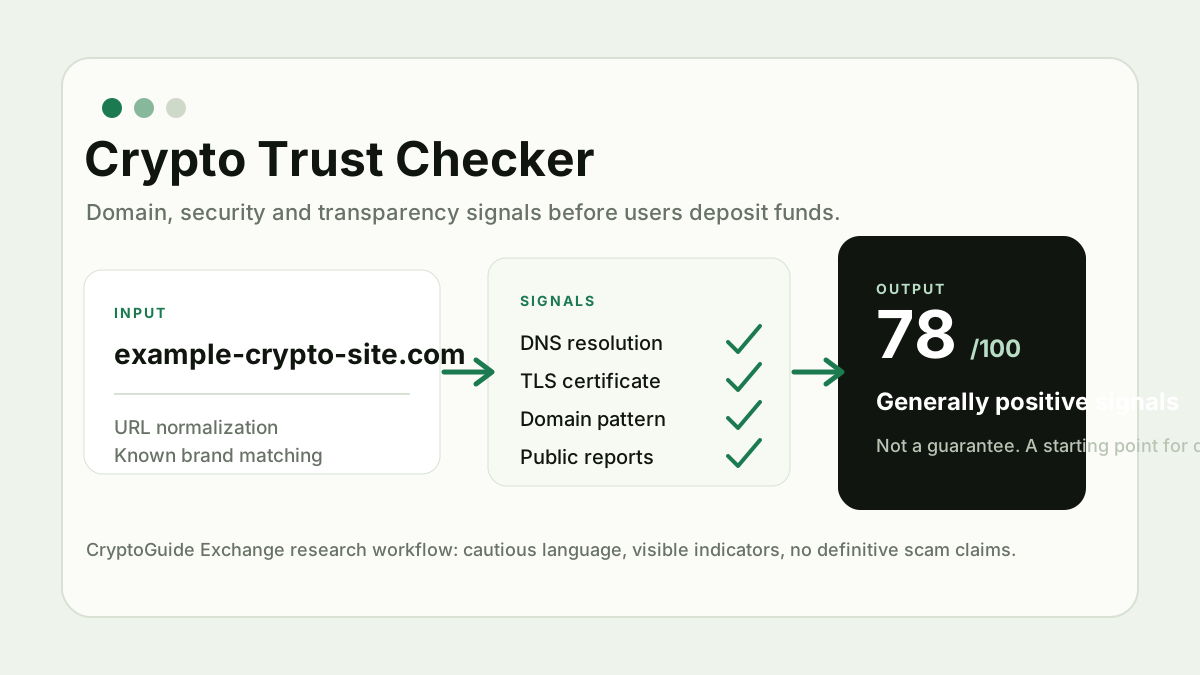
The CryptoGuide Trust Checker reviews domains and exchange names using a conservative scoring model. It looks for domain patterns, known exchange matches, live technical signals and reputation-provider availability where possible.
The checker intentionally avoids definitive accusations. It uses language such as “risk indicators detected” or “limited transparency detected” because a website assessment is probabilistic. The goal is to help users decide what to verify next.
Practical example workflow
- Paste the domain into the Crypto Trust Checker.
- Read the score band and the individual indicators, not only the number.
- Check whether the domain is an official exchange domain or a lookalike.
- Open the platform's terms, fees, KYC and withdrawal pages.
- Search for independent reputation signals before depositing funds.
- If you still proceed, start with a small test transaction and verify withdrawal behavior.
Common risk patterns
Brand plus extra words
Domains like “login”, “bonus”, “support” or “secure” added to a known brand can be used for impersonation.
Deposit urgency
Countdowns, guaranteed profit language and private-message pressure are not normal research signals.
Missing policies
No terms, no risk disclosure and no company context make it harder to evaluate accountability.
FAQ
Can a trust checker prove that a crypto website is safe?
No. It can surface risk indicators, technical signals and transparency gaps. It cannot guarantee safety, solvency, honest operations or future withdrawal reliability.
Should I avoid every new crypto domain?
No. New projects can be legitimate. But a new domain asking for deposits, wallet signatures or seed phrases should receive stricter review than an established public platform.
What is the strongest warning sign?
Any request for a seed phrase, private key or remote wallet access should be treated as a severe danger signal. Legitimate exchanges and wallet providers do not need your recovery phrase.
Conclusion
A crypto website trust check is not about finding one magic signal. It is about combining domain verification, technical health, transparent policies, public reputation and user behavior. The safest habit is to slow down before signup, wallet connection or deposit.
Related articles
- How to avoid crypto scams
- How crypto phishing works
- What makes a crypto exchange trustworthy?
- Crypto security methodologies
Sources and methodology
This article is based on CryptoGuide's internal trust methodology, domain-risk review model and security-focused editorial standards. For the scoring framework, see the methodology page, security page and risk disclosure.