
TLDR
Coinbase said on August 19, 2026 that Brazilian users can now trade BRL directly into USDC on Coinbase Advanced, using Pix and bank-transfer rails, and that the path can cut on-ramp costs by as much as 85 percent. That is a meaningful product improvement for Brazil-based users who regularly move between local currency and dollar-linked crypto liquidity. It is not the whole story. Coinbase's own Brazil payments documentation says BRL deposits can take up to 30 minutes because of bank-side security checks, and Banco Central do Brasil said on August 7 that from January 1, 2027 certain higher-value virtual-asset transfers will face a mandatory 24-hour retention window. Better access is real. So are the delays and compliance checks.
Key takeaways
- Coinbase announced on August 19, 2026 that BRL-USDC trading is live on Coinbase Advanced for users in Brazil.
- Coinbase said the direct route can reduce crypto on-ramp costs by up to 85 percent compared with older conversion paths.
- Coinbase's Brazil help documentation says Pix deposits are usually instant, but BRL deposits can still take up to 30 minutes because of bank security measures.
- Banco Central do Brasil announced on August 7, 2026 that Resolution BCB No. 584 adds anti-fraud measures for virtual-asset providers.
- The central bank said a 24-hour retention rule starts on January 1, 2027 for certain daily or individual transfers above US$10,000, including transfers to self-custody or foreign providers.
- Cheaper stablecoin access does not remove exchange custody risk, spread risk, network-choice risk or transfer-review delays.
- CryptoGuide Exchange is an independent research and comparison platform, not an exchange, broker, custodian, investment adviser or legal adviser.
Market context: why this launch matters
Brazil is one of the more important local-currency crypto markets because retail users and small businesses often care less about speculative token turnover than about fast conversion between reais, dollar-linked assets and cross-platform liquidity. A direct BRL-USDC pair matters because it cuts out an extra leg. That can lower conversion costs, simplify treasury movements and make stablecoin access feel more predictable for users who treat USDC as transaction infrastructure rather than a trade.
Coinbase is clearly leaning into that use case. Its announcement frames the new market as a way to buy USDC with BRL directly inside Coinbase Advanced, using familiar local payment rails. That is a stronger user proposition than vague "Brazil expansion" language because it points to one concrete improvement: users no longer need to route through as many intermediate conversions just to reach a liquid dollar stablecoin.
What changed on the product side
| New element | What Coinbase says | Why users should care |
|---|---|---|
| Direct BRL-USDC market | Brazilian users can trade BRL directly into USDC on Coinbase Advanced. | Fewer conversion steps can reduce friction and spread leakage. |
| Lower stated on-ramp cost | Coinbase said the direct route can reduce crypto on-ramp costs by up to 85 percent. | The savings may be real, but users still need to compare final execution and withdrawal costs. |
| Pix and bank-transfer support | Coinbase's Brazil documentation lists Pix and bank transfer for BRL funding. | Local rails decide whether the product is genuinely convenient day to day. |
| USDC-focused access | The simplified route is built around USDC, not around every stablecoin equally. | Users should confirm whether their preferred network and exit venue actually support that USDC path. |
Decision checklist before using the BRL-USDC rail
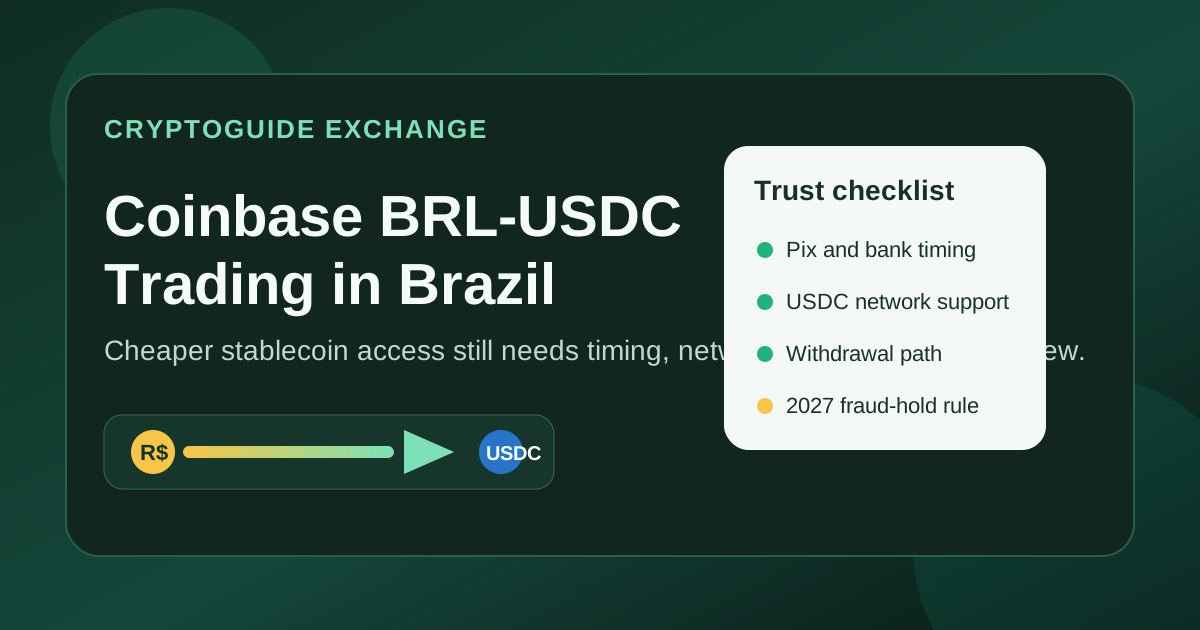
- Check whether the total cost improvement is still visible after spread, withdrawal fee and destination-network costs.
- Check which USDC network you will actually use next, and whether the receiving exchange or wallet supports it cleanly.
- Check whether your use case is local storage, exchange trading, self-custody or offshore transfer, because each path carries different review and timing risk.
- Check BRL deposit timing expectations instead of assuming Pix means every step is immediate.
- Check whether the destination platform gives you a clear redemption or off-ramp path back into cash if you need to exit.
- Check account-level security controls before moving larger balances just because the on-ramp feels cheaper.
- Check whether a transfer may fall into the higher-value review bucket that becomes more important under Brazil's January 1, 2027 anti-fraud rule.
Comparison: stronger trust signals vs weaker launch signals
| Question | Stronger signal | Weaker signal |
|---|---|---|
| Is the cost saving real? | The platform shows the trading pair, funding method, fees and typical settlement timing. | The platform markets a large percentage saving without showing the full user path. |
| Will the rail work for your next step? | The platform explains USDC network support, withdrawal options and local restrictions. | The platform implies any USDC route is interchangeable across wallets and exchanges. |
| How are delays handled? | The platform documents deposit-review timing and what happens when funds are held for security checks. | The platform markets Pix familiarity as if it removes all transfer friction. |
| Are regulation changes explained? | The user can see when retention windows may apply and to which transfer types. | The user is left to discover anti-fraud delays only after initiating a larger transfer. |
| Is trust tied to usability? | The platform separates on-ramp convenience from custody, redemption and support quality. | The platform treats easier fiat entry as proof that the whole exchange stack is low risk. |
Why Banco Central do Brasil's August 7 rule still matters
Banco Central do Brasil said on August 7, 2026 that virtual-asset providers must adopt new anti-fraud controls, including stronger identity checks and a retention requirement for certain larger-value transfers. The central bank's note and Resolution BCB No. 584 matter because they describe the exact category users often treat as the easiest part of crypto: moving a bigger amount from a local on-ramp into self-custody or an offshore venue once the stablecoin is already in hand.
From January 1, 2027, the resolution requires a 24-hour retention period for incoming funds that will be used in transactions with a destination abroad or in self-custody wallets when the transfer is above US$10,000 in a day or in a single operation. That does not block ordinary usage today on August 29, 2026. It does mean that users planning to rely on Brazil-based stablecoin rails for fast larger transfers should not assume the current path will remain frictionless at the same size threshold next year.
Practical explanation: where the user experience improves and where it does not
The clearest improvement is at the first step. If you are a Brazil-based user who wants USDC exposure or wants dollar-linked liquidity for another exchange, a direct BRL-USDC book is cleaner than bouncing through multiple conversions. That can make portfolio funding, exchange arbitrage preparation or merchant-treasury management easier.
The improvement fades if users stop the analysis there. Once funds leave the local funding step, the usual questions return fast: Which chain is cheapest and safest for this transfer? Can the destination venue receive that version of USDC without manual support intervention? Can you redeem or cash out quickly if conditions change? Will a larger-value transfer trigger timing assumptions that break your plan? Those are not side questions. They are the trust layer.
Risk notes
Cheaper entry can hide downstream cost
A lower-cost BRL entry is useful, but the full route may still become expensive if the destination chain is wrong, the receiving venue charges a meaningful withdrawal fee or the user ends up paying spread twice on the way out.
Local-speed branding can create false timing assumptions
Pix is associated with fast payments, but Coinbase's own help documentation says BRL deposits can still take up to 30 minutes because of bank security checks. A fast payment rail does not guarantee instant exchange availability.
Future anti-fraud controls will matter most for bigger users
The January 1, 2027 retention rule is not a reason to avoid the product. It is a reason to plan around size, timing and destination. Users moving larger balances to offshore venues or self-custody should treat next-year operational friction as a realistic scenario, not an edge case.
CryptoGuide take
This is a good example of hype that deserves a measured yes. Coinbase's BRL-USDC launch looks genuinely useful because it solves a concrete exchange-user problem: getting from local currency into a liquid stablecoin with fewer steps. But trust does not come from the pair listing alone. It comes from how clearly the platform explains funding timing, network choice, withdrawal handling, fraud reviews and the path back out. Brazil users should read this as a practical rail upgrade, not as permission to stop doing exchange-level due diligence.
FAQ
What changed with Coinbase's BRL-USDC trading in Brazil?
Coinbase said on August 19, 2026 that Brazilian users can now trade Brazilian real directly into USDC on Coinbase Advanced, with bank and Pix support, and that the route can lower crypto on-ramp costs compared with older paths.
Does cheaper BRL-to-USDC access mean withdrawals and offshore transfers will always be instant?
No. Coinbase says BRL deposits can take up to 30 minutes because of bank-side security checks, and Banco Central do Brasil's Resolution BCB No. 584 introduces a 24-hour retention requirement from January 1, 2027 for certain higher-value virtual-asset transfers.
What should Brazil-based exchange users verify before using BRL-USDC rails?
Check fees and spread, Pix and bank-transfer availability, USDC network support, withdrawal timing, who controls redemption and how the platform handles fraud reviews or transfer holds before moving meaningful size.
Conclusion
As of Saturday, August 29, 2026, Coinbase's BRL-USDC launch is one of the cleaner stablecoin access upgrades for a major local market. The trust-first reading is straightforward: direct fiat-to-USDC rails are useful, but they do not eliminate platform risk, timing risk or regulatory friction. Users in Brazil should judge the feature by the complete route, including deposits, network choice, withdrawals and the rules that apply when transfer size increases.
Related pages
- Visa Stablecoin Platform: what crypto exchange users should check
- MoneyGram, Kraken and MGUSD: what changed for crypto cash-out rails
- Circle National Trust and USDC: what exchange users should check
- Crypto to bank account
- Coinbase trust check
Sources
- Coinbase: Coinbase Brings Direct BRL Trading for USDC to Coinbase Advanced in Brazil
- Coinbase Help: Payment methods for Brazilian customers
- Banco Central do Brasil: BC estabelece novas medidas de segurança para prestadores de serviços de ativos virtuais
- Banco Central do Brasil: Resolução BCB No. 584, de 7 de agosto de 2026
- Banco Central do Brasil FAQ: o que é o Mecanismo Especial de Devolução (MED)?