
TLDR
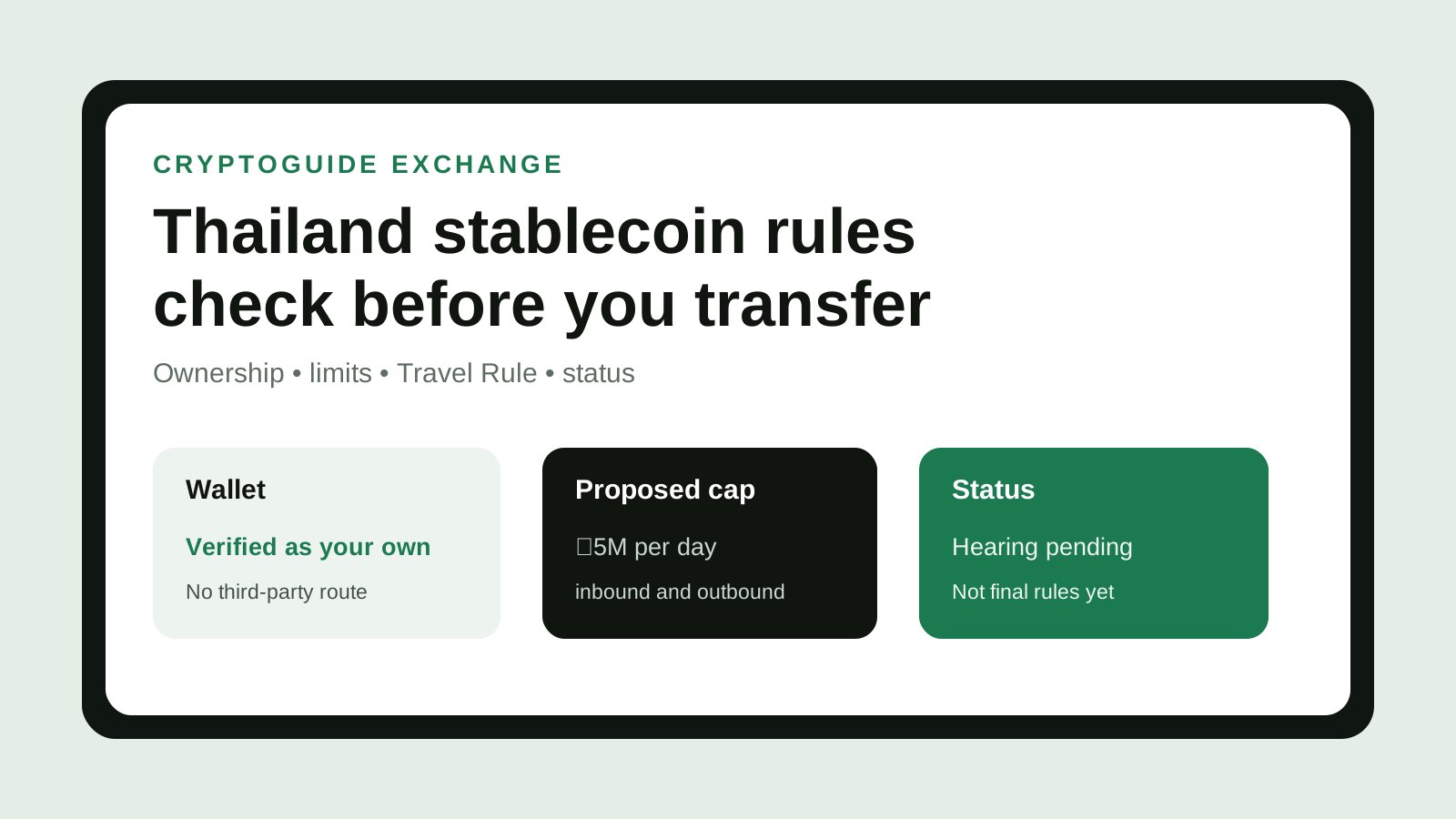
On September 3, 2026, Thailand's Securities and Exchange Commission said its board had approved principles for closer supervision of stablecoin activity through licensed digital-asset operators. The proposal would require external sending and receiving wallets to be verified as belonging to the customer, prohibit transfers involving another person's account, and cap inbound and outbound stablecoin transfers at 5 million baht per person per operator per day. Transfers between customer accounts at SEC-supervised operators would be exempt from that cap when both comply with the Travel Rule. These are not final rules: the SEC said a public hearing would follow in September.
Key takeaways
- The SEC Board approved policy principles, not a final rule or immediate ban.
- External sending and receiving wallets would need to be verified as the customer's own.
- The proposed ceiling is 5 million baht inbound and 5 million baht outbound per person per operator per day, subject to consistency with income and financial position.
- Transfers between accounts at SEC-supervised operators would sit outside that cap if both operators meet Travel Rule requirements.
- The package also covers market makers, broker liquidity providers and off-platform transactions.
- CryptoGuide Exchange is an independent research and comparison platform, not an exchange, broker, custodian, investment adviser or legal adviser.
What changed
The regulator has moved from monitoring stablecoin activity to publishing a specific supervisory design. It said volume and value had increased, particularly for USDT, and identified patterns it believes may relate to money laundering, cybercrime or attempts to bypass international money-transfer rules. The SEC said the principles were developed with the Bank of Thailand, the Thai Digital Asset Operators Trade Association and digital-asset operators.
That does not make every detail effective now. The September 3 release puts a public hearing next in the process. The accurate sequence is: the board approved the direction, the regulator disclosed proposed mechanics, and final text and timing remain pending.
Who is affected
The clearest affected group is customers moving stablecoins into or out of Thai-licensed exchanges and brokers. People who fund relatives' accounts, withdraw to a business partner, use a payment intermediary, or move assets through a wallet whose ownership is difficult to prove could face more friction if the principles become rules.
High-volume users may encounter source-of-funds checks before reaching the proposed ceiling. Operators would compare transfer value with a customer's income and financial position, screen for mule-account and watchlist connections, and use blockchain analytics. The 5 million baht figure is not an unconditional allowance.
Comparison: what may change
| Route | Announced principle | User check |
|---|---|---|
| External wallet to operator | Wallet verified as customer's own; proposed ฿5M daily inbound cap. | Ask how ownership is proved and confirm token and network support. |
| Operator to external wallet | Destination verified as customer's own; proposed ฿5M daily outbound cap. | Confirm address-book, test-transfer and withdrawal-hold procedures. |
| Between SEC-supervised operators | Proposed cap does not apply when both meet Travel Rule requirements. | Verify both legal entities are under SEC supervision. |
| Broker liquidity route | Liquidity providers and source exchanges would need regulatory supervision. | Check whether the broker identifies its execution venue. |
| Off-platform trade | Guidelines would target transparency and legitimate big-lot use. | Request written pricing, settlement and counterparty terms. |
Decision checklist before moving stablecoins
- Confirm whether you are reading a final rule, consultation or early platform policy.
- Verify the exact Thai legal entity serving the account and its SEC status.
- Check how the operator verifies that an external wallet is yours.
- Do not use another person's account or wallet as a shortcut.
- Calculate the day's total inbound and outbound value per operator.
- Prepare legitimate source-of-funds records and ask about review times.
- Confirm asset, blockchain, memo, minimum deposit and recovery policy.
- Use a small test transfer where supported and retain the transaction hash.
Risk notes
The policy is not final
A platform may adopt controls early, but users should not claim Thailand has already enacted every threshold or wallet rule. Consultation feedback may change mechanics, timing or exceptions.
Wallet ownership is operationally hard
A signed message can show control of some self-custody wallets, but control is not always legal ownership. Smart-contract wallets, multisignature accounts, custodial addresses and business wallets complicate verification.
Regulated routes can still fail
Travel Rule compliance does not prevent wrong-network transfers, stablecoin depegs, downtime, withdrawal queues or account reviews. Regulatory status is one trust signal, not a substitute for operational checks.
CryptoGuide take
Thailand's proposal is more consequential than a simple cap. It would make stablecoin movement through licensed platforms more identity-bound and could favor transfers inside the supervised exchange perimeter over external routes. That may improve traceability, but it can also create false comfort. A supervised transfer can still go to the wrong network, stall in review or depend on a weakly disclosed liquidity provider. A trustworthy operator should explain the route, ownership test, limits and appeal process before a customer presses send.
FAQ
Has Thailand already imposed the 5 million baht limit?
No. The SEC announced approved principles and a September public hearing. Final rules and an effective date were still pending.
Do transfers between two Thai-regulated operators count toward the proposed limit?
The announced principles say no when both operators are SEC-supervised and comply with Travel Rule requirements.
What should users check now?
Check the rule's status, both platforms' legal entities, wallet-ownership process, source-of-funds requirements and live limits.
Conclusion
Thailand is not banning stablecoins. It is proposing stricter gates around how they enter, leave and source liquidity for licensed operators. Until final rules arrive, users should follow the consultation, keep ownership and source-of-funds records clear, and verify each platform's live policy before moving funds.
Related pages
- Stablecoins are becoming payment rails
- KYC tiers and source-of-funds checks
- How to choose a crypto exchange
- How to verify a legitimate exchange
- Run a trust check