
TLDR
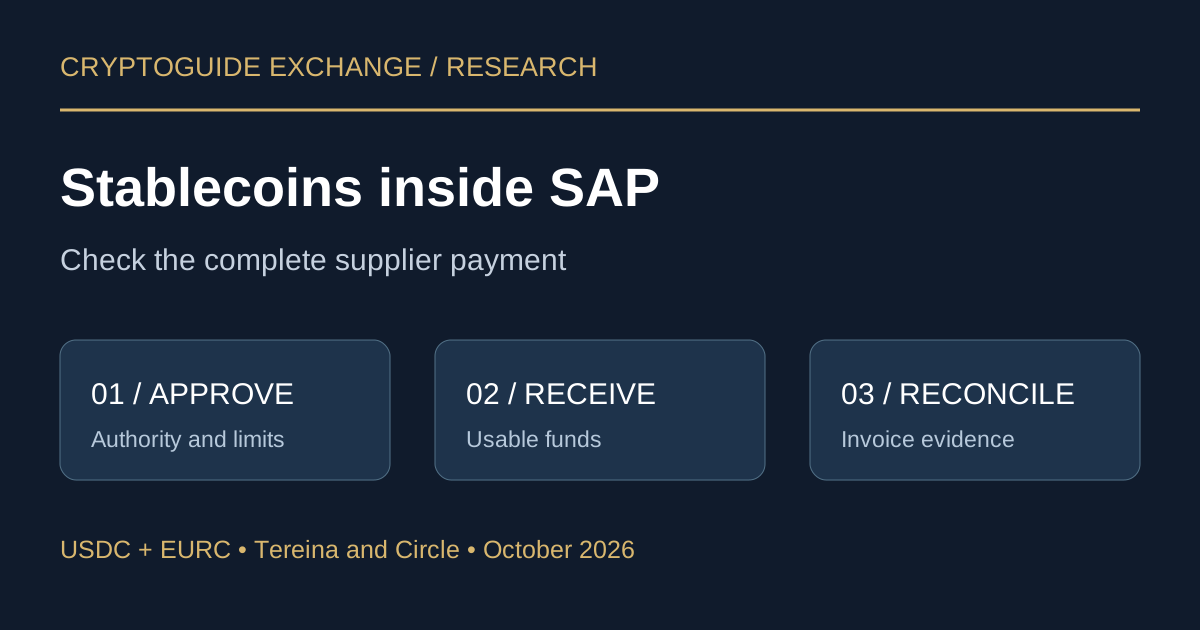
A stablecoin payment button inside an accounting system still needs a complete approval and receipt process. Tereina and Circle announced their partnership on October 7, 2026, covering USDC and EURC in enterprise payments, starting with SAP Cloud ERP. Finance teams should verify their own deployment and recipient arrangements before treating the integration as an operational payment route. Circle announcement
Key takeaways
- Confirm production access for your business and the exact payment corridor.
- Document who approves an instruction, who controls the funds and who resolves an exception.
- Match the invoice, payment reference and recipient receipt before closing the payable.
What the enterprise integration changes
Circle describes access through SAP Pay for SAP customers, with USDC preferred for eligible dollar workflows and EURC an option for euro activity. The release also schedules customer proof-of-value programs and specialist training over the coming months. It does not supply a customer-by-customer rollout list, route pricing or detailed custody terms. Scope and implementation plans
Our interpretation: the useful development is bringing payment initiation closer to the invoice and approval records. That can simplify a finance team's workflow, but the assessment should cover the entire transaction. A familiar application interface cannot by itself answer which entity owes the recipient money or how an exception is handled.
Decision checklist for a finance team
The checks below are CryptoGuide's evaluation framework, not a description of features already implemented by Tereina.
- Define the obligation. Record the invoice currency and whether the supplier has agreed to receive tokens or bank money. Specify who pays fees and what amount counts as full payment.
- Confirm access in writing. Ask for the eligible business entity, jurisdiction, enabled currencies, supported networks and whether the environment is a trial or production service.
- Map control of funds. Identify each service provider, the account holder and who can authorize a transfer. Ask how funds are treated during a delay or provider outage.
- Test approval boundaries. Check separation between the person editing beneficiary details and the person releasing payment. Require independent verification of a changed address using an established supplier contact.
- Validate receipt. Obtain current receiving instructions directly from the supplier. If an exchange is involved, verify the deposit asset and network in that recipient's account; a token ticker alone is insufficient evidence.
- Reconcile an example. In an approved trial, follow one instruction through its status changes and export the records. Define what staff should do if a payment is pending, rejected or received in the wrong amount.
Compare the evidence at each payment stage
| Stage | Evidence to request | Question before proceeding |
|---|---|---|
| Invoice approval | Approved supplier record, currency and amount | Who may change the destination after approval? |
| Token transfer | Network, asset identity, payment reference and status | Does this status mean submitted or received? |
| Exchange credit, if used | Recipient account credit and applicable restrictions | Can the supplier use or withdraw the balance? |
| Bank payout, if required | Conversion quote, fees and bank receipt | Does the final amount satisfy the invoice? |
| Accounting close | Matched invoice and transfer records | Who owns any fee or currency difference? |
Risks: reserves, approvals and incomplete settlement
Circle says USDC and EURC reserves are held separately from its operating funds. Its transparency page describes weekly USDC reserve disclosure and monthly third-party assurance. Those disclosures are relevant issuer evidence; they do not certify a particular business application's controls or a supplier's exchange account. Circle reserve disclosures
For an illustrative euro invoice paid through a dollar-token route, ask where currency conversion occurs and who accepts the quoted rate. A token amount and an invoice amount are different units until the parties agree how to translate them. Compare the complete cost and receipt timing against an available bank-payment route, using actual quotes rather than a headline transfer fee.
Automation deserves its own approval limit. If software can create payment instructions, require a documented rule for new beneficiaries, unusual amounts and duplicate requests. Ask how staff can stop an instruction before release and how they should investigate an uncertain outcome. These are recommended controls, not reported defects in either company's systems.
Retain the original invoice identifier across the payment record. Without that link, an onchain transaction reference can show movement while leaving the accounts-payable team unable to determine which obligation it settled. Assign one person or team to coordinate provider support so an exception does not disappear between systems.
CryptoGuide take
Embedding stablecoins in business software becomes useful when the payment remains understandable to the people approving and reconciling it. The best evaluation is a documented supplier-payment test: known authority, agreed currency, usable receipt and a matched invoice. Ecosystem reach is a distribution claim; operational confidence comes from that evidence.
FAQ
Does the announcement establish access for every SAP customer?
No. Confirm eligibility, enabled features and production terms for your business before scheduling a payment.
Does a stablecoin reserve report prove an invoice is paid?
No. Reserve evidence concerns the token issuer. Invoice completion also requires the agreed amount, recipient receipt and matching accounting records.
What should a supplier verify before providing an exchange deposit address?
Check business-account eligibility, exact token and network support, deposit restrictions and the route from the credited balance to usable funds.
Conclusion
Start with one defined payment scenario and require evidence at every handoff. Expand use only after the finance team can explain approval, custody, recipient access, exception handling and reconciliation in its own records.
Related pages
- Exchange research and comparison
- Wallet research
- Security checks
- Volante and Circle: bank payment checks
Sources
Primary sources reviewed October 8, 2026. The announcement establishes partnership scope; the transparency page supplies issuer reserve information. The operational checklist and illustrative invoice scenario are CryptoGuide editorial analysis, not verified product capabilities.
- Circle: Tereina enterprise workflow partnership, October 7, 2026
- Circle: transparency and reserve assurance
CryptoGuide Exchange is an independent research and comparison platform, not an exchange, broker, custodian, investment adviser or legal adviser. This is educational research, not investment or legal advice.