
TLDR
A token can remain visible in an exchange account after its market has closed. Kraken’s June delisting notice, updated September 30, sets October 16, 2026 at 14:00 UTC as the withdrawal cutoff, followed by liquidation October 19–30. The approaching deadline makes destination checks urgent; a portfolio valuation is not evidence of an executable exit. Kraken’s dated notice
Key takeaways
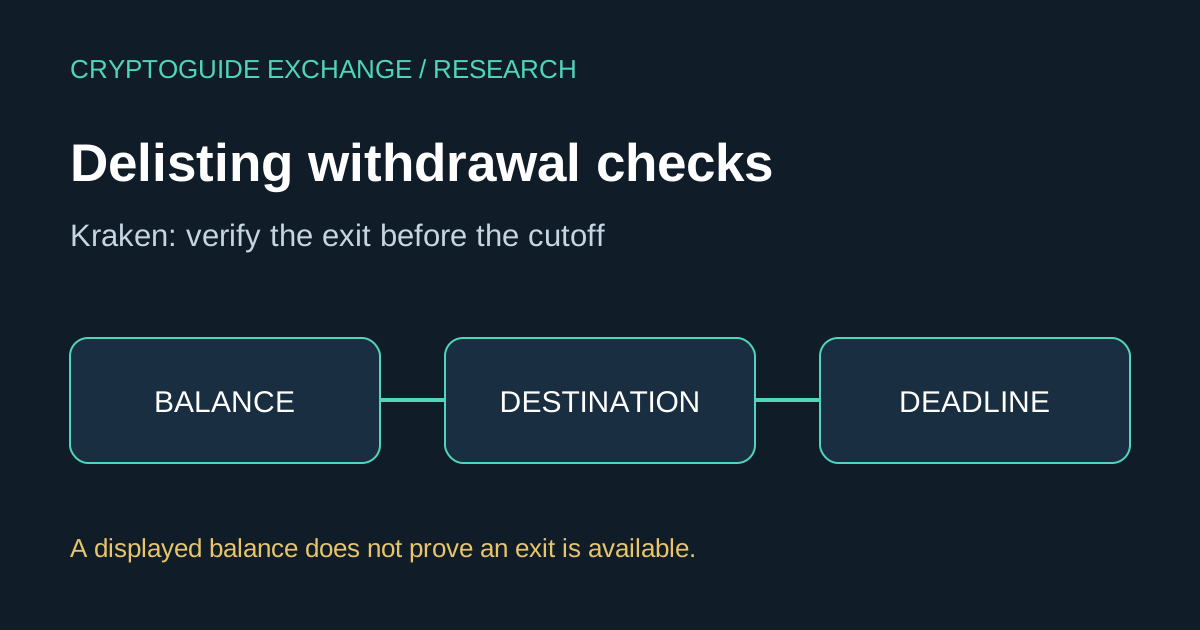
- Check account controls separately: a balance, an active market and an available withdrawal are different things.
- Verify the receiving service before approving a transfer.
- Keep evidence of instructions and failed attempts, especially near a cutoff.
Which balances does the notice cover?
Kraken lists TITCOIN, MXC, TOKE, ASRR, ART, UNITE, TANSSI, MIRROR, SOGNI, ALMANAK, VERSE, XRT, RETARDIO and RAVE. Deposits and trading were scheduled to stop June 29 at 14:00 UTC. This is a deadline reminder for that cycle, not a newly announced exchange-wide shutdown. Affected assets and schedule
Match a ticker to the asset details in your account. For receiving-platform research, use network and token identity as well as the symbol; a search result with a matching name is not enough to establish compatibility.
Decision checklist before the cutoff
- Inventory the balance. Record available and restricted amounts, open support cases and any account warning. Do not assume a small balance is transferable.
- Read the current notice inside a trusted browsing session. Compare it with account-specific messages. Save a dated copy so changes can be identified.
- Validate the destination. Confirm that the receiving wallet supports the asset and network. For another exchange, inspect its current deposit screen, minimum and any memo requirement.
- Check the withdrawal quote. Kraken’s guide requires a matching network and an amount meeting its withdrawal minimum. It warns that incompatible networks can cause permanent loss. Withdrawal instructions
- Allow time for exceptions. If using a test transfer, make sure both the test and remaining transfer meet applicable minimums and leave enough time to verify receipt. A test is an operational precaution, not a guarantee.
- Save the outcome. Keep the withdrawal reference and transaction hash when available, then verify receipt at the destination. Escalate an unexplained pending state rather than repeatedly submitting transfers.
Compare the available paths
This framework helps assess operational choices. It does not recommend holding, selling or transferring any asset.
| Path to evaluate | Evidence needed | Risk to resolve |
|---|---|---|
| Personal wallet | Correct network, token support and a secure backup process | Who can restore access if the device fails? |
| Another exchange | Live deposit instructions for your account and region | Will receipt become a usable balance, and is an exit market available? |
| Remaining balance treatment | Current platform notice and account-specific clarification | What proceeds, fees, timing and records will actually be provided? |
| Blocked withdrawal | Error details and a support case reference | Can the restriction be resolved within the remaining window? |
Risks: reference prices and operational dead ends
Kraken warns that limited or inactive markets can leave liquidation proceeds substantially below reference prices, potentially minimal or zero. Its generic suggestion to withdraw or convert should not be read as proof that conversion remains available after the stated trading stop. Check the account interface and ask support about any discrepancy. Liquidation warning
For your own records, distinguish a displayed valuation from an actual transaction receipt. An estimated total cannot tell you how much a thin market can execute, what costs apply or whether a recipient accepts the asset. Avoid planning a payment around an unconfirmed conversion amount.
Withdrawal eligibility also depends on the account. Kraken’s general guide describes temporary funding-related holds and directs users to track withdrawal status in their activity history. Those general instructions do not promise an exception or extension for a delisting. Account holds and activity tracking
Our security recommendation is to treat unsolicited “migration assistance” as a reason to stop and verify. Navigate through a known exchange bookmark, keep credentials out of support messages and reject requests for wallet recovery words. A time-sensitive notice should not become permission to skip authentication checks.
CryptoGuide take
The quality of an exchange exit process matters as much as the ease of listing a token. Clear deadlines help, but users also need a supported destination, understandable balance treatment and a way to resolve blocked withdrawals. Evaluate those concrete controls before giving weight to a portfolio number or a token’s promotional narrative.
FAQ
Does a visible balance mean I can still trade it?
No. Balance display, trading availability and withdrawal access are separate checks. Open the relevant account screens and confirm which actions remain available.
Should I use a wallet suggested in an unsolicited message?
Verify destination support independently. Do not share a recovery phrase or follow a private-message offer to unlock, migrate or recover a delisted balance.
What should I ask support if withdrawal fails?
Provide the asset, selected network, amount, timestamp and error message. Ask whether the obstacle is an account restriction, a minimum, a network issue or the asset cutoff. Never include passwords or wallet secrets.
Conclusion
Start with the current account state, then document a compatible destination and the remaining operational steps. If the route is blocked, ask a precise support question while time remains. Keep the notice, transfer records and any eventual balance-treatment statement together.
Related pages
- Kraken research profile
- Wallet comparison research
- Crypto security checks
- GYEN wind-down and conversion checks
Sources
Primary sources reviewed October 7, 2026. Dates and asset scope come from the delisting notice; transfer mechanics come from Kraken’s withdrawal guide. The decision framework and security precautions are CryptoGuide editorial analysis.
- Kraken: June 2026 delisting cycle, updated September 30
- Kraken: cryptocurrency withdrawal guide, updated August 19
CryptoGuide Exchange is an independent research and comparison platform, not an exchange, broker, custodian, investment adviser or legal adviser. This is educational research, not investment or legal advice.